







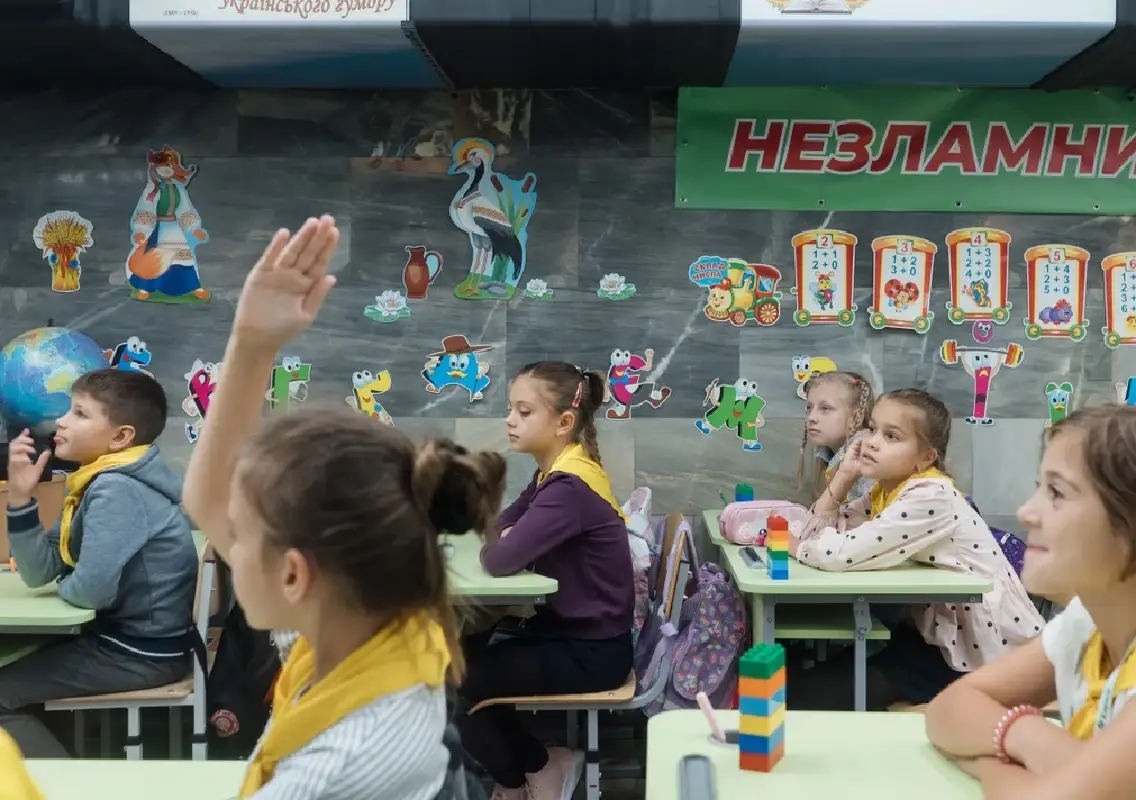


In the eastern Ukrainian city of Kharkiv, where air raid sirens and missile threats remain a part of daily life, an unusual yet vital solution has emerged to keep education going—schools operating inside subway stations.
Classrooms beneath the city
At the Oleksandr Maselsky station, what was once a closed hallway has been transformed into a functioning “metro school.” Here, teacher Maksym Trystapshon conducts English lessons just metres away from passing trains.
The underground setup now accommodates nearly 2,000 students, including preschoolers, who attend classes in shifts across four compact classrooms throughout the week.
Safety above everything
For children and parents alike, safety is the primary concern. Since the start of the war in 2022, the Kharkiv region has witnessed repeated attacks, resulting in thousands of civilian casualties, including children.
Underground stations, built to withstand impacts, have become the safest available spaces for learning.
“You don’t have to think about the war here,” said Trystapshon, highlighting how the environment allows both teachers and students to focus on education rather than survival.
A growing network of underground schools
Kharkiv’s metro system, which includes around 30 stations, has become a backbone for emergency education. Currently, eight such metro schools are operational, along with additional facilities set up in basements and bunkers.
Together, they serve nearly 20,000 students, as most regular schools across the region remain closed or damaged.
Learning amid uncertainty
Despite the confined spaces and constant threat outside, children continue to study, play and interact with peers—something many had missed during prolonged periods of online learning.
Parents say the metro schools provide not just safety but also essential social interaction.
“This is safer than sitting alone at home,” said one parent, reflecting a sentiment widely shared among families.
War reshapes education
The ongoing conflict has forced Ukraine to rethink its education system. By early 2026, more than 4,000 educational institutions across the country have been damaged or destroyed.
In response, schools have adapted their curriculum as well, introducing subjects focused on survival skills and first aid under programmes like “Defence of Ukraine.”
Preserving normalcy in crisis
Beyond academics, metro schools are helping preserve a sense of normalcy for children growing up in war conditions. They also play a role in cultural continuity, as students continue to learn and practise the Ukrainian language.
For many families, these underground classrooms symbolise resilience—proof that even in the face of conflict, education continues.