







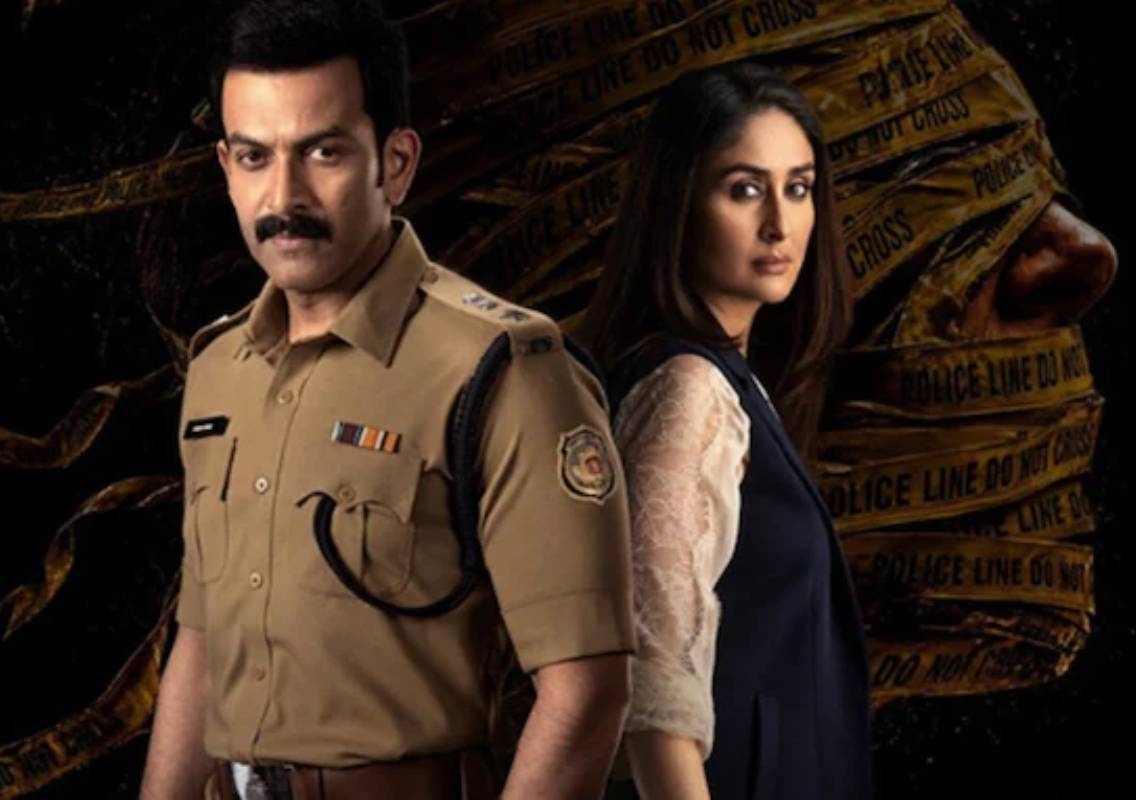


Mumbai: Meghna Gulzar’s Daayra, starring Kareena Kapoor Khan and Prithviraj Sukumaran, takes on a difficult question: what happens when a justice system fails a young woman before it can even begin to protect her?
The film brings together two people with sharply different ideas of justice. DCP Ajooni Kohli, played by Kareena, believes in procedure, evidence and the judicial system. DCP Raman Kumar, portrayed by Prithviraj, believes that when the system repeatedly fails victims, extraordinary action becomes inevitable.
At the centre of their conflict is the case of 24-year-old Ragini Poojari, whose brutalisation and death exposes several layers of institutional failure. Daayra has all the ingredients of a compelling procedural drama, but while it raises important questions, it does not always push them far enough.
A system that failed before the crime was solved
One of the film’s most striking lines comes when Ajooni tells her subordinate Vishal, “System change hote hain Vishal, log nahi. Attitude kaise change karoge?”
The line captures the central argument of Daayra. Changing rules and institutions may be possible, but changing the attitudes within those institutions is considerably harder.
The film begins with Raman Kumar being celebrated after his team shoots four men accused of brutalising and killing Ragini and leaving her remains near a Delhi highway.
The public sees the incident as an example of swift justice. But questions immediately emerge about whether the encounter was genuine or staged.
Ajooni, who belongs to Internal Vigilance, is assigned to investigate the encounter. She arrives in Suryapur with her team and begins working backwards through the events that led to Ragini’s death and the subsequent police action.
The investigation gradually shifts attention away from the encounter itself and towards the failures that preceded it.
Missing complaint becomes the film’s strongest thread
Daayra is at its most effective when it examines what happened before Ragini’s body was discovered.
Her family tries to report her disappearance, but instead of receiving immediate help, they are sent from one place to another. There are forms to fill, procedures to follow and reasons to return later.
CCTV footage has a convenient gap, while the machinery that should have responded to a missing young woman appears slow and indifferent.
These sequences are among the film’s most uncomfortable moments because they show how institutional failure can occur through a series of seemingly ordinary decisions.
By the time Ragini’s body is found the following morning, the system has already failed her repeatedly.
This is where Meghna Gulzar’s storytelling carries the most weight. The film does not need excessive drama to communicate the family’s desperation. Their repeated attempts to seek help, and the responses they receive, are enough to generate genuine anger.
Kareena Kapoor brings restraint to Ajooni
Kareena Kapoor Khan is solid as Ajooni Kohli, playing the character with composure and precision.
Ajooni is not presented as a conventional cinematic hero. She is a police officer doing her job and attempting to follow the evidence wherever it leads.
One of her quieter moments comes when she visits Ragini’s family and listens to their account of those missing hours. Kareena keeps the performance restrained, allowing the family’s pain and the weight of the investigation to occupy the scene.
Ajooni’s belief in due process also becomes more interesting because of her personal history.
Her father, played by Kanwaljit Singh, is a retired judge who was shot on court premises. That background could have given Ajooni’s commitment to the judiciary an additional emotional dimension.
Does her father’s fate make her trust the system more strongly? Or does it leave her with an anger that she has learned to suppress? Could her experiences make her fear becoming someone like Raman?
These are potentially fascinating questions, but Daayra introduces them without fully exploring them.
A little more attention to Ajooni’s relationship with her father could have made her considerably more layered.
Prithviraj Sukumaran makes Raman convincing
Prithviraj Sukumaran brings conviction to Raman Kumar, a police officer whose position is clear from the beginning.
Raman believes the system failed Ragini and that it will continue to fail women unless someone takes matters into their own hands.
The film does not ask the audience to agree with Raman. Instead, it attempts to make his position understandable.
That distinction is important because Daayra works best when it allows the audience to see how institutional failure can create support for extra-judicial ideas of justice.
Prithviraj plays Raman without turning him into a straightforward sympathetic figure. His conviction remains troubling even when the circumstances surrounding Ragini’s case make his frustration understandable.
That contradiction could have been the film’s most powerful dramatic weapon.
Two ideas of justice, but not enough conflict
The central premise gives Daayra considerable dramatic potential.
On one side is Ajooni, who believes that justice must operate within the law. On the other is Raman, who believes that a broken system cannot be trusted to deliver justice.
The more effectively the film establishes the failures Ragini’s family experienced, the easier it becomes to understand why someone like Raman might lose faith in procedure.
But the film does not explore this contradiction as deeply as it could.
Daayra largely positions itself as a commentary rather than a conventional thriller. It presents competing viewpoints without clearly asking the audience to choose one.
That approach is understandable, but it also means the promised ideological collision never becomes as intense as it should.
The airport confrontation disappoints
The biggest missed opportunity arrives towards the end.
Ajooni and Raman’s eventual confrontation at the airport should be the emotional and ideological culmination of everything that came before.
By this stage, the audience understands their positions, their conflicting ideas about justice and the institutional failures that have shaped the case.
Yet the confrontation remains subdued.
Instead of a moment that forces both characters to confront the limits of their beliefs, the sequence feels restrained and almost polite. The expected tension does not fully materialise.
For a film that spends so much time building towards this collision, the eventual encounter does not have the impact it deserves.
The investigation also promises a cat-and-mouse dynamic that never quite develops. There is little sense of the characters genuinely challenging each other’s convictions or reaching a point where the moral ground beneath them shifts.
Supporting cast delivers strong performances
Jitendra Joshi remains dependable in his supporting role, while Biswapati Sarkar makes an impression despite limited screen time.
Kanwaljit Singh brings credibility to his role as Ajooni’s father, although the character is not given enough material to fully explore the emotional history hinted at by the film.
Kshitee Jog, however, stands out as Ragini’s mother.
Her performance conveys the grief and helplessness of a parent trying to understand how a daughter could disappear while the institutions meant to help her fail to respond adequately.
Her scenes add emotional weight to the film’s broader commentary about institutional indifference.
The film chooses commentary over thriller
Daayra is clearly more interested in asking questions than delivering a conventional thriller.
Its closing statistics underline the point it wants to make, highlighting the scale of sexual violence, encounters and convictions.
The film wants audiences to think about justice, policing, the judiciary and the consequences of institutional failure.
That ambition is evident throughout the screenplay.
The problem is that the film sometimes explains its questions instead of allowing the characters and their conflicts to push those questions to their most uncomfortable conclusions.
The procedural portions are among the strongest sections, particularly when Ajooni reconstructs the events surrounding Ragini’s disappearance.
But the emotional and philosophical confrontation between Ajooni and Raman needed greater depth.
Daayra review: A film that needed to push harder
Daayra has the right instincts and genuine conviction behind its subject.
Meghna Gulzar takes aim at institutional failures that can leave vulnerable people without meaningful protection. The film also raises an important debate about whether frustration with a broken system can ever justify abandoning due process.
Kareena Kapoor Khan and Prithviraj Sukumaran are both effective in their respective roles, while the procedural investigation provides some of the film’s strongest material.
Yet the film holds back precisely where it needs to push forward.
Ajooni’s personal history is not explored enough, the relationship with her father remains underdeveloped, and the final confrontation between her and Raman lacks the force expected from the setup.
Daayra is therefore less successful as a gripping thriller than it is as a social commentary. It raises the right questions, but does not always pursue them to their most challenging conclusions.
The film is worth a watch for its performances, subject and institutional critique, but audiences may finish it wishing it had gone further.