


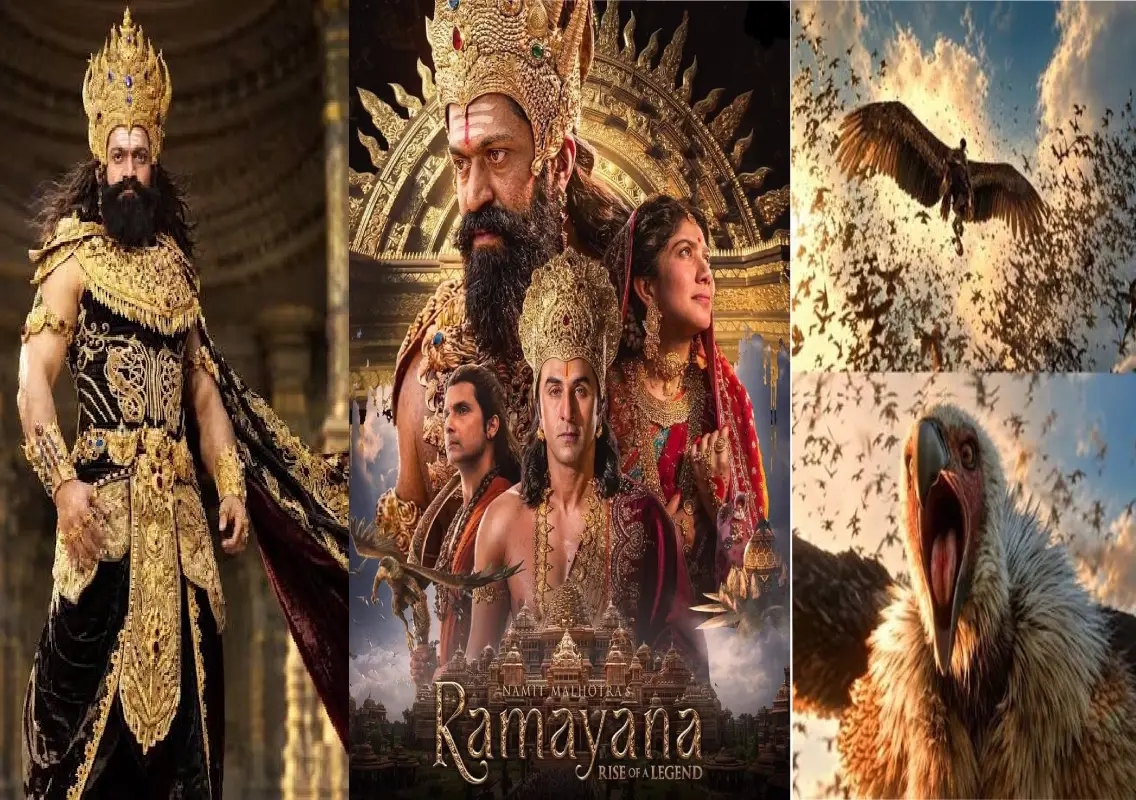


New Delhi: Nitesh Tiwari‘s Ramayana: Rise of Legend, which arrived in theatres on November 5, offers audiences a fresh perspective on one of India’s most familiar epics. Although the story of Lord Rama, Goddess Sita, Lakshman and Ravana has been retold countless times, the film finds new ways to explore its characters through unexpected details, emotional moments and spectacular visual sequences.
Starring Ranbir Kapoor as Lord Rama, Sai Pallavi as Goddess Sita, Yash as Ravana and Ravie Dubey as Lakshman, the film has reportedly been made on a budget of Rs 4,000 crore. Its elaborate sets, visual effects and action sequences are among its major attractions. However, beyond the scale of the production, several character choices and smaller narrative details help distinguish this adaptation.
The film also builds anticipation for its second instalment, with the story setting the stage for the eventual confrontation between Rama and Ravana.
Here are seven moments that make Ramayana: Rise of Legend an interesting retelling of the epic.
1. Ravana’s introduction and the story behind his ten heads
One of the film’s notable choices is the time it devotes to establishing Ravana’s past before bringing him face to face with Lord Rama. Rather than presenting him simply as the antagonist, the narrative explores his journey, ambitions and the circumstances that shape him into the powerful ruler of Lanka.
Yash makes a strong impression in his introduction, followed by the dramatic Tandav sequence. However, the film’s interpretation of Ravana’s ten heads is particularly intriguing.
Instead of treating them merely as a physical feature, the narrative gives each head a distinct personality, almost suggesting ten different voices within Ravana. This offers a different perspective on a character whose ten heads have been interpreted in various ways in earlier adaptations.
The decision to explore Ravana’s background also gives the character greater narrative depth and makes his eventual conflict with Rama something audiences can look forward to in the next instalment.
2. When visual effects become part of the storytelling
The visual effects are among the biggest talking points of the film. Yet some of the sequences stand out not simply because of their scale but because they help bring the world of the Ramayana to life.
Ranbir Kapoor’s portrayal of Rama during the battle with the demon brothers Khar and Dushan is one such sequence. The action, creatures and scale of the confrontation make it a major theatrical highlight.
The film also depicts Ravana’s confrontation with Lord Indra and Indra’s visit to Vaikunth Lok, adding to the visual grandeur of the narrative.
Another memorable sequence involves Jatayu, voiced by Anupam Kher. The mighty bird’s attempt to rescue Sita from Ravana’s Pushpak Vimana leads to an aerial confrontation that is among the film’s most striking visual moments. The flying vehicle, the battle in the sky and the emotional significance of Jatayu’s intervention make the sequence particularly memorable.
These portions demonstrate how visual effects can contribute to the storytelling rather than functioning only as spectacle.
3. Sita is portrayed as more than a damsel in distress
Sai Pallavi brings grace and composure to her portrayal of Goddess Sita, but the character is not restricted to the familiar image of a woman waiting to be rescued.
One of the film’s notable aspects is the space it gives Sita to demonstrate her courage and strength. Her participation in action sequences alongside Rama and Lakshman offers a glimpse of her ability to stand her ground while confronting demons.
The film also explores her knowledge of farming and healing, adding further dimensions to her character.
Her response to Ravana’s abduction is another significant moment. Rather than portraying her as helpless or overwhelmed, the narrative presents her as calm and composed. She even tells Ravana that his actions will mark the beginning of his end, expressing her confidence that Rama will come to rescue her.
This interpretation gives Sita a stronger presence in the narrative and allows audiences to see her beyond the circumstances of her abduction and her relationship with Rama.
4. Lakshman emerges as a relatable younger brother
Ravie Dubey’s portrayal of Lakshman brings warmth, energy and humour to the film. Fiercely protective of his elder brother, Lakshman is also shown as someone who can tease Rama, express his opinions and react spontaneously to situations.
Some of his lighter moments come when Rishi Vishwamitra speaks about Sita and her swayamvar. Lakshman’s expressions and reactions add humour without taking away from the importance of the occasion. His one-liners also provide welcome moments of relief.
However, the character is not limited to comic exchanges. His anger when Kaikeyi sends Rama into exile and his unwavering decision to accompany his brother reveal his emotional depth and loyalty.
The Lakshman Rekha sequence is another important moment, particularly his exchange with Sita after Maricha imitates Rama’s voice. Dubey conveys Lakshman’s conviction and concern without making the scene unnecessarily dramatic.
His portrayal makes Lakshman feel like both a devoted brother and a recognisable family figure.
5. The emotional weight of Rama’s exile
Rama’s exile is one of the most familiar episodes in the Ramayana, but the film places emphasis on the emotional consequences of the decision.
The moment is not merely about a prince giving up his kingdom. It is also about a son accepting his father’s promise and a man preparing to leave behind the life he has known.
Ranbir Kapoor’s restrained performance works particularly well in these portions. Rather than relying on constant dramatic expressions, he communicates Rama’s feelings through subtle reactions and controlled emotions.
The portrayal brings attention to the human side of a character who is revered as a deity. His acceptance of exile, despite the sudden change in his circumstances, becomes an important emotional element of the film.
This approach allows the audience to connect with Rama’s personal journey while retaining the larger spiritual and moral significance of the epic.
6. Small details add depth to familiar characters
Some of the film’s most engaging moments are not necessarily its grand battles or elaborate visual sequences. Instead, they emerge through expressions, conversations and unexpected reactions.
Kaikeyi’s realisation of the consequences of her decision to send Rama into exile adds an emotional dimension to a character often remembered primarily for that choice.
Similarly, Lakshman’s reactions to situations involving his elder brother bring a personal touch to the familiar narrative. The interactions between Rama and Sita also help establish their relationship through smaller, more natural moments.
Another subtle detail concerns Rama’s promise to King Janaka, played by Rajiv Kumar, that Sita will be his only wife. As Rama makes this commitment, the camera briefly shifts towards Kaushalya. The visual suggestion links his decision to the suffering his mother experienced because his father had multiple wives.
Such details add layers to the characters and encourage audiences to look beyond the major events of the epic.
7. Sunny Deol’s Hanuman appearance builds anticipation
The film’s post-credit sequence provides one of its biggest surprises. Sunny Deol appears as Lord Hanuman, offering audiences a brief glimpse of the character and setting up expectations for the next chapter.
The appearance has already generated excitement among fans, particularly because the second instalment is expected to explore the events surrounding Rama’s meeting with Hanuman and Sugriva in Kishkindha Kand.
As Ramayana: Rise of Legend is planned as a two-part adaptation, the first film focuses on establishing the characters and events leading towards the conflict with Lanka. The post-credit appearance of Hanuman offers a clear indication of the direction in which the story is expected to move.
Ramayana Part 2 is scheduled to release during Diwali 2028.
A familiar epic with fresh storytelling choices
While audiences already know the broad outline of the Ramayana, Tiwari’s adaptation attempts to make the familiar journey engaging through character interpretations, emotional storytelling and large-scale visual effects.
Yash’s Ravana, Sai Pallavi’s Sita, Dubey’s Lakshman and Ranbir Kapoor’s Rama each bring different dimensions to the narrative. The smaller character moments, alongside the spectacular action sequences, help give the film its distinct identity.
With Hanuman’s introduction pointing towards the next chapter, the first instalment leaves audiences with anticipation for the continuation of the epic on screen.