







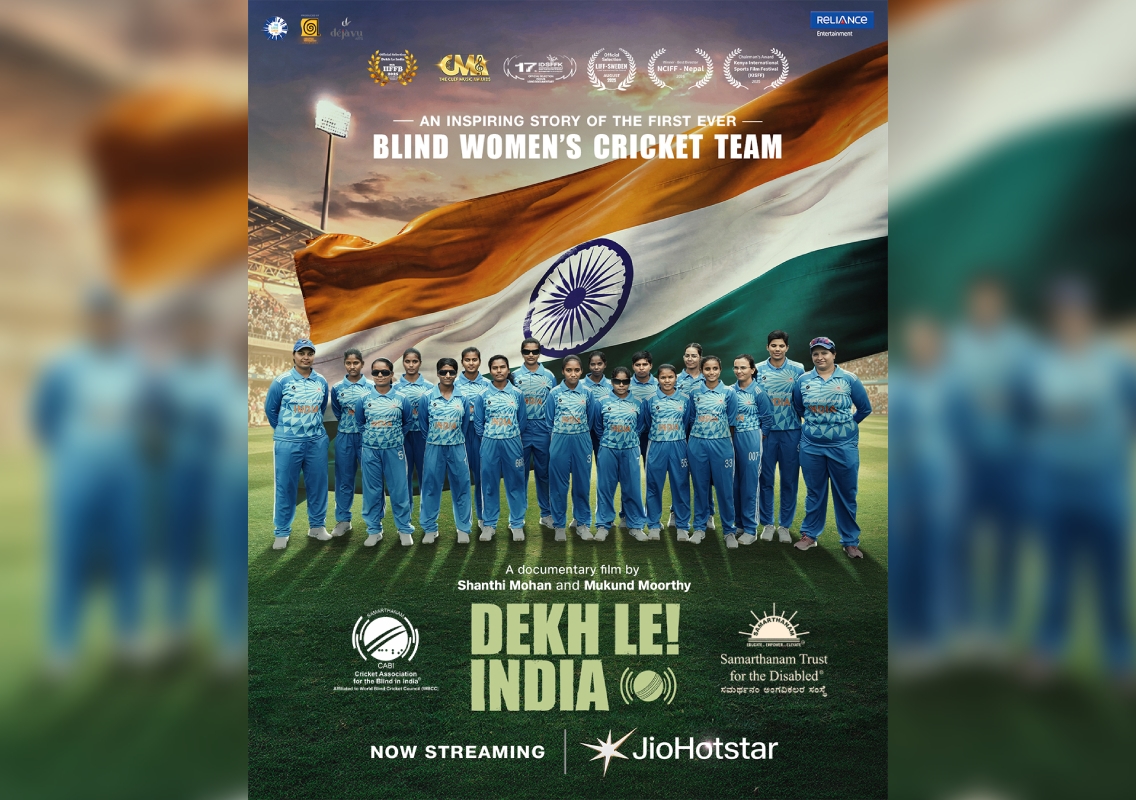


Bengaluru: In a significant milestone for disability inclusion and women’s sports, JioHotstar will premiere the award-winning documentary ‘Dekh Le India’ on June 26, 2026, showcasing the inspiring journey of India’s Women’s Cricket Team for the Blind and their historic triumph at the first-ever Women’s Blind Cricket World Cup.
Supported by the Cricket Association for the Blind in India (CABI), the apex body for blind cricket in the country promoted by Samarthanam Trust for the Disabled, the documentary celebrates the determination, resilience, and extraordinary achievements of a team that overcame numerous social and economic barriers to become world champions.
Inspiring Story of Courage and Triumph
Directed by filmmakers Shanthi Mohan and Mukund Moorthy, Dekh Le India chronicles the rise of India’s pioneering Women’s Cricket Team for the Blind.
The documentary follows the players’ journey from small towns and remote communities across India to the international stage, where they created history by winning the Gold Medal at the inaugural Women’s Blind Cricket World Cup, defeating Australia by nine wickets in the final.
Beyond their sporting success, the film highlights the team’s inspiring interactions with national leaders and sporting icons, including Prime Minister Narendra Modi, the President of India, Union Ministers, Chief Ministers from multiple states, and cricket legends such as Sachin Tendulkar and Rohit Sharma.
Documentary Earns International Recognition
The documentary has already received widespread acclaim on the international film festival circuit. It has been screened at six national and international film festivals and has been praised for its authentic storytelling and powerful social message.
Through intimate narratives, the film captures not only victories on the cricket field but also the personal stories of sacrifice, determination, and perseverance that shaped the players’ remarkable journey.
Promoting Inclusion Through Sports
Speaking about the documentary, Dr Mahantesh G. Kivadasannavar, Chairman of the Cricket Association for the Blind in India and Founder Managing Trustee of Samarthanam Trust for the Disabled, said the team’s success represents far more than a sporting achievement.
He noted that the documentary reflects the power of inclusion, opportunity, and human potential, while showcasing how determination can overcome barriers. He expressed confidence that the JioHotstar premiere would help the inspiring story reach millions of viewers across India and beyond.
The filmmakers said the documentary is a celebration of courage, perseverance, and the ability to dream beyond limitations. They expressed hope that the film would encourage audiences to challenge stereotypes and believe in the possibilities that determination and hard work can create.
Players Hope to Inspire Future Generations
Simu Das, a B1 player of India’s Women’s Cricket Team for the Blind, described the documentary as a reflection of the team’s resilience and belief.
She said winning the first-ever Women’s Blind Cricket World Cup was a dream not only for the players but also for every girl with a disability who aspires to achieve greatness. She expressed hope that the documentary would inspire people to look beyond limitations and pursue their goals with confidence.
About Samarthanam and CABI
Founded in 1997 by Dr Mahantesh G. Kivadasannavar, Samarthanam Trust for the Disabled is a Bengaluru-based non-profit organisation dedicated to empowering persons with disabilities and underserved communities through education, sports, rehabilitation, livelihood initiatives, and social development programmes.
The Cricket Association for the Blind in India (CABI) serves as the apex body for blind cricket in the country and is affiliated with the World Blind Cricket Council. The organisation works to create opportunities for visually impaired athletes and promote excellence in blind cricket at national and international levels.
The premiere of Dekh Le India is expected to shine a spotlight on the achievements of visually impaired women athletes and reinforce the importance of inclusive opportunities in sports and society.