







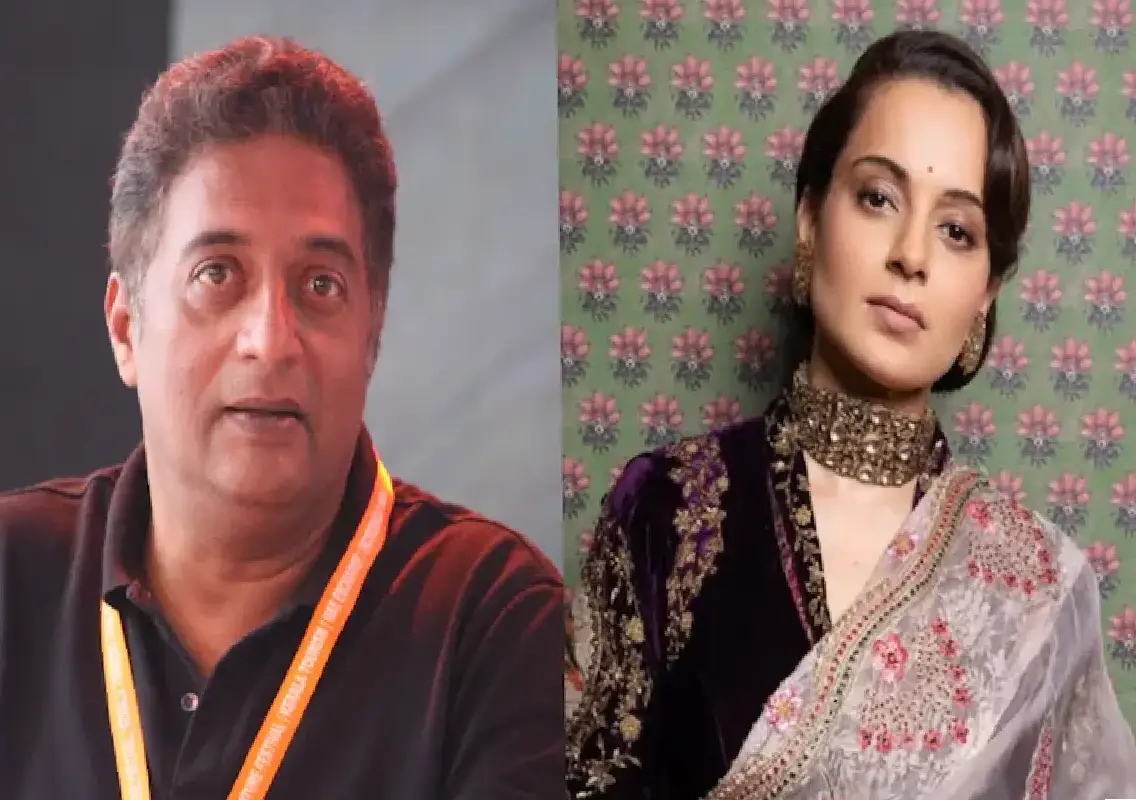


New Delhi: Actor Prakash Raj spoke strongly in favour of freedom of expression and the right to dissent while addressing a session at the Kerala Literature Festival, where he participated in a discussion titled “Criminalising Dissent! Who Gets Locked Up for Speaking Out?” During the interaction, he referred to the recent controversy surrounding music composer AR Rahman as an example of how public discourse unfolds when prominent voices express uncomfortable opinions.
Remarks on dissent and public discourse
During the session, Prakash Raj reflected on how artists and public figures are often judged harshly when they express views that differ from dominant narratives. He said debates around nationalism, artistic choice and political opinion are increasingly becoming polarised, leaving little room for nuance.
Referring to AR Rahman, Prakash Raj highlighted how the composer — widely celebrated for his patriotic and global contributions — faced backlash after expressing his views about a recent film and the broader environment in the Hindi film industry.
Quoting Rahman’s past achievements, Prakash Raj said, “What is happening with AR Rahman? What is the public discourse? ‘Maa Tujhe Salaam.’ ‘Jai Ho.’ Two Oscars. You rejoiced. He just said… he is not begging for work for your kind information, he’s beyond that. He said, this is the truth.”
He suggested that the swift shift in public tone — from praise to criticism — shows how quickly opinion can turn when a public figure voices a controversial or dissenting view.
Reference to Kangana Ranaut’s reaction
Prakash Raj also addressed actor and filmmaker Kangana Ranaut’s public response to Rahman’s comments. He referred to the debate in the context of her film Emergency, which is based on the life and political period of former Prime Minister Indira Gandhi.
Criticising the reaction to Rahman’s refusal to work on the project, Prakash Raj said, “Look at the euphoria that has started. Look at the barking that has started. A lady director and actress suddenly, just because he did not work for her, calls him an anti-national. Kangana Ranaut is calling her film Emergency, a propaganda film, as a classic. And that he denied to work. Look at what is happening around you.”
He framed the episode as part of a larger pattern where disagreement or refusal is interpreted as ideological hostility rather than professional choice.
Origin of the Rahman controversy
The debate began after AR Rahman, in an interview with BBC Asian Network, described the film Chhaava as “divisive” and suggested that communal considerations may sometimes influence opportunities and collaborations within sections of the Hindi film industry. His remarks triggered mixed reactions across social media and the film fraternity.
Some supported his right to express an opinion, while others criticised the remarks as politically loaded.
Following the comments, Kangana Ranaut responded publicly on Instagram. She stated that despite facing prejudice herself for her political views, she considered Rahman’s remarks unfair and biased. She also revealed that he had declined to compose music for her film Emergency.
In her post, she wrote that she had wanted to narrate the film to him but was told he did not want to be associated with what he considered a “propaganda film.” She further claimed that the film had been appreciated by critics and even political opponents, and accused Rahman of being prejudiced.
Rahman’s clarification
After the controversy escalated, AR Rahman issued a video statement clarifying his position. He reaffirmed his love for India and said his remarks were not intended to hurt sentiments or target any group. He emphasised that his observations were about creative direction and social impact, not about people or communities.
Rahman also reiterated his long-standing commitment to music that brings people together and said his body of work reflects unity and cultural pride.
Debate over art, politics and accountability
The exchange between leading film personalities has reignited discussion about the boundaries between artistic freedom, political belief and public accountability. The Kerala Literature Festival session in which Prakash Raj spoke focused specifically on whether dissent is increasingly being labelled as misconduct or disloyalty.
Participants at the session discussed how legal, social and digital pressures can shape what artists, writers and public thinkers feel safe to say. Prakash Raj argued that disagreement should not automatically lead to vilification and that democratic societies must protect diverse viewpoints.
Conclusion
Prakash Raj’s remarks have added fresh momentum to an ongoing debate on free speech in cultural and political spaces. By invoking the AR Rahman episode, he underscored how quickly admiration can turn into outrage when a public figure speaks out of line with prevailing sentiment. As reactions continue across platforms, the controversy highlights the growing tension between celebrity speech, political interpretation and the right to dissent in public life.