


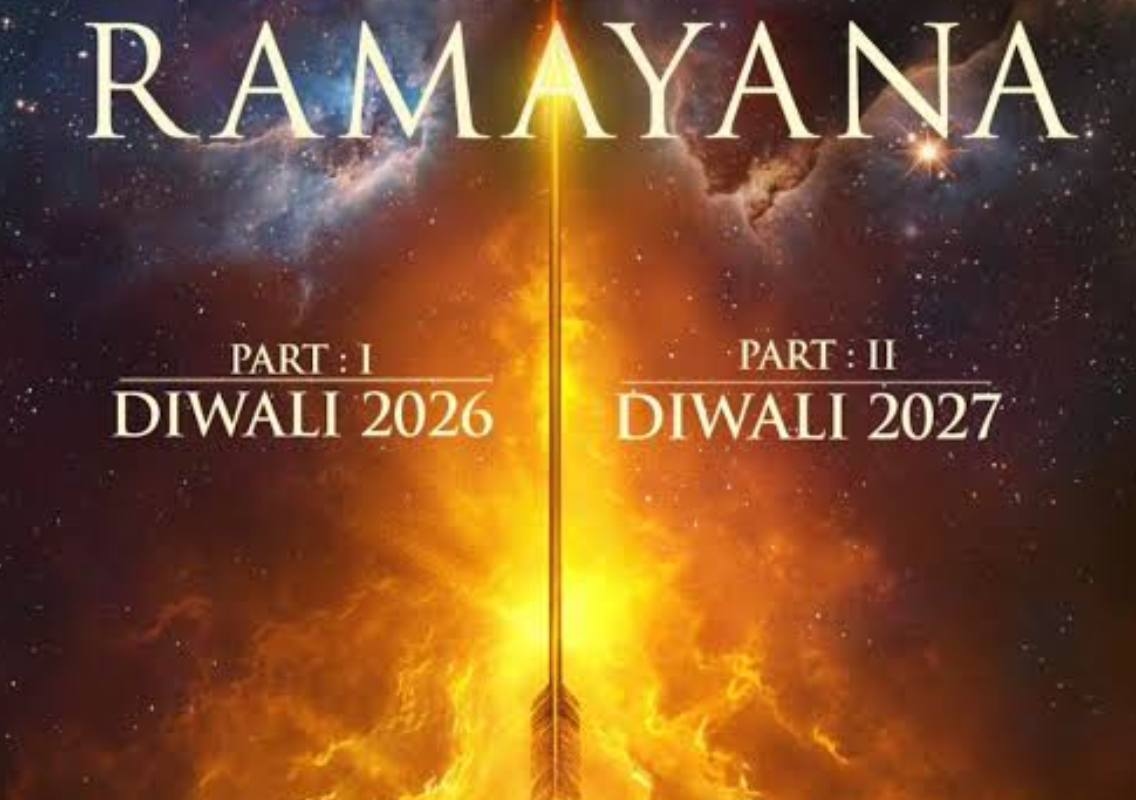


Mumbai: The second instalment of director Nitesh Tiwari’s Ramayana may miss its planned Diwali 2027 release, with producer Namit Malhotra reportedly considering postponing the film to Diwali 2028 to allow more time for filming and production. The makers have not officially confirmed a change to the release schedule.
The proposed delay would extend the gap between the two parts of the ambitious adaptation of the Indian epic. The first instalment, Ramayana: Rise of a Legend, is scheduled to arrive in theatres on November 5, 2026, with Ranbir Kapoor, Sai Pallavi, Yash and Sunny Deol among the principal cast members.
According to a report by Bollywood Hungama, the production team is discussing an extended schedule for the second film because of additional shooting requirements. The scale and complexity of its major war sequences are reportedly among the factors behind the possible postponement.
A source quoted by the entertainment portal said Malhotra considers the project deeply significant and wants to deliver an ambitious theatrical experience for Indian audiences.
The source also indicated that the second instalment requires more filming time, particularly because the large-scale conflict central to the story unfolds in the concluding part.
If the revised schedule is approved, the additional time could allow the filmmakers to complete the sequences and production work planned for the sequel. However, until the production team makes an official announcement, Diwali 2027 remains the reported original release window and Diwali 2028 is only a possibility.
Why Ramayana 2 could be pushed back
The reported postponement is linked primarily to the amount of work required for the second instalment. While the first film introduces the principal characters and establishes the narrative, the sequel is expected to feature the large-scale war that forms a major part of the epic’s concluding events.
Sequences of this scale can involve extensive filming, visual effects, action choreography and post-production. The reported decision to consider a later release suggests that the makers may be looking for additional time to complete these elements.
The production is being mounted on a large scale, with the filmmakers aiming to bring the story to cinema audiences across several Indian languages. Such projects require coordination between cast members, production teams, visual-effects specialists and other departments.
A longer schedule could give the team more time to finish the film without having to work towards the original deadline. It could also provide additional time for the visual-effects work needed to bring large battles and elaborate settings to the screen.
However, the specific production milestones that remain incomplete have not been officially detailed. The reported delay should therefore not be treated as a confirmed change to the film’s release date.
For now, the key question is whether the production team will retain the original Diwali 2027 window or formally announce a move to the following festive season.
Ramayana: Rise of a Legend gears up for November release
The first instalment, Ramayana: Rise of a Legend, is scheduled for theatrical release on November 5, 2026. The film is the opening part of a planned two-film adaptation of the ancient Indian epic traditionally associated with Valmiki.
The production brings together a prominent cast and an international visual-effects team. Ranbir Kapoor plays Lord Rama, while Sai Pallavi portrays Goddess Sita. Yash appears as Ravana, Sunny Deol plays Lord Hanuman and Ravi Dubey portrays Lakshman.
Namit Malhotra is producing the film, with Yash also associated with the production. Prime Focus Studios is co-producing the project in association with DNEG and Yash’s Monster Mind Creations.
The film is planned for release in Hindi, Tamil, Telugu, Kannada and Malayalam, giving it a broad potential audience across India. Its multilingual release strategy reflects the story’s cultural significance and the filmmakers’ ambition to reach viewers beyond a single regional market.
The first film is expected to establish the characters and events that lead into the second instalment. The sequel’s reported focus on the major war sequences makes its production schedule particularly important to the overall two-part narrative.
Advance bookings for the first film gain momentum
While uncertainty surrounds the sequel’s release timeline, advance bookings for the first Ramayana film have been gathering pace ahead of its November theatrical debut.
According to trade tracker Sacnilk, the film had sold more than 1.47 lakh tickets across 3,964 tracked shows as of 11.42 am on October 23, 2026.
The advance gross stood at Rs 8.27 crore when blocked seats were included and Rs 6.25 crore when those seats were excluded. These figures reflect advance sales at that point and should not be confused with the film’s final opening-day collections or overall box-office revenue.
The reported gross, including blocked seats, increased from Rs 5.44 crore in the first 24 hours to Rs 8.27 crore. The amount excluding blocked seats rose from Rs 3.61 crore to Rs 6.25 crore over the same period.
The number of tracked shows also increased from 3,533 to 3,964, while the total number of tickets booked, including blocked seats, climbed from 92,755 to more than 1.47 lakh.
Average ticket sales per tracked show rose from 26 to 37. The figures suggest that advance sales were increasing as more screenings became available, although substantial ticket inventory remained at the time of the report.
No tracked screening had sold out at that stage. Blocked seats accounted for around 24 per cent of the reported gross, down from approximately 34 per cent earlier, indicating that confirmed purchases contributed a larger share of the increase in collections.
Premium formats and festive expectations
Early interest has reportedly included premium cinema formats such as IMAX and 4DX, while bookings for standard multiplex screenings were still developing.
Advance bookings had crossed 50,000 tickets across major multiplex chains, including PVR INOX and Cinepolis, by Thursday night, according to the supplied trade report.
The film’s show count was still lower than that of some major releases used as industry benchmarks. For comparison, Dhurandhar: The Revenge reportedly sold more than 9.50 lakh opening-day advance tickets across over 17,000 shows before its release.
The comparison is not a direct measure of final box-office performance, as show availability, release timing, pricing and audience demand can differ between films. Exhibitors may also add screenings as schedules are finalised.
Industry estimates cited in the report suggested that more than 3.5 lakh opening-day ticket sales across the three leading national cinema chains would represent a strong pre-Diwali start, with five lakh tickets viewed as a higher target.
Trade discussions also included an India net opening target of Rs 70 crore, although this remains an expectation rather than a confirmed outcome.
November 5 falls on a Thursday before Diwali, meaning the film will not receive the full benefit of a national holiday on its opening day. The main festive period was expected to begin around November 9, potentially providing a further boost if audience response is favourable.
Paid previews scheduled for November 4 were also expected to contribute to the film’s initial business. The scale of that contribution will depend on the number of screenings, ticket demand and audience response.
What the possible delay means for the two-part adaptation
A move from Diwali 2027 to Diwali 2028 would give the production team approximately another year to complete the second film. It would also create a longer gap between the two instalments than originally planned.
For a project of this scale, the additional time could be used for further filming, the completion of major action sequences and extensive visual-effects work. The filmmakers would also have to coordinate the schedules of the principal cast and the various teams involved in post-production.
At the same time, a later release would change the franchise’s planned theatrical calendar and extend the period audiences must wait for the conclusion of the story.
The reported possibility of a delay does not necessarily indicate a problem with the first film’s release. The November 5, 2026, date for Ramayana: Rise of a Legend remains the schedule provided by the makers, while the sequel’s revised timeline has yet to be confirmed.
For now, the first instalment is approaching its theatrical release as advance bookings continue to develop. Attention will remain on the production team for an official update on the second film, particularly whether the scale of its war sequences leads to a shift to Diwali 2028.
Until such confirmation arrives, the reported postponement should be treated as a possibility rather than a final release decision.