


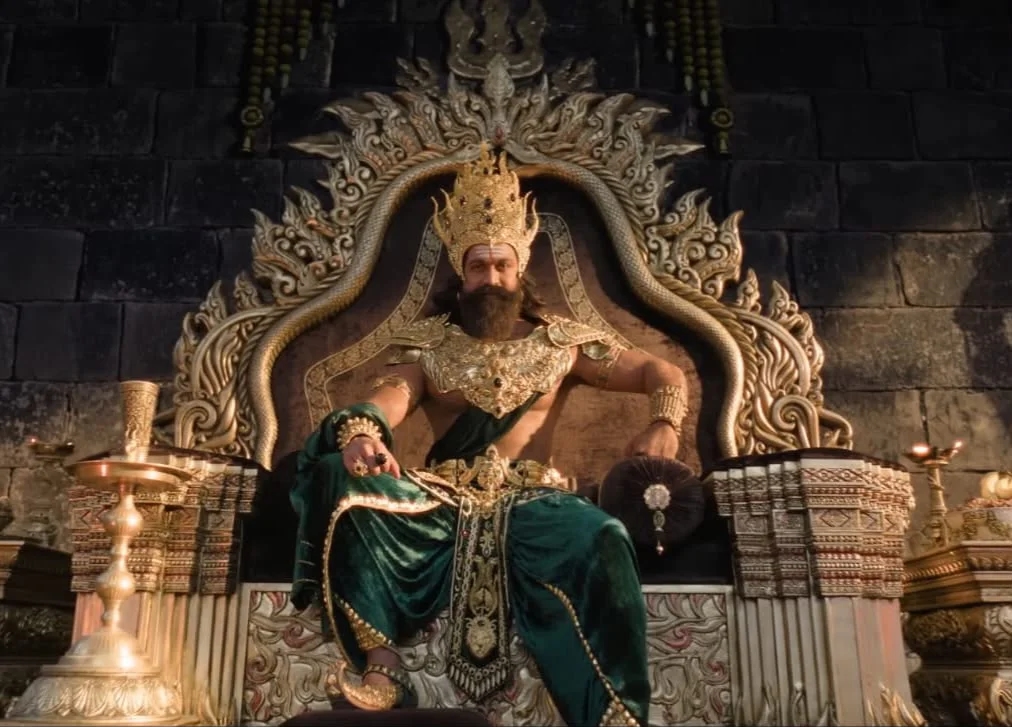


Hyderabad: Yash has urged audiences to overlook minor VFX flaws in Ramayana, but his appeal raises questions about audience expectations, accountability and the freedom to criticise a big-budget film.
Yash asks audiences to support Ramayana’s vision
Actor Yash, who plays Ravana in Nitesh Tiwari’s ambitious adaptation of the Indian epic Ramayana, has urged audiences to watch the film with an open mind instead of looking for minor flaws in its visual effects. Speaking at the film’s pre-release event in Hyderabad, Yash defended producer Namit Malhotra’s ambition to take Indian cinema to a global platform and asked viewers to support the effort.
The actor acknowledged the risks involved in mounting a production of this scale and warned that the industry could lose valuable opportunities if people behind such ambitious projects were discouraged.
“Sometimes, when someone tries to do things like this . . . he has gambled on his reputation and money to put this film on a global platform. Please don’t try to find small faults in the VFX. It will never happen again if we lose people like him (Namit) now. It will take more years. We will go back in time,” Yash said.
He added that Malhotra had been receptive to feedback and had tried to improve the film in response to criticism. Yash appealed to audiences to come together and support the project if they liked what they saw.
His comments have brought the film’s visual effects back into the spotlight. While his appeal reflects the challenges of producing a large-scale Indian epic, it also raises an important question: should audiences be encouraged to overlook technical shortcomings before they have even watched the finished film?
Why should audiences ignore VFX flaws?
A film presented as a landmark production for Indian cinema will inevitably attract scrutiny. Reports have placed the combined budget of the two-part Ramayana project at around Rs 4,000 crore, although the precise final expenditure has not been independently established here. With such a significant investment and expectations of a global-scale spectacle, viewers are likely to examine every aspect of the production.
Visual effects are particularly important in a cinematic adaptation of an epic featuring extraordinary settings, powerful characters and supernatural elements. They are not simply decorative additions. They help establish the world in which the story unfolds and determine whether audiences can believe in what they see on screen.
That does not mean every frame must be technically perfect. Minor inconsistencies can be overlooked when a film delivers compelling performances, effective storytelling and an emotional connection with its audience. But there is a difference between accepting an occasional imperfection and being asked to lower expectations for an aspect central to the film’s appeal.
Moviegoers pay for a theatrical experience. They are entitled to decide whether the visuals, performances and storytelling justify the ticket price. They are also entitled to discuss their reactions publicly, whether positive or negative.
A producer’s financial commitment and an actor’s confidence in a project do not automatically guarantee audience satisfaction. Nor does criticism of visual effects necessarily indicate hostility towards Indian cinema. Viewers can want an ambitious film to succeed while still questioning whether it delivers on its promises.
The VFX criticism that preceded Yash’s appeal
The debate surrounding Yash’s remarks has a history. When the makers unveiled an early glimpse of Ranbir Kapoor as Lord Rama, the response was mixed. While the project generated considerable anticipation, some viewers criticised the visual effects, colour grading and overall appearance of the footage.
Questions were raised about whether the imagery captured the authenticity, scale and grandeur expected from a cinematic adaptation of the Ramayana. The criticism was particularly noticeable given the project’s reported budget and the involvement of DNEG, the visual effects company associated with Malhotra.
DNEG has worked on several internationally recognised productions, including Inception and Interstellar. Its involvement naturally raised expectations among viewers familiar with large-scale visual effects.
The makers did not simply dismiss the feedback. Malhotra acknowledged that the team was listening to criticism, while Yash had previously described the film as a work in progress and indicated that improvements would be made. Subsequent promotional material was reported to feature enhanced visuals, with some viewers responding more positively to the updated footage.
That history makes Yash’s latest appeal particularly interesting. If feedback helped the makers identify areas for improvement, it demonstrates why audience criticism can be useful during a film’s promotional and development journey.
His remarks need not be interpreted as a direct attack on critics. However, asking viewers not to search for flaws could leave some wondering whether the same feedback that was previously welcomed is now being discouraged.
There is an important distinction between asking audiences to approach a film with an open mind and asking them to overlook shortcomings. An open mind allows viewers to assess the film on its merits. Being told not to look for flaws risks creating the impression that certain aspects should be exempt from scrutiny.
A producer’s gamble is not the audience’s responsibility
Yash’s defence of Malhotra is understandable. Producing a film of this scale requires substantial investment, technical expertise, time and a willingness to take risks. Attempting to bring a culturally significant epic to the screen with global ambitions is a major undertaking, and the people involved deserve recognition for attempting something ambitious.
Yash also argued that Malhotra could have continued doing business comfortably in Los Angeles but instead chose to invest in a project intended to take Indian cinema to a wider audience. The actor’s message was that India should encourage people willing to make such commitments rather than risk discouraging future productions.
There is merit in that argument. Indian cinema benefits when producers invest in technical innovation, explore ambitious storytelling and attempt to compete with major international productions.
However, supporting the film industry does not mean audiences must protect producers from criticism. Viewers are not investors in the production simply because they purchase tickets. Their primary expectation is to receive a satisfying cinematic experience.
A production can represent an important step for an industry and still fall short in certain areas. Both things can be true. Recognising the scale of a project should not require audiences to suspend their judgement of its execution.
In fact, honest feedback can help filmmakers understand what resonates with viewers and where improvements are needed. If the makers of Ramayana responded to criticism of early visuals, that should reinforce the value of audience engagement rather than diminish it.
The responsibility for delivering a compelling film ultimately rests with its creators. Audiences can appreciate their ambition without feeling obliged to endorse every creative decision.
Why the Ramayana carries higher expectations
The cultural significance of Ramayana adds another dimension to the discussion. Unlike an entirely unfamiliar fictional universe, the epic has been retold across generations through literature, television, theatre, regional traditions and other forms of storytelling.
Many viewers already have strong ideas about its characters, settings and emotional themes. These expectations can make a cinematic adaptation particularly challenging, especially when the filmmakers aim to combine a familiar narrative with modern visual effects.
For some viewers, authenticity may be more important than spectacle. Others may expect elaborate environments, impressive action sequences and a scale comparable to international fantasy productions. Still others may place greater emphasis on performances, dialogue and the emotional depth of the characters.
The makers cannot necessarily satisfy every expectation. But audiences should be free to assess how effectively the film balances these competing demands.
A powerful performance can make viewers forget a technical imperfection. A moving scene can create an emotional connection that outweighs an imperfect visual. Yet those moments must emerge from the finished film rather than being assumed in advance.
The involvement of a major visual effects studio also does not make the final work immune to scrutiny. If anything, it creates expectations that the production will meet a high technical standard.
The scale of Ramayana means that comparisons with international spectacles are almost inevitable. That scrutiny is not necessarily unfair; it is part of the public conversation surrounding a film that is being positioned as a major cinematic event.
Can criticism and support coexist?
Yash’s comments highlight a tension that often emerges around ambitious Indian films. Supporters may view criticism as an attempt to undermine a project before it has had a chance to succeed, while critics may feel that appeals for support are being used to discourage legitimate questions.
Neither position needs to be absolute. Audiences can recognise the difficulty of producing a film on this scale while remaining critical of its promotional material. They can hope that Indian cinema succeeds internationally without agreeing that every production deserves praise simply because it has ambitious goals.
It is also important to distinguish between criticism of a film and personal attacks on the people making it. Feedback about visual effects, editing, storytelling or performances can contribute to a meaningful discussion. Abuse directed at actors, technicians or producers is a different matter.
An open-minded approach means evaluating a film fairly, considering its strengths and weaknesses and allowing the finished work to make its case. It does not require viewers to ignore problems or refrain from discussing them.
If Ramayana delivers spectacular visuals and a compelling story, audiences are likely to recognise those strengths. If parts of the film disappoint, viewers should be able to explain their concerns without being made to feel that they are acting against the interests of Indian cinema.
Let Ramayana win audiences through its execution
Yash is right to emphasise the importance of ambition and the need to support filmmakers willing to attempt something on a grand scale. Malhotra’s commitment to the project may help create opportunities for Indian cinema, and the film’s eventual impact could extend beyond its immediate box-office performance.
But ambition alone cannot determine whether a film succeeds. The finished product must justify the expectations created around it.
If the visual effects are impressive, audiences will say so. If the performances and storytelling leave a lasting impression, viewers will recommend the film. And if elements fall short, criticism is a natural part of the response.
The makers’ reported willingness to respond to earlier feedback is itself a reminder that audience opinions matter. The same viewers who questioned the initial visuals may become the film’s strongest supporters if the final version wins them over.
Ultimately, audiences can be asked to watch Ramayana with an open mind, but they cannot reasonably be expected to leave their critical judgement at the theatre door. Supporting Indian cinema and scrutinising an ambitious production are not opposing choices. A film that truly delivers should be able to withstand both admiration and criticism.