







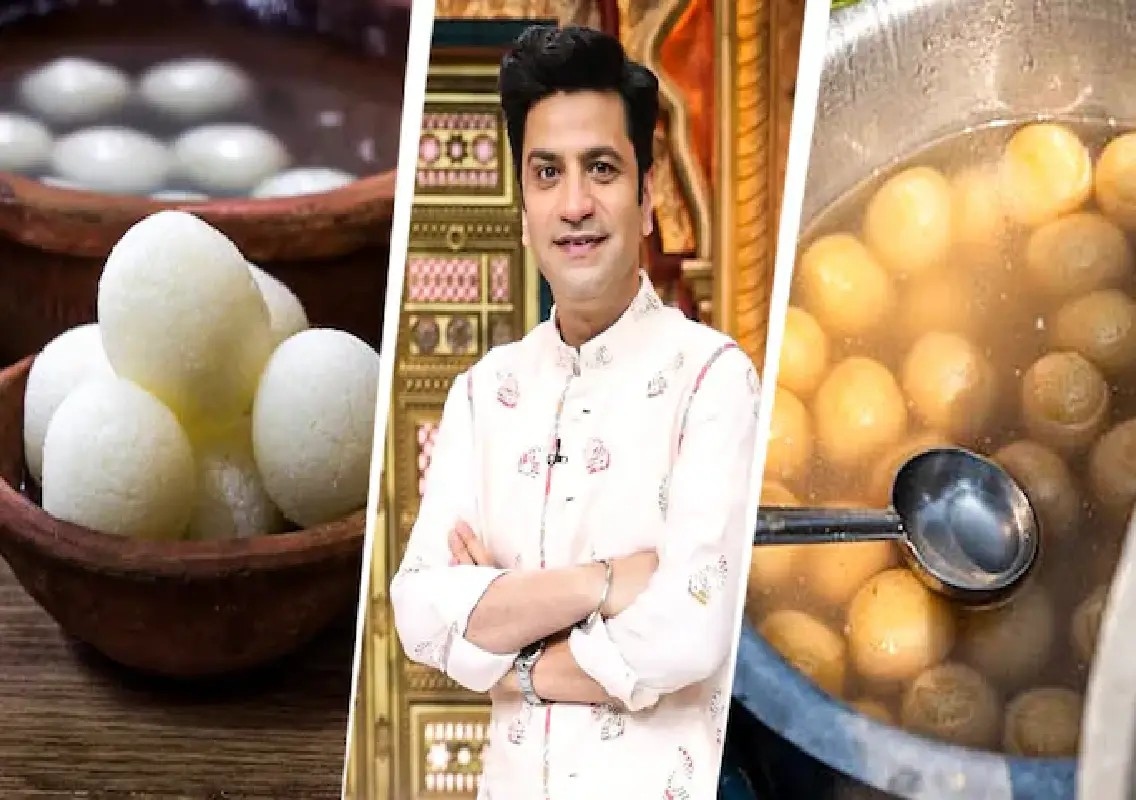


Celebrity chef Kunal Kapur has reignited the long-running debate over the origin of rasgulla after stating during a podcast discussion that the iconic sweet is “widely believed” to belong to Odisha.
The remarks, made during a conversation with Mirchi Punjabi host RJ Abby, quickly triggered fresh reactions online, reviving one of India’s most famous culinary rivalries between West Bengal and Odisha.
Chef’s remarks trigger social media reactions
During the podcast discussion on Indian sweets and culinary heritage, Kunal Kapur remarked that rasgulla is often said to have originated in Odisha.
Reacting to the statement, RJ Abby jokingly noted that people from Kolkata might become upset over the comment.
Kapur clarified that he was only referring to widely discussed claims regarding the dessert’s origin and not making a definitive historical assertion himself.
The exchange rapidly gained traction across social media platforms, with users from both West Bengal and Odisha once again debating the history, texture and cultural identity of the beloved chhena-based dessert.
Rasgulla remains centre of regional rivalry
The rasgulla — also spelled rasagola or rasogolla depending on the region — has for decades remained at the centre of a passionate cultural and culinary debate between Odisha and West Bengal.
Both states have historically claimed association with the sweet, citing different traditions, preparation styles and historical references.
Odisha’s claim is strongly linked to religious traditions associated with the Jagannath Temple.
According to Odisha’s historical narrative, rasagola has long been associated with the Niladri Bije ritual during the annual Rath Yatra celebrations, where the sweet is traditionally offered to Goddess Lakshmi.
Historians and cultural scholars from Odisha have also pointed to references in the 15th-century Odia literary work Dandi Ramayana.
Bengal’s rasogolla has separate legacy
West Bengal, meanwhile, is widely credited with popularising the modern sponge-style rasogolla recognised across India today.
Food historians in Bengal often attribute the development of the contemporary Bengali rasogolla to renowned confectioner Nobin Chandra Das during the 19th century.
The Bengali version is typically softer, whiter and more sponge-like in texture compared to Odisha’s traditional rasagola, which is often slightly caramelised with a light brown appearance.
Over time, the debate evolved beyond food into a matter of regional pride, cultural heritage and identity.
GI tags recognised both versions separately
The dispute over the sweet eventually reached the Geographical Indication (GI) registry, where both states sought legal recognition for their respective versions.
In 2017, West Bengal received the GI tag for “Banglar Rasogolla”, officially recognising the Bengali version of the dessert.
However, the issue did not end there.
In 2019, Odisha was granted a separate GI tag for “Odisha Rasagola”, recognising its own traditional preparation and cultural association.
According to the GI application submitted by Odisha, the sweet was described as soft, juicy and deeply linked to temple traditions in the state.
The dual GI recognition effectively acknowledged that both states possess distinct regional variations of the dessert.
Chhena-based sweets common in both regions
During the podcast, Kunal Kapur also spoke about the similarities between Bengali and Odia sweets, particularly their extensive use of fresh chhena.
He praised Odisha’s famous chhena poda dessert, comparing it to a baked cheesecake while noting that the sweet has existed in Odisha for generations.
Food experts often point out that eastern India shares deep culinary overlaps, with recipes and food traditions historically evolving across regions over centuries.
As a result, many historians argue that tracing the exact origin of certain traditional dishes can be difficult due to cultural exchange and adaptation over time.
Culinary debates continue to fascinate Indians
The rasgulla debate continues to remain one of India’s most widely discussed food rivalries, regularly resurfacing online whenever public figures comment on the dessert’s origins.
Despite the rivalry, both Odisha and West Bengal continue to celebrate their respective versions of the sweet as important symbols of regional culinary heritage.
Food historians believe the continuing fascination with rasgulla reflects the emotional connection Indians often share with traditional food, culture and local identity.
For many dessert lovers, however, the long-running debate ultimately changes little — both versions remain hugely popular across the country.