







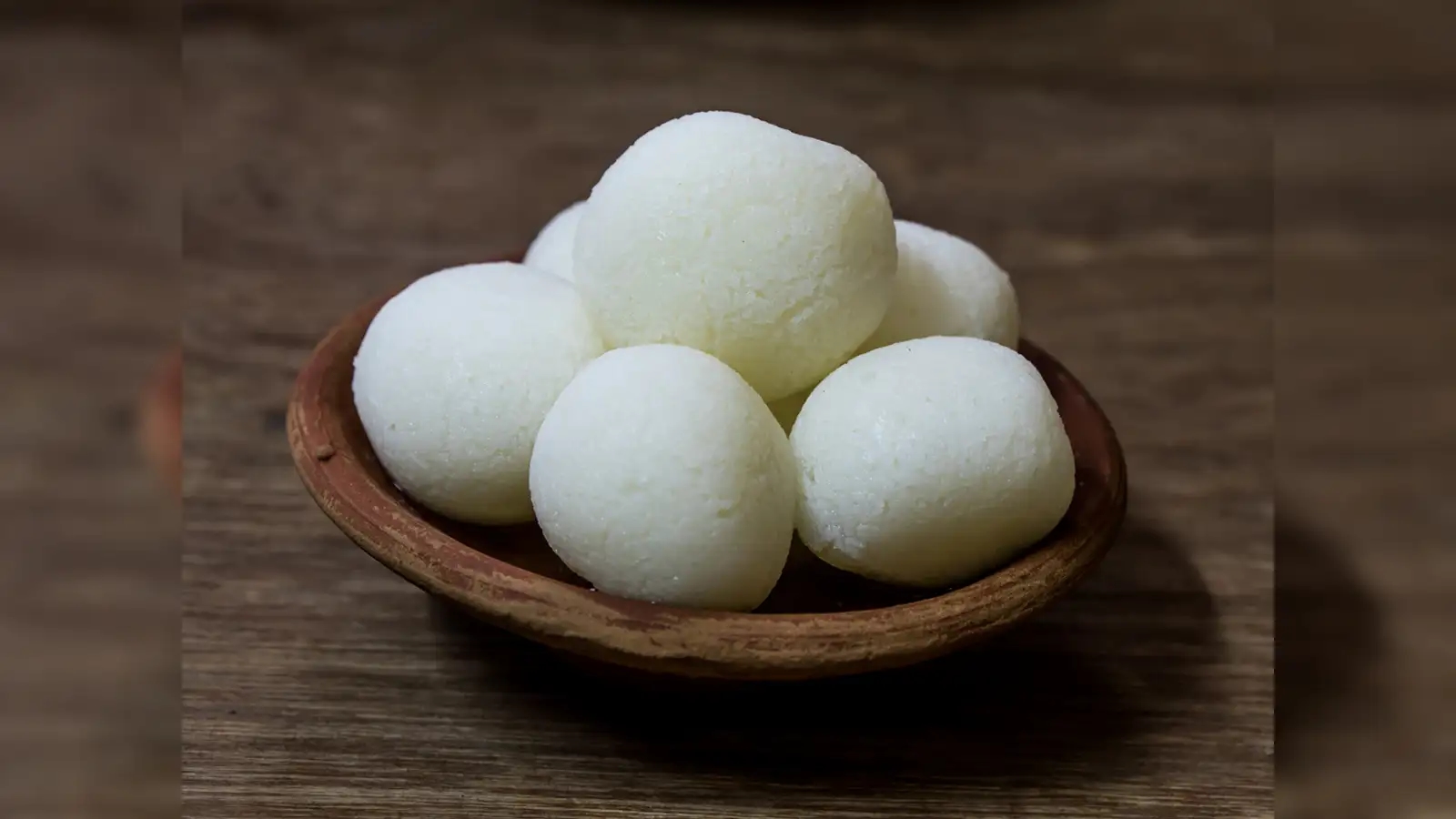


Along the highway connecting Bhubaneswar and Cuttack, lies Pahala, a modest settlement that has quietly earned the reputation of being Odisha’s rasgulla hub. As evening sets in, the village transforms into a glowing stretch of yellow-lit sweet shops, their large vessels filled with freshly prepared rasgullas soaking gently in syrup.
Pahala rasgulla is not a dessert one stumbles upon accidentally; it announces itself through aroma, warmth and visual simplicity. The shops are unpretentious, often offering little more than wooden benches, steel plates and sweets served straight from the chashni. There are no elaborate displays or marketing flourishes—just a product that relies entirely on taste and tradition.
What makes Pahala rasgulla different
Unlike the softer, snow-white rasgullas commonly associated with Bengal, Pahala rasgullas carry a faint caramelised hue. The chhena is kneaded to a slightly coarser texture and slow-cooked, resulting in a sweet that is soft yet structured. The syrup is thinner and less perfumed, allowing the depth of milk to dominate rather than overwhelming it with sweetness.
This balance gives Pahala rasgulla its defining character—mellow, earthy and comforting. It is a dessert rooted in process rather than presentation, where timing, temperature and technique matter more than refinement.
Rasgulla and the GI tag debate
Rasgulla gained national attention during the Geographical Indication (GI) debate between Odisha and West Bengal. While West Bengal received the GI tag for “Banglar Rosogolla” in 2017, Odisha was awarded the GI for “Odisha Rasagola” in 2019. Odisha’s claim is closely linked to its cultural and ritual traditions, particularly its association with the Jagannath Temple and the Niladri Bije ritual.
Though often framed as a rivalry, the debate ultimately encouraged a deeper appreciation of regional variations rather than a single, uniform narrative around rasgulla.
A sweet shaped by place
What truly defines Pahala rasgulla cannot be captured by certification alone. Local milk, water quality, cooking pace and the rhythms of everyday life all contribute to its taste. These elements are inseparable from the place itself. While the recipe can be replicated elsewhere, the experience cannot be fully recreated outside Pahala.
The warmth of rasgullas served fresh from roadside shops, eaten moments after preparation, is central to their appeal. It is this immediacy—both in flavour and atmosphere—that gives Pahala rasgulla its lasting emotional and cultural resonance.
In a country rich with chhena-based sweets across regions, Pahala rasgulla stands as a reminder that some flavours are deeply local. They are not meant to travel or evolve endlessly, but to remain rooted—quietly preserving memory, tradition and taste