







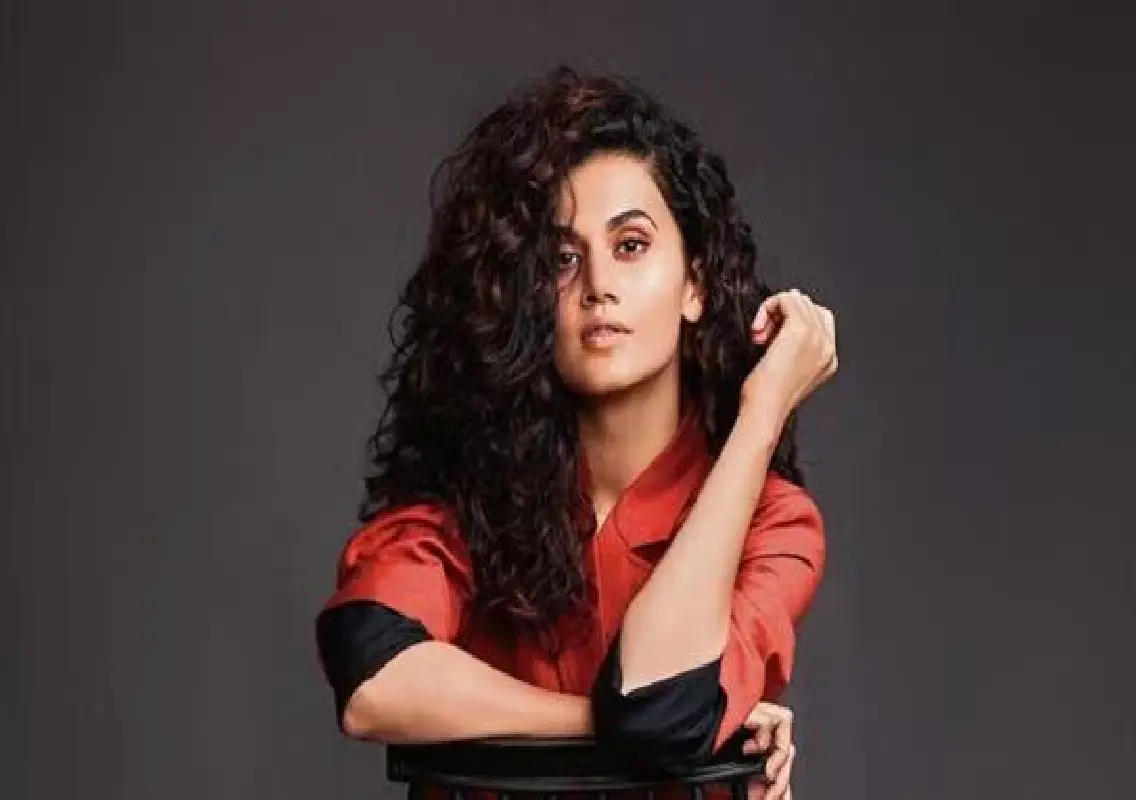


Mumbai: Actor Taapsee Pannu has spoken candidly about what she describes as the increasingly aggressive and unhealthy publicity culture in Bollywood, saying promotion in the Hindi film industry has moved beyond self-branding to actively pulling others down. Known for her outspoken views and refusal to conform to industry norms, Taapsee said she has consciously chosen to stay away from such practices, even if it means slowing down professionally.
In a recent interview with Times Now News, Taapsee reflected on how public relations strategies in Bollywood have evolved over the last few years. She revealed that her relatively quieter phase over the past one-and-a-half to two years was deliberate, allowing her to step back and observe how the industry’s publicity ecosystem now functions.
“I was too busy doing my own things. But last 1.5–2 years I have slowed down things and it has also been a conscious effort,” Taapsee said. “I have realised that this PR game has gone to some other level. You are paying either to push yourself, which was one version of doing PR. You are also paying to push someone else down.”
“Since when did success depend on someone else’s failure?”
Questioning this shift, Taapsee expressed concern over what she sees as a distorted idea of success in the industry. According to her, achievements are increasingly being measured in comparison to others rather than on individual merit.
“Since when did your success depend upon someone else’s failure?” she asked. “People have started creating a new façade of their personalities because they need relevance.”
The actor suggested that the constant race for visibility has pushed some celebrities to manufacture public personas that are disconnected from who they really are. She pointed out that relevance today is often driven by optics, controversy and noise rather than consistent work.
Taapsee’s comments come at a time when Bollywood’s PR machinery has become more visible than ever, with social media trends, anonymous blind items and planted stories frequently shaping narratives around actors and films.
Disconnect between image and work
Taapsee also highlighted what she believes is a growing mismatch between the public image celebrities project and the work they actually deliver on screen. She said she finds it problematic when an actor’s “voice” outside films does not align with their choices as a performer.
“I am not okay with just me being there in a hit film, I also need to have a very strong voice even if it is not yours,” she said. “But you have to create a voice. And that voice that you are trying to create beyond films is not matching with the work you are doing. So that discrepancy.”
According to Taapsee, authenticity is crucial, and audiences can eventually see through inconsistencies between what celebrities say and what they do. She stressed that letting work speak for itself is far more sustainable than relying on aggressive publicity tactics.
Choosing a different path
Making her stance clear, Taapsee said she prefers investing her time, money and energy in herself and her close circle rather than engaging in what she described as manipulative PR strategies. She specifically mentioned practices such as “planting articles” as something she has consciously avoided.
Her decision, she acknowledged, may come at a cost in an industry where visibility often translates to opportunities. However, Taapsee maintained that staying true to herself matters more than chasing constant relevance.
Over the years, the actor has built a reputation for carving her own path, often backing content-driven films and strong female-led narratives rather than relying on star-driven spectacle.
Career built on distinct choices
Taapsee Pannu made her acting debut with the Telugu film Jhummandi Naadam in 2010 and entered Hindi cinema with Chashme Baddoor in 2012. She gradually established herself as a versatile performer with films such as Baby and Naam Shabana, before gaining critical acclaim for projects like Manmarziyaan, Mulk, Badla and Thappad.
Her filmography also includes Rashmi Rocket, Haseen Dillruba, Dobaaraa and Phir Aayi Hasseen Dillruba, roles that reinforced her image as an actor willing to take risks and tackle complex themes.
Taapsee was last seen in Mudassar Aziz’s Khel Khel Mein, which featured an ensemble cast including Akshay Kumar, Vaani Kapoor, Ammy Virk, Aditya Seal, Pragya Jaiswal and Fardeen Khan.
What lies ahead
Looking ahead, Taapsee will next be seen in Gandhari, a revenge drama directed by Devashish Makhija and produced by Kanika Dhillon under the Katha Pictures banner. The film is set to premiere on Netflix and marks yet another collaboration between Taapsee and content-driven storytelling.
Conclusion
Taapsee Pannu’s remarks offer a rare insider critique of Bollywood’s evolving publicity culture, raising questions about authenticity, relevance and the true cost of aggressive PR. By choosing to step back rather than play the comparison game, the actor has once again reinforced her position as someone unwilling to compromise her values for visibility, even in an industry driven by constant noise.