







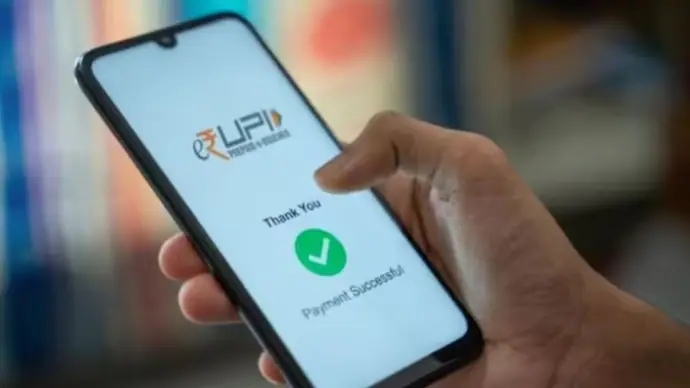


India’s Unified Payments Interface (UPI) has received landmark global recognition, with the International Monetary Fund (IMF) declaring it the world’s largest real-time payment system by transaction volume in its June 2025 report, Growing Retail Digital Payments: The Value of Interoperability. Further reinforcing this achievement, the 2024 ACI Worldwide study confirmed that UPI alone accounts for 49 per cent of all real-time transactions worldwide, underscoring India’s leadership in the global fintech landscape.
What is UPI?
Unified Payments Interface (UPI) is a real-time payment system developed by the National Payments Corporation of India (NPCI) under RBI supervision. It enables instant transfers between bank accounts using mobile devices, UPI IDs and QR codes.
Launched in 2016, UPI has transformed digital payments in India by:
- enabling interoperability across banks and apps,
- allowing 24×7×365 instant transfers,
- supporting peer-to-peer and merchant payments, and
- maintaining zero merchant discount rate (MDR) on popular platforms.
UPI by the numbers: India leads the world
According to the ACI Worldwide 2024 report, global real-time payments reached 266.2 billion transactions, of which:
- India accounted for 129.3 billion (49%),
- Brazil: 37.4 billion (14%),
- Thailand: 20.4 billion (8%),
- China: 17.2 billion (6%),
- South Korea: 9.1 billion (3%).
India’s share alone surpasses the combined volumes of the next several nations, demonstrating the scale and adoption achieved by UPI.
(See related: NK insight on fintech growth)
Government initiatives behind UPI’s expansion
UPI’s success is rooted in coordinated efforts by the Government of India, the RBI, and NPCI. Key initiatives include:
Payments Infrastructure Development Fund (PIDF)
Aims to improve digital infrastructure in tier-3 to tier-6 regions by supporting banks and fintechs in deploying POS terminals and QR codes.
- As of 31 October 2025, India has 5.45 crore digital touchpoints under PIDF.
BHIM-UPI Incentive Scheme
Encourages small-value UPI transactions, boosting accessibility for low-income users.
Expansion of RuPay and UPI Integration
UPI is now widely used for:
- e-commerce,
- public utility payments,
- transport services, and
- government services.
As of FY 2024–25, 56.86 crore QR codes have been deployed across 6.5 crore merchants, deepening digital acceptance in rural and small-business sectors.
Why UPI matters to India and the world
UPI’s global influence extends beyond transaction volume. Its achievements highlight:
For India:
- A major milestone in the Digital India initiative.
- A successful fusion of policy, technology, and public–private collaboration.
- Large-scale financial inclusion through low-cost digital payments.
For the global economy:
- UPI is being studied as a model for scalable, low-fee, interoperable payment systems.
- Countries including Singapore, the UAE and France are exploring cross-border UPI linkages.
- Its success challenges traditional card networks and accelerates the shift towards real-time payments.
For small businesses:
- Eliminates the need for expensive card machines.
- Offers instant, traceable payments at zero cost.
- Enhances transparency and reduces reliance on cash.
What is a real-time payment system?
A real-time payment system (RTPS) enables immediate fund transfers at any time, without traditional banking delays. Key features include:
- instant confirmation,
- 24×7 availability,
- high transparency, and
- reduced dependence on cash.
Systems like UPI are rapidly replacing older modes such as NEFT and RTGS for both personal and business transactions.
Key takeaways
- IMF confirms UPI as the world’s largest real-time payment system by volume (2025).
- ACI Worldwide reports UPI handles 49% of all global real-time payments.
- Government-led initiatives have driven mass adoption across cities, towns and villages.
- UPI stands as a global blueprint for affordable, scalable fintech innovation.