







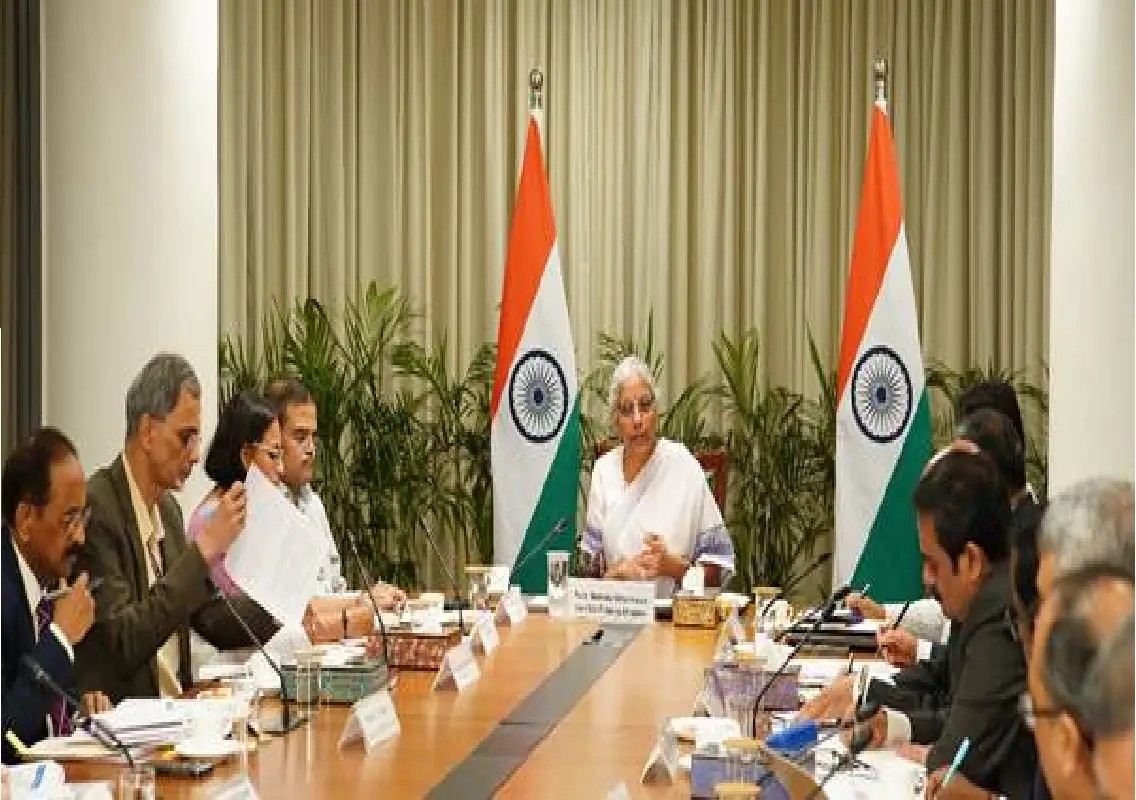


New Delhi: Union Finance and Corporate Affairs Minister Nirmala Sitharaman on Monday reviewed the progress of the Reserve Bank of India’s (RBI) swap facility schemes aimed at attracting foreign currency inflows through Foreign Currency Non-Resident (Bank) [FCNR(B)] deposits, External Commercial Borrowings (ECBs) and Overseas Foreign Currency Borrowings (OFCBs).
During a meeting in New Delhi, managing directors and chief executive officers of public sector banks (PSBs) and public financial institutions (PFIs) briefed the minister on the response to the initiatives and outlined strategies to further enhance deposit mobilisation.
Banks report encouraging response
The meeting was attended by Secretaries of the Departments of Financial Services, Economic Affairs and Revenue, the Chief Economic Advisor, the RBI Deputy Governor and other senior government officials.
According to officials, banks reported an encouraging response to the RBI’s swap facility schemes, particularly from the Indian diaspora.
The heads of PSBs and PFIs informed the Finance Minister that the schemes have generated healthy interest across FCNR(B) deposits, ECBs and OFCBs, supported by attractive returns offered by banks.
Strong interest from NRIs
Banks said there has been significant participation from non-resident Indians (NRIs) residing in Singapore, Hong Kong, West Asia, the United Kingdom, the United States and several other overseas jurisdictions.
They noted that the suspension of the interest rate ceiling on fresh FCNR(B) deposits has enabled banks to offer attractive returns, including on five-year deposits, encouraging greater participation.
Officials also informed the minister that FCNR(B) deposit mobilisation has shown an accelerating trend since the launch of the scheme.
Focus on digital outreach
The banks said they have adopted customised outreach strategies to engage with the NRI community through digital platforms and targeted campaigns.
They expressed confidence that mobilisation under the ECB schemes would gain stronger momentum during the third quarter of FY 2026-27 (October to December 2026).
The institutions also highlighted efforts to expand participation by leveraging overseas banking relationships and customer networks.
GIFT City to play a bigger role
During the meeting, banks informed the Finance Minister that International Banking Units (IBUs) at the International Financial Services Centre (IFSC), GIFT City, Gujarat, are being actively utilised to mobilise funds from multiple international markets.
These include the United Kingdom, the United States, West Asia, Hong Kong, Singapore and Southeast Asia.
Sitharaman urged banks to maximise the use of GIFT City’s financial infrastructure and institutional ecosystem to attract greater foreign capital.
RBI assures continued support
The RBI Deputy Governor assured participants that the central bank is extending full support to banks and financial institutions in mobilising deposits and facilitating eligible borrowings under the schemes.
Officials also noted that the RBI’s daily reporting framework has enabled transparent and real-time monitoring of the progress made by participating institutions.
Minister calls for greater mobilisation
Appreciating the initial response to the schemes, Sitharaman asked banks to intensify outreach efforts among the NRI diaspora and introduce innovative deposit products to sustain momentum during the remaining period of the initiatives.
She said continued participation by public sector banks, private sector banks and financial institutions would strengthen foreign currency inflows, reinforce India’s foreign exchange reserves and improve the resilience of the country’s external sector amid global economic uncertainties.
The RBI had announced the swap facilities in the Monetary Policy Statement on June 5, 2026. The initiatives include a US dollar-rupee forex swap facility at par for fresh FCNR(B) deposits and concessional swap facilities for eligible ECBs and OFCBs.
Under the scheme, FCNR(B) deposits remain eligible until September 30, 2026, while ECBs and OFCBs are eligible until December 31, 2026.