







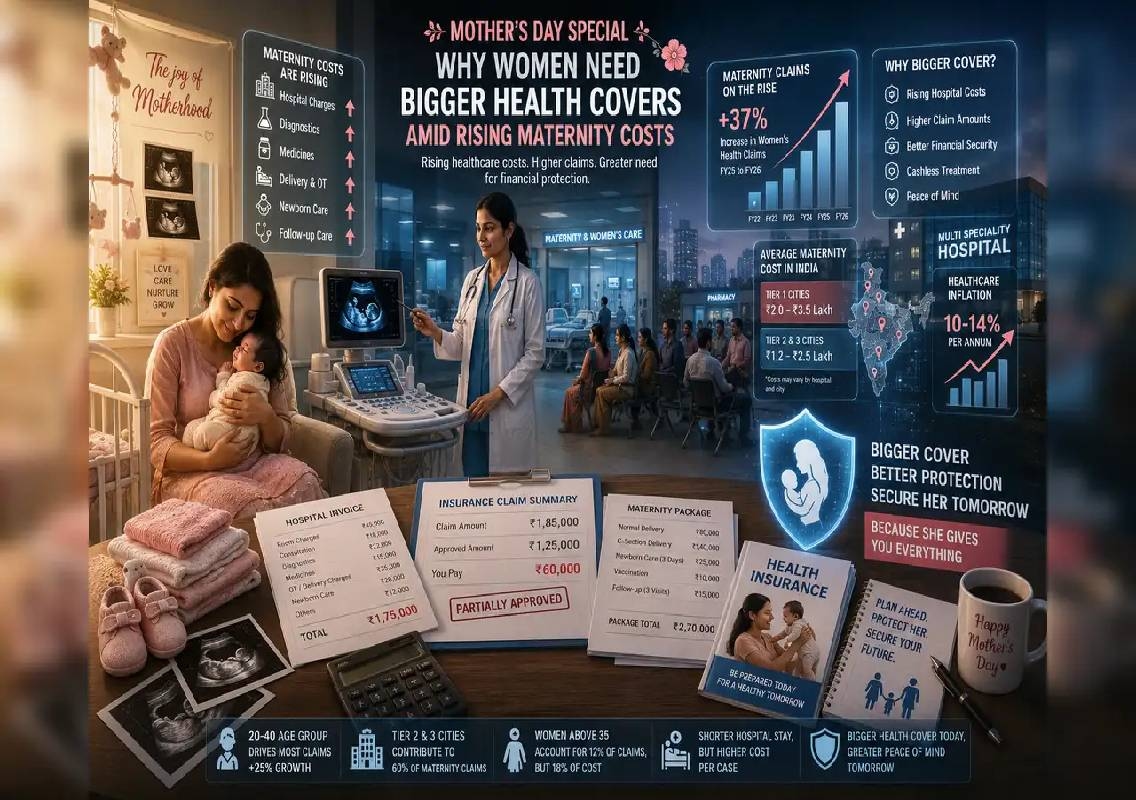


Mumbai: Women’s health insurance claims in India have surged by 37 per cent between FY25 and FY26, driven mainly by rising maternity expenses and increasing dependence on hospital-based maternal care, according to a report released by Care Health Insurance. The findings underline the growing need for women to opt for larger health insurance covers amid rising treatment costs and changing healthcare patterns.
The report revealed that women in the 20–40 age group continue to account for the highest share of claims, reflecting the increased financial burden associated with pregnancy, childbirth, and postnatal care. At the same time, maternity-related claims are becoming more expensive, particularly in Tier 2 and Tier 3 cities, which now contribute nearly 60 per cent of all maternity claims reported by the insurer.
The increasing cost intensity has emerged despite shorter hospital stays and better institutional healthcare access, highlighting a structural shift in maternal healthcare spending across India.
Rising maternity costs driving insurance claims
According to the report, the overall maternity claim outgo has increased by 25 per cent over the last two years, even though the number of claims has fluctuated during the same period. This trend indicates that the average spending per maternity case is rising significantly.
Healthcare experts believe that inflation in medical services, increased use of advanced procedures, and higher hospitalisation costs are among the major reasons behind the sharp rise in claim amounts. Private hospitals, especially in urban and semi-urban areas, are also witnessing greater demand for specialised maternal care, leading to higher treatment bills.
The report further noted that women are increasingly seeking planned and medically supervised deliveries, resulting in greater healthcare expenditure. Caesarean section deliveries, specialised prenatal monitoring, neonatal intensive care support, and post-delivery consultations are contributing to the overall increase in maternity-related costs.
With women becoming more financially independent and aware of healthcare options, insurance coverage is also being viewed as an essential financial safeguard rather than an optional benefit.
Institutional deliveries continue to rise
Data from the Ministry of Health and Family Welfare showed that more than 88–90 per cent of births in India are now taking place in institutional settings. The share of institutional deliveries reached 97.3 per cent during 2023–24, reflecting a major shift towards hospital-based maternal care.
Government data presented in 2025 further revealed that C-section deliveries accounted for over 27 per cent of all reported births in India during 2024–25. The growing number of medically assisted deliveries indicates increasing reliance on specialised maternal healthcare services.
While institutional healthcare has improved maternal safety and reduced complications in many cases, it has also significantly increased the financial burden on families. Even shorter hospital stays are no longer translating into lower treatment expenses.
The report highlighted that the percentage of women discharged within five days for maternal care increased from 75 per cent in FY24 to 82 per cent in FY26. However, despite quicker discharges and more efficient hospital operations, treatment costs have continued to rise steadily.
Insurance providers say this reflects a broader transformation in healthcare delivery, where the quality and intensity of treatment have become more resource-driven and technology-oriented.
Tier 2 and Tier 3 cities see stronger growth
One of the most notable trends identified in the report is the rapid increase in maternity claims from Tier 2 and Tier 3 cities. These regions now account for nearly 60 per cent of maternity-related insurance claims handled by the company.
Healthcare access in smaller cities has improved significantly over the last decade, with better hospital infrastructure, growing private healthcare investments, and increasing awareness among women regarding maternal health services.
As a result, more women from non-metro areas are opting for institutional deliveries and comprehensive maternity care. However, the associated costs are also rising rapidly, making adequate insurance coverage increasingly important for middle-income households.
Industry experts suggest that families should carefully evaluate maternity benefits, waiting periods, newborn cover, and postnatal care inclusions while selecting health insurance plans. Many standard policies continue to offer limited maternity coverage, which may not be sufficient considering the sharp increase in healthcare costs.
Nutritional concerns remain a challenge
The report also highlighted wider public health concerns affecting women beyond maternity care. Although a majority of women in India now access formal antenatal services, nutritional deficiencies continue to remain a major issue.
Public health data cited in the report showed that three out of four women still have inadequate dietary iron intake. Poor nutrition during pregnancy can lead to long-term health complications for both mothers and newborns, increasing the need for medical intervention and healthcare spending.
Experts believe that improving nutritional awareness and preventive healthcare can help reduce medical complications and lower long-term healthcare expenses. However, until such improvements become widespread, financial preparedness through adequate health insurance remains critical.
The report concluded that India is witnessing a structural shift in maternal healthcare, with rising treatment intensity and evolving healthcare expectations driving higher financial exposure for women and families. As maternity care becomes increasingly advanced and institutionalised, larger health insurance covers are likely to become a necessity rather than a luxury for many households.