









“Healthcare in the US will likely get worse before it gets better,” remarked Amit Garg, Managing Partner at Tau Ventures, as we concluded a fireside chat at Stanford GSB. The words weren’t dramatic, but grounded—spoken with the clarity of someone who’s seen beneath the surface of a chronically ill system. His prognosis? Pain before progress.
As an MBA student immersed in innovation, I see peers building bold healthcare solutions every day. Yet, even the most brilliant technologies struggle in a system built more to process claims than to serve people.
A Dysfunctional Status Quo
Despite spending over $4.5 trillion a year, the US healthcare system underperforms across almost every key metric. That’s not for lack of talent or tools—but because the system isn’t designed for outcomes; it’s designed for itself.
From providers and payers to policymakers and PBMs, the ecosystem is riddled with misaligned incentives. Doctors are drowning in documentation. Hospitals are stuck wrestling with reimbursement codes. Innovation chokes in a system more focused on compliance than compassion. As Garg put it, “Too many players benefit from the status quo.”
AI as a Treatment, Not a Cure
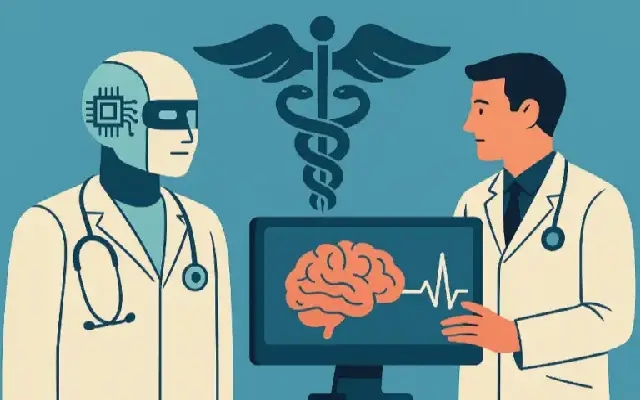
Still, artificial intelligence offers one of the clearest paths to systemic healing—not as a silver bullet, but as a scaffolding for reinvention:
-
Diagnostics: AI tools like AlphaFold and PathAI are catching diseases with unprecedented accuracy, improving early detection.
Drug Development: AI-driven companies like Insilico Medicine are slashing development costs and timelines.
Surgical Support: AI is now guiding procedures, predicting outcomes, and enhancing surgical precision.
Administrative Relief: Automating billing and transcription is already reducing the burden that drives clinician burnout.
Personalized Care: AI enables custom treatment plans by analyzing genomic and historical patient data.
The Reluctant Testbed
Healthcare, however, doesn’t welcome half-finished solutions. “Good enough” doesn’t cut it when lives are on the line. That’s why health-tech founders face tougher tests: longer timelines, complex regulations, and skepticism from institutions conditioned to demand not just innovation—but proof.
In my own circles at Stanford, I’ve watched startups with solid tech falter at the final hurdle—not due to technical flaws, but because trust couldn’t be coded. In this industry, the MVP is not an app—it’s clinical validation.
The Road Through Pain
Garg’s realism is not pessimism. We may be at the peak of the hype cycle, but he believes in the coming “plateau of productivity,” when AI is no longer an accessory but the architecture of care.
Yes, there will be more friction—burnout, inequality, resistance. But to ignore what AI offers would be its own form of malpractice.
Because when an algorithm flags what a human eye misses, when a doctor reclaims time for care, and when a screen becomes a lifeline in a remote town—then we’ll know: this system can heal.
Read Also: