







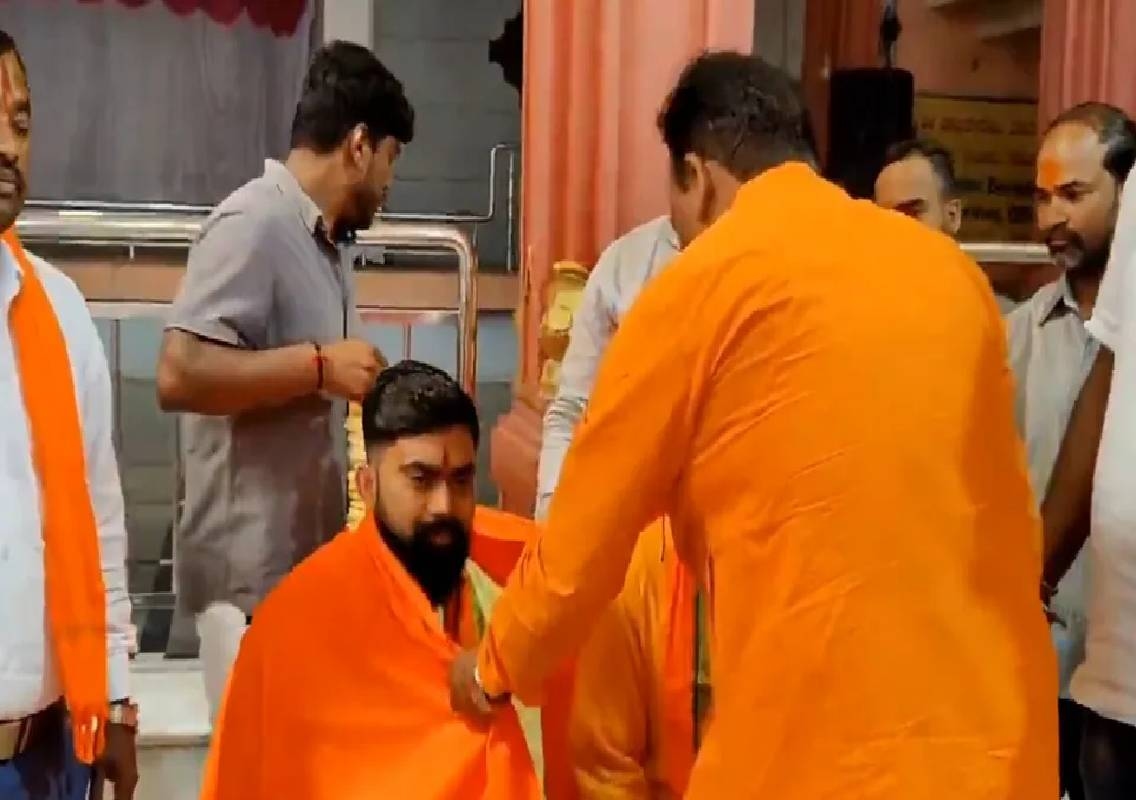


Hubballi: Photographs of newly appointed Hubballi-Dharwad Police Commissioner Bhushan Gulabrao Borase being greeted by two men facing criminal cases have sparked controversy after the images surfaced on social media. One of the men, Amit Baddi, is an accused in the 2017 murder of journalist Gauri Lankesh, while the other, Khet Singh Rajpurohit, is facing a case under the Narcotic Drugs and Psychotropic Substances (NDPS) Act.
The photographs reportedly show the two men presenting bouquets to Borase at his office after he assumed charge as the new police commissioner. The images prompted questions about how accused persons in serious criminal cases were able to enter the commissioner’s office and participate in a felicitation event.
Borase, however, said he did not personally know everyone who came to greet him during his first few days in office. He explained that more than 200 people from different sections of society had met him since he took charge and that people had arrived in groups.
The commissioner maintained that his decision to allow people to meet him was part of his effort to make the police department more accessible to the public. He also stressed that his approach towards crime and criminals remained firm.
Photographs trigger controversy
The controversy began after photographs showing Borase being greeted by the two men circulated online.
According to reports, Baddi, who is an accused in the Gauri Lankesh murder case, and Rajpurohit, who is facing an NDPS case, were among those who presented bouquets to the newly appointed commissioner. The photographs quickly attracted attention because of the criminal cases associated with the two men.
The images raised questions about the vetting of visitors entering the office of the police commissioner and whether officials were aware of the backgrounds of those participating in the felicitation.
The incident has also drawn particular attention because Borase had spoken about combating illegal drug activity in Hubballi-Dharwad after taking charge. The presence of a person facing an NDPS case at a felicitation event involving the police chief has consequently added to the scrutiny.
However, the photographs themselves do not establish any association between the commissioner and the accused persons beyond the reported interaction at his office.
Commissioner says he did not know everyone
Responding to the controversy, Borase told Hindustan Times that he did not personally know everyone who came to meet him.
The commissioner said that more than 200 people from different sections of society had visited him during the three days after he assumed charge. Because visitors arrived in groups, he said it was not possible for him to identify or know each individual personally.
Borase also explained that he had deliberately not refused people who wanted to meet him because he wanted the police to have a people-friendly image.
At the same time, he made it clear that being accessible to members of the public did not mean that his position on criminal activity had changed.
He reiterated that his stance against criminals remained tough, seeking to distinguish the open-door approach from any leniency towards criminal activity.
Who is Amit Baddi?
Amit Baddi, whose presence in the photographs has drawn considerable attention, is an accused in the murder case of journalist and activist Gauri Lankesh.
Lankesh was shot dead outside her home in Bengaluru on September 5, 2017. Her murder triggered widespread protests and a major investigation by a Special Investigation Team of the Karnataka Police.
The case has involved several accused persons and has been linked by investigators to a wider conspiracy. Baddi’s identification in the latest controversy is based on his reported status as an accused in that case; it should not be interpreted as a finding of guilt.
The photographs have become particularly sensitive because they emerged around the anniversary of Lankesh’s killing. September 5, 2026, marked nine years since the journalist was murdered.
The renewed attention to the case has therefore coincided with the controversy surrounding the new Hubballi-Dharwad police commissioner’s office.
Rajpurohit faces an NDPS case
The second individual shown in the photographs is Khet Singh Rajpurohit, who is facing a case registered under the NDPS Act.
His presence has attracted additional attention because tackling illegal drugs was identified as one of the priorities of the Hubballi-Dharwad police leadership.
Borase had spoken about the need to curb the illegal drug trade in the twin cities after taking charge. The police chief’s reported focus on narcotics has made the appearance of an NDPS accused at his office particularly noteworthy.
However, as with Baddi, the fact that Rajpurohit is facing a criminal case does not by itself establish guilt. The legal status of an accused person remains distinct from a conviction.
Borase had announced focus on narcotics
The controversy comes shortly after Borase took charge as Hubballi-Dharwad police commissioner and identified combating narcotics and improving traffic control as important priorities.
The police leadership’s focus on illegal drugs has been highlighted in recent reports, with narcotics enforcement described as an urgent area for the department.
Against this backdrop, the photograph involving a person facing an NDPS case has inevitably raised questions about the circumstances under which the meeting took place.
Borase’s explanation, however, is that the interaction occurred because his office was receiving large numbers of visitors following his appointment. He said his intention was to remain accessible and people-friendly while maintaining a strict position on crime.
Questions over access to the commissioner’s office
The incident has also brought attention to the issue of access to senior police officials.
A police commissioner’s office is visited by citizens, community representatives, political figures, officials and other stakeholders. During the initial days after an officer assumes charge, formal greetings and courtesy meetings are common.
The controversy in this case centres on whether the backgrounds of visitors were known before they were photographed felicitating the police chief.
The available reports do not indicate that Borase invited either accused person specifically or that the meeting represented an official association with them. The commissioner has instead said he did not know everyone who came to greet him.
This distinction is important while assessing the photographs, particularly because a photograph of a public official with a person facing criminal charges can generate interpretations that go beyond what the image itself establishes.
Police chief reiterates tough stance on crime
Despite the controversy, Borase has maintained that his approach to criminal activity remains unchanged.
His comments indicate that he sees accessibility to the public and strict enforcement against crime as two separate aspects of his role.
The commissioner said his decision not to turn away visitors was driven by the objective of making the police department people-friendly. At the same time, he emphasised that his position against criminals remained tough.
The clarification is likely to be closely watched as Borase begins his tenure in Hubballi-Dharwad, particularly given the priorities he has identified for the department.
Timing adds to public attention
The controversy has emerged at a particularly sensitive time because September 5 marked the ninth anniversary of Gauri Lankesh’s murder.
Lankesh was killed outside her Bengaluru residence in 2017, and the case remains one of the most closely followed political and criminal investigations in Karnataka in recent years.
The circulation of a photograph identifying one of the people greeting a police commissioner as an accused in that case has therefore generated heightened public interest.
At the same time, the anniversary and the current controversy are separate events. The photographs relate to Borase’s assumption of office and the people who visited him, while the Gauri Lankesh case concerns the investigation and prosecution arising from her 2017 murder.
Importance of maintaining public confidence
The episode highlights the importance of transparency and public confidence in law enforcement institutions.
Senior police officials regularly meet people from different sections of society, and such interactions can be part of maintaining public engagement. However, photographs involving individuals facing serious criminal allegations can create questions about institutional protocols and the vetting of visitors.
For the police department, clear communication about the circumstances of such meetings can help prevent misunderstandings.
Borase’s response has attempted to provide that context by explaining the volume of visitors he received after taking charge and stressing that he did not personally know everyone who came to his office.
Conclusion
Hubballi: Photographs showing Gauri Lankesh murder case accused Amit Baddi and NDPS case accused Khet Singh Rajpurohit greeting newly appointed Hubballi-Dharwad Police Commissioner Bhushan Borase have sparked questions over their presence at the commissioner’s office.
Borase has clarified that more than 200 people had met him during his first three days in office and that he did not personally know everyone who came in groups to greet him. He said his decision to remain accessible was part of making the police people-friendly, while insisting that his stance against criminals remained firm.
The controversy comes as the commissioner has identified narcotics control as one of his priorities and also coincides with the ninth anniversary of Gauri Lankesh’s murder. The episode is likely to keep attention focused on visitor protocols, public access to senior police officials and the need to maintain public confidence in law enforcement.