







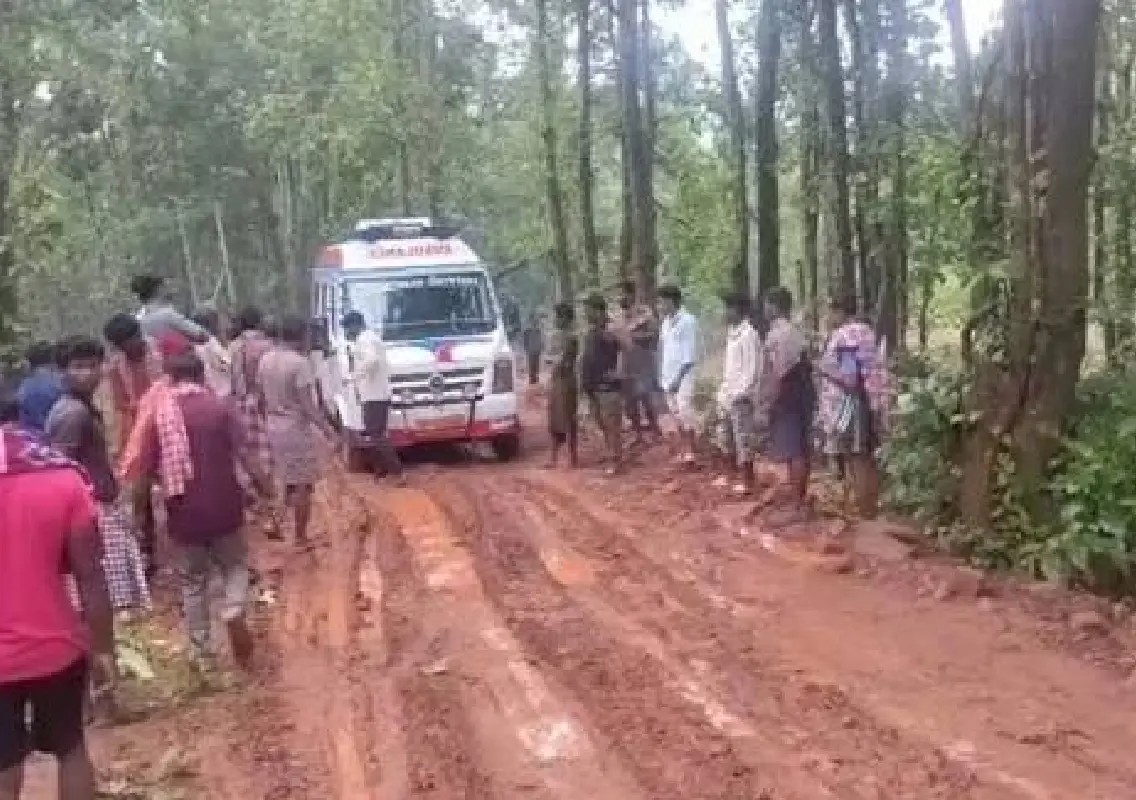


Latehar : A distressing incident in Jharkhand’s Latehar district has highlighted the continuing difficulties faced by villagers because of poor road connectivity after an ambulance carrying a body became stuck in mud.
The incident occurred in Kekrahi village under Chandwa block, where the ambulance reportedly could not proceed along the badly damaged road. With the vehicle stranded and the journey disrupted, local residents had to carry the deceased person on their shoulders to reach the village.
The episode has once again raised questions about basic road infrastructure and access to emergency services in remote rural areas.
Ambulance gets stuck on muddy road
According to reports, an ambulance was transporting the body towards Kekrahi village when it encountered severe mud on the poorly maintained road.
The vehicle became stuck, making it impossible for the ambulance to continue its journey. The condition of the road had reportedly deteriorated considerably, creating difficulties for vehicles attempting to reach the village.
For the villagers waiting for the deceased person to be brought home, the situation quickly became an additional ordeal during an already painful moment.
Villagers carry body on their shoulders
With the ambulance unable to move forward, villagers stepped in to complete the final part of the journey themselves.
They reportedly lifted the body from the stranded ambulance and carried it on their shoulders through the muddy stretch towards the village.
The sight of villagers walking through mud with the body has drawn attention to the difficulties faced by residents of remote settlements where basic road access remains inadequate.
What should ordinarily have been a straightforward journey became a physically demanding task because the road was not accessible to the ambulance.
Poor road conditions create hardship
The incident has brought renewed focus on the condition of the road connecting Kekrahi village with the surrounding areas.
During the monsoon, unpaved and poorly maintained roads can become particularly difficult to navigate. Mud, waterlogging and damaged stretches can prevent ambulances and other essential vehicles from reaching villages.
For residents, the problem extends beyond inconvenience. Poor connectivity can affect access to hospitals, emergency services, schools, markets and other essential facilities.
In emergencies, even a short stretch of impassable road can make a significant difference to the time taken to reach medical care.
A painful journey for the grieving family
The difficulties faced by the villagers were particularly poignant because the journey involved carrying a deceased person back to the community.
The family was already dealing with the loss of a loved one when the ambulance became stranded. Villagers then had to take responsibility for transporting the body through the difficult terrain.
Such incidents can add considerable emotional and physical hardship to families during moments of bereavement.
The villagers’ decision to come together and carry the body also reflects the importance of community support in areas where infrastructure remains inadequate.
Raises questions over rural connectivity
The incident has once again raised questions about the pace of infrastructure development in remote parts of Jharkhand.
While road connectivity has improved in many parts of the state over the years, incidents involving ambulances getting stuck demonstrate that challenges remain in some rural settlements.
Roads need not only to be constructed but also regularly maintained, particularly before and during the monsoon season.
For villages such as Kekrahi, reliable all-weather road connectivity is essential to ensure that ambulances and other emergency vehicles can reach residents without obstruction.
Need for better access to emergency services
Access to emergency healthcare depends not only on the availability of ambulances but also on roads capable of supporting them.
An ambulance can provide timely assistance only when it can travel safely to and from a village. Poor road conditions can undermine the purpose of emergency transportation and place additional pressure on local communities.
The Kekrahi incident therefore serves as a reminder that rural development must include dependable last-mile connectivity.
Ensuring that remote villages have roads that remain usable during the monsoon could help prevent similar situations in the future.
Incident sparks concern over development claims
The episode has also prompted criticism of development claims when basic infrastructure remains inadequate in some rural areas.
For residents, development is experienced not merely through large projects but through everyday access to roads, healthcare, transportation and essential services.
When an ambulance carrying a body cannot reach a village because of mud, the incident becomes a stark illustration of the gap that can exist between infrastructure plans and conditions on the ground.
The villagers’ difficult journey has therefore brought attention to an issue that extends beyond one road or one village.
Villagers’ resilience amid hardship
Despite the difficult circumstances, the villagers came together to ensure that the deceased person could be taken home.
Their collective effort helped the family complete the final journey despite the failure of the road to support the ambulance.
The incident is a reminder of the resilience of rural communities, but it also underlines why such resilience should not have to compensate for inadequate infrastructure.
For the people of Kekrahi, the hope will now be that the condition of the road receives urgent attention and that ambulances and other essential vehicles can reach the village safely in the future.
The episode has left behind a deeply distressing image — villagers carrying a body through mud because an ambulance could go no further — and has renewed the call for dependable rural roads and basic public services.