


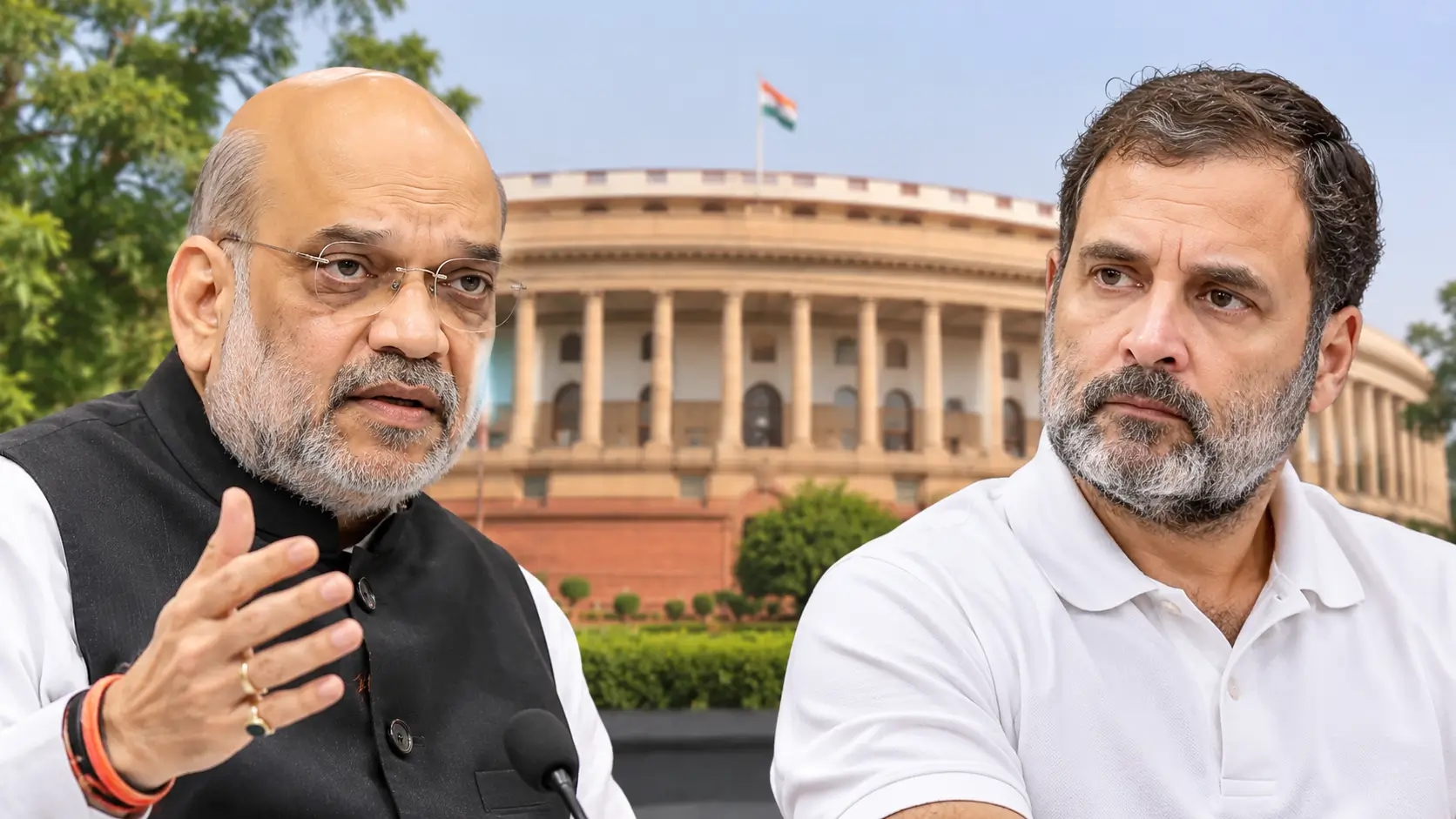


Karnal: Union Home Minister Amit Shah on Thursday challenged Congress leader Rahul Gandhi to debate allegations of irregularities in the Special Intensive Revision (SIR) of electoral rolls inside Parliament instead of holding protests on the streets. Addressing the Bharatiya Janata Party’s (BJP) ‘Loktantra Bachao, Arajakta Hatao’ rally in Haryana’s Karnal, Shah accused the Congress leader of disrupting parliamentary proceedings and spreading what he described as anarchy.
Shah also said the government was ready to convene a special session of Parliament to discuss the SIR exercise. He asked Gandhi to formally write to Prime Minister Narendra Modi if he wanted a debate on the issue.
The Home Minister’s remarks came amid an escalating political confrontation between the BJP and the Congress over the electoral roll revision exercise and allegations of “vote chori”.
Addressing the gathering, Shah said the BJP’s campaign across the country was intended to respond to the Opposition’s allegations and defend the electoral process.
“Across 600 districts in the country, this ‘Loktantra Bachao, Arajakta Hatao’ rally has served as a strong response to Rahul Gandhi. Let me state this clearly: Rahul Gandhi taking to the streets will not serve you well. I still advise you: hold your discussions in Parliament,” Shah said.
Shah asks Rahul Gandhi to debate in Parliament
Shah questioned Gandhi’s approach to raising concerns about electoral processes through street protests, arguing that Parliament was the appropriate forum for constitutional discussions.
“They wave the Constitution in the air. Parliament is the very place where one is meant to fulfil constitutional duties. You insult Parliament, you insult the Speaker, you insult the courts—and yet, you talk about democracy…” he said.
The Home Minister also accused the Congress leader of repeatedly disrupting parliamentary proceedings and staging walkouts instead of allowing debates to take place.
“You have created chaos and uproar in Parliament, and staging walkouts is the culture of the Congress Party. You do not allow Parliament to function, and then you gather crowds on the streets and spread anarchy like anarchists,” Shah said.
He questioned whether Gandhi believed that India’s democratic institutions could be weakened by such protests.
“What do you think, brother? Do you believe that our 80-year-old democracy will fall for your tricks?” he added.
Shah’s remarks were part of the BJP’s broader campaign against the Opposition’s allegations concerning the SIR exercise and the Election Commission.
BJP promises response to Congress protests
Shah also said the BJP would respond to the Congress politically across different platforms, including Parliament, state legislatures and public gatherings.
“Rahul Ji, let me make one thing clear: we are people who belong to the streets. Remember my words. The Bharatiya Janata Party will respond to you in Parliament, in the Legislative Assemblies, in villages, in the fields, on the streets, and everywhere else,” he said.
He added that BJP workers would be present if the Congress organised public gatherings.
“And if you want to gather crowds, BJP workers will be there too and give you a fitting reply,” Shah said.
The BJP’s ‘Loktantra Bachao, Arajakta Hatao’ campaign has been organised to counter the Opposition’s allegations of electoral irregularities and questions about the functioning of the Election Commission.
Shah’s Karnal programme included a foot march and a public meeting. The party had announced the campaign as an outreach effort to present its position on the SIR exercise and counter the Opposition’s “vote chori”.
Shah counters Congress’s ‘vote chori’ allegations
Taking a swipe at Gandhi over his allegations of “vote chori”, Shah referred to the Congress’s electoral defeats in the 2014, 2019 and 2024 Lok Sabha elections.
He argued that the party had lost all three general elections even when no SIR exercise was conducted.
The remark was aimed at challenging the Congress’s argument that electoral roll revision had contributed to alleged irregularities in the electoral process.
The SIR exercise has become a major point of disagreement between the BJP and Opposition parties. Congress and other Opposition leaders have questioned aspects of the revision process and raised concerns about the possibility of eligible voters being removed from electoral rolls.
The BJP, on the other hand, has defended the exercise and accused the Opposition of attempting to undermine public confidence in democratic institutions.
The competing claims have led to protests, political rallies and demands for discussions on the electoral process.
Rahul Gandhi had challenged PM Modi to an open debate
Shah’s comments also came days after Rahul Gandhi renewed his challenge to Prime Minister Narendra Modi for an open debate over allegations involving foreign backing.
In a post on X on November 2, the Congress leader accused Modi of becoming Prime Minister and remaining in office with foreign assistance. Gandhi also alleged that foreign interests supported the country’s financial system and that foreign social media platforms backed the Prime Minister.
He challenged Modi to debate the allegations at any venue and at any time.
Gandhi’s post included a direct challenge to the Prime Minister, with the Congress leader saying he was ready for a discussion whenever Modi agreed.
He also tagged senior BJP leaders Rajnath Singh, Nitin Gadkari, Shivraj Singh Chouhan and Uttar Pradesh Chief Minister Yogi Adityanath, asking them to persuade the Prime Minister to accept the challenge.
The Congress leader’s remarks followed Modi’s criticism of the Opposition during his address at the Rashtriya Ekta Diwas celebrations in Gujarat on October 31.
The Prime Minister had accused Opposition forces of creating instability by spreading rumours and described them as an “obstructionist” side rather than an Opposition.
Gandhi responded by rejecting Modi’s criticism and challenging him to an open debate.
BJP leaders respond to Rahul Gandhi’s challenge
Several senior BJP leaders also criticised Gandhi following his challenge to the Prime Minister.
Union Finance Minister Nirmala Sitharaman, Parliamentary Affairs Minister Kiren Rijiju and Commerce Minister Piyush Goyal were among those who responded to the Congress leader’s remarks.
The BJP’s position, as reflected in Shah’s Karnal address, was that Gandhi should use Parliament to raise his concerns rather than rely on public challenges and street protests.
Shah’s suggestion that the government was prepared to convene a special parliamentary session added another dimension to the political exchange. He asked Gandhi to formally communicate his demand for a debate to the Prime Minister.
Meanwhile, Gandhi’s renewed challenge on foreign influence and the BJP’s response have widened the political confrontation beyond the SIR issue.
SIR controversy continues to fuel BJP-Congress confrontation
The Special Intensive Revision of electoral rolls has become a central issue in the ongoing political dispute between the BJP and the Opposition.
Opposition parties have raised concerns about electoral roll changes and alleged voter deletions, while the BJP has defended the revision exercise and accused its critics of spreading misinformation.
The BJP’s nationwide ‘Loktantra Bachao, Arajakta Hatao’ campaign is intended to counter these allegations. The Karnal rally formed part of the party’s outreach, with Shah using the platform to challenge Gandhi and defend the government’s position.
The latest exchange has brought together two separate political challenges: the Opposition’s demand for answers on SIR and Gandhi’s call for an open debate with Modi on allegations involving foreign influence.
Shah has insisted that the debate over electoral roll revision should take place in Parliament and said the government is ready for a special session. Gandhi’s demand for a public debate with the Prime Minister remains a separate political challenge.
The developments underline the continuing confrontation between the BJP and Congress over electoral processes, parliamentary conduct and allegations of foreign influence.