







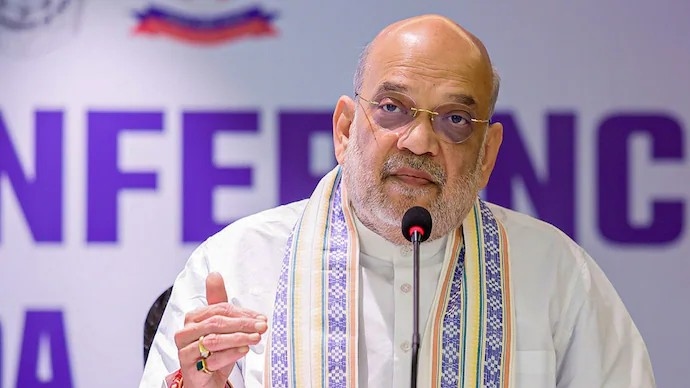


Bhopal: Union Home Minister Amit Shah has said that the full implementation of India’s new criminal laws will enable criminal cases to be disposed of within three years, from the filing of an FIR to proceedings in the Supreme Court.
Shah made the remarks on Saturday while addressing a state-level conference of cattle rearers in Bhopal after inaugurating an exhibition on the new criminal laws. He said the reforms were aimed at reducing delays that have long been associated with India’s criminal justice system.
According to Shah, the three laws would be fully operational in about one-and-a-half years, after which the system would be capable of completing the journey from an FIR to a Supreme Court verdict within three years. The claim is Shah’s stated target for the reformed system rather than a currently applicable statutory deadline for every criminal case.
The three new criminal laws — the Bharatiya Nyaya Sanhita (BNS), Bharatiya Nagarik Suraksha Sanhita (BNSS) and Bharatiya Sakshya Adhiniyam (BSA) — came into force across India on July 1, 2024.
Shah says new laws will change criminal justice system
Shah said India’s judicial system had previously become associated with repeated adjournments and delays, referring to the popular phrase “tareekh pe tareekh”.
He said the new criminal laws were intended to change that approach by bringing greater use of technology, forensic science and time-bound procedures into criminal investigations and trials.
“I have come especially to tell the people and the youth that after about one and a half years, once the new criminal law is fully implemented, any case, from the filing of an FIR to the Supreme Court, will be disposed of within three years,” Shah said, according to reports from the event.
Shah also described the new framework as a major modernisation of India’s criminal justice system.
He said the basic principle of the new laws was “justice, not punishment”, arguing that punishment should serve primarily as a deterrent against crime.
The minister contrasted the new laws with the criminal statutes introduced during British rule, saying the earlier framework was designed to protect the colonial government and its authority.
BNS, BNSS and BSA came into effect in 2024
The three laws replaced India’s principal colonial-era criminal statutes.
The Bharatiya Nyaya Sanhita replaced the Indian Penal Code and sets out offences and their punishments.
The Bharatiya Nagarik Suraksha Sanhita replaced the Code of Criminal Procedure and governs procedures including investigation, arrest, bail and trial.
The Bharatiya Sakshya Adhiniyam replaced the Indian Evidence Act and establishes the framework governing evidence in criminal proceedings.
The laws came into force on July 1, 2024, although some provisions relating to terrorism and organised crime were also part of the wider changes introduced through the new framework.
Shah has repeatedly said the reforms are intended to make the criminal justice system more technology-driven and efficient.
Greater emphasis on forensic investigation
Shah highlighted the use of science and technology in criminal investigations as one of the major changes under the new laws.
He said the framework gives greater importance to forensic investigation and scientific evidence.
The Union government has previously said that forensic examination would be mandatory in serious offences carrying a punishment of seven years or more, with the objective of strengthening evidence collection and improving conviction rates.
The reforms also include provisions dealing with crimes against women and children, terrorism, mob lynching and other offences.
According to Shah, the new framework is intended to make criminal investigations less dependent on conventional methods and more reliant on technology and scientific evidence.
The government has also been working on digital integration between police, prosecution and courts as part of the wider implementation process.
Three-year timeline depends on full implementation
While Shah has set out a three-year goal from FIR registration to the Supreme Court, the timeline is linked to the full implementation of the new criminal laws.
This distinction is important because the laws themselves do not mean that every criminal case currently pending or filed in India will automatically be completed within three years.
The functioning of the criminal justice system also depends on police investigations, forensic capacity, prosecution, trial courts, High Courts and the Supreme Court.
The government has therefore been working on infrastructure, technology and institutional changes alongside the legal reforms.
Shah has previously said that the new laws would take time to become fully operational across police stations and other institutions. The latest statement in Bhopal reiterated that the three-year target would apply once the implementation process is complete.
Shah announces drug-free Madhya Pradesh target
Shah’s comments on criminal justice came alongside a separate announcement on narcotics control.
He said the government would work towards making Madhya Pradesh free from drugs by December 31, 2029.
“We have to make Madhya Pradesh drug-free,” Shah said, adding that detailed planning would be undertaken to achieve the target.
The announcement forms part of the Centre’s wider campaign against narcotics, which includes efforts to target drug networks as well as prevention, treatment and rehabilitation.
The 2029 target is an announced government objective rather than an established outcome, and achieving it would depend on enforcement, prevention and treatment measures across the state.
Shah linked the campaign to the broader objective of protecting young people from drug abuse.
Focus also on White Revolution 2.0
The Home and Cooperation Minister also used the cattle rearers’ conference to discuss the dairy sector and the government’s plans for expanding cooperative dairies.
Shah said a large number of new cooperative dairies would be established under what the government calls White Revolution 2.0, with Madhya Pradesh expected to be among the major beneficiaries.
The government has outlined a plan for 75,000 new cooperative dairies across villages, according to reports from Shah’s Bhopal visit.
Shah said cooperative dairies could increase the income of cattle rearers by reducing the role of intermediaries in milk procurement and marketing.
He also linked the dairy sector with women’s empowerment, rural development and efforts to address malnutrition.
New dairy projects announced in Madhya Pradesh
The Bhopal event also featured announcements related to dairy infrastructure in the state.
A foundation stone was laid for a Rs 255-crore milk processing plant in Ujjain, with a planned processing capacity of 3 lakh litres of milk per day.
A separate unit established at the Bhopal Milk Union at a cost of Rs 17 crore was also highlighted during the programme.
The projects are part of the broader push to expand dairy-processing capacity and strengthen cooperative structures in Madhya Pradesh.
Shah said the large gathering of cattle rearers in Bhopal was an encouraging sign for the state’s participation in the next phase of the dairy cooperative movement.
Political criticism accompanies policy announcements
Shah also criticised the Congress while discussing the cooperative sector.
He alleged that demands for a separate Ministry of Cooperation had remained unfulfilled for decades and credited Prime Minister Narendra Modi’s government with creating the ministry.
He said the ministry would give greater institutional support to cooperative societies and dairy producers.
The remarks were part of a broader political address in which Shah contrasted the policies of the BJP-led central government with those of the Congress.
His comments on the Congress were political claims made during the event and were not directly connected to the technical implementation of the new criminal laws.
What the three-year target means
Shah’s announcement places the speed of criminal justice delivery at the centre of the government’s pitch for the new laws.
The stated objective is for a criminal case to move from FIR registration through investigation, trial, appeals and ultimately the Supreme Court within three years once the new system is fully operational.
Achieving such a timeline across the country’s vast and diverse judicial system would require coordination among police departments, forensic laboratories, prosecutors and courts, as well as sufficient judicial and administrative capacity.
For now, the three-year figure remains a government target articulated by Shah rather than a guarantee that every case will follow the same timeline.
The new laws have nevertheless introduced significant changes to India’s criminal justice framework, with greater emphasis on forensic science, technology and digital processes.
In Bhopal, Shah presented those reforms alongside the government’s drug-control and dairy-cooperative initiatives, linking the legal changes to a broader policy agenda focused on public safety, rural development and institutional reform.