


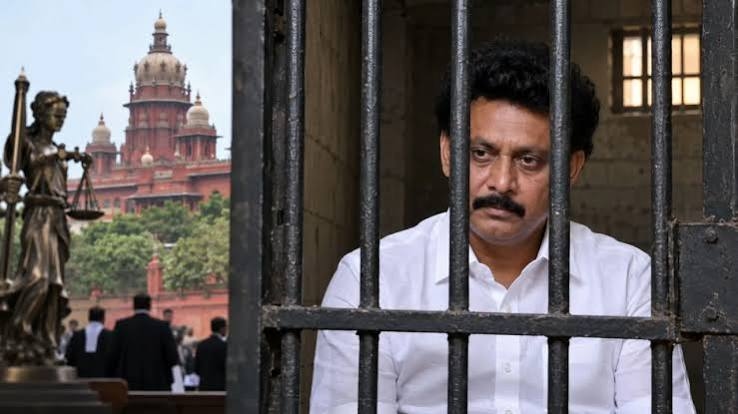


Chennai: Former Tamil Nadu School Education Minister and senior Dravida Munnetra Kazhagam (DMK) leader Anbil Mahesh Poyyamozhi was arrested on Monday, October 26, in connection with an alleged Rs 100-crore corruption and fraud case involving government approvals for private schools.
The arrest by the Greater Chennai Police’s Central Crime Branch (CCB) came hours after the Madras High Court dismissed his anticipatory bail petition. Investigators are probing allegations that money was collected from private school managements in the name of a “party fund”, with assurances that pending applications for permanent recognition, school upgrades and other statutory clearances would be approved.
Mahesh served as School Education Minister from 2021 to 2026 under the previous DMK government. He has challenged the case against him, and the allegations have yet to be established in court.
What are the allegations against Anbil Mahesh?
The case concerns alleged payments collected from private educational institutions on the promise of securing government approvals. According to the complaint, school managements were allegedly approached by office-bearers of an association who claimed they could help obtain recognition certificates, licences, no-objection certificates and renewals.
The alleged collection was presented as a party fund, according to the investigating agency. The CCB has alleged that the money was linked to assurances that pending applications for official approvals would be cleared.
The complaint was lodged by DC Ilangovan, secretary of the Federation of Associations of Private Schools in Tamil Nadu. The case initially focused on allegations that representatives of the Tamil Nadu Private Schools Association had collected money from school managements without fulfilling the promises made to them.
Mahesh was subsequently named as an accused after investigators sought to add provisions of the Prevention of Corruption Act to the case. The CCB has alleged that he was involved in the collection of money and that further investigation, including custodial questioning, was necessary.
How many schools are linked to the alleged scam?
Investigators have identified at least 177 private school managements in connection with the alleged scheme, according to reports of the police submissions before the Madras High Court.
The wider allegations concern money purportedly collected in exchange for securing a range of approvals, including permanent recognition, permission to upgrade schools, building-related clearances from the Directorate of Town and Country Planning (DTCP), and other statutory permissions.
The amount cited in the case is around Rs 100 crore. However, the sum allegedly collected and the precise number of affected institutions remain matters for the investigation to establish. Reports have carried differing figures regarding the number of schools potentially involved, so the allegations should not be treated as proof that every institution made a payment or that the entire amount has been traced.
The investigation is examining the role of the people who allegedly collected the money, the assurances made to school managements and the subsequent movement of funds.
Madras High Court rejects anticipatory bail
The arrest followed the dismissal of Mahesh’s anticipatory bail application by the Madras High Court on Monday.
Justice V Lakshminarayanan rejected the plea after hearing arguments from the former minister’s side and the prosecution. The investigating agency opposed pre-arrest protection, arguing that further questioning was necessary to establish the role of the accused and trace the alleged financial transactions.
Mahesh’s counsel had argued that he had cooperated with investigators, appeared for questioning and provided documents. The defence also disputed the claim that there was sufficient material to establish his involvement in the alleged collection of illegal gratification.
The prosecution, meanwhile, argued that the case required further investigation, including efforts to locate an accused who was reported to be absconding.
The High Court’s dismissal of the anticipatory bail petition removed the immediate legal protection Mahesh had sought against arrest. It was not a finding of guilt on the underlying allegations.
Other accused and earlier police searches
The case also involves B T Arasakumar, president of the Tamil Nadu Private Schools Association, and Muthukumar, an office-bearer of the Tamil Nadu Parent-Teacher Association who has been described in reports as an associate of Mahesh.
The CCB had earlier arrested Arasakumar and other accused in connection with the case. Police have also conducted searches at locations linked to Mahesh and his associates in Chennai, Tiruchy and other areas as part of the investigation.
Investigators are examining whether money collected from school managements was subsequently transferred to other individuals and whether the alleged payments were connected to decisions involving government approvals.
The case initially included allegations of cheating and criminal breach of trust. Provisions of the Prevention of Corruption Act were subsequently added, bringing the alleged conduct into the scope of a corruption investigation.
The authorities have not yet established the full chain of transactions or the final amount, if any, attributable to each accused.
Enforcement Directorate examines suspected money trail
The Enforcement Directorate (ED) has also initiated proceedings under the Prevention of Money Laundering Act (PMLA) to investigate the suspected financial trail linked to the alleged scam.
The ED’s role is to examine whether funds connected to the alleged collection were transferred, concealed or used in ways that would constitute money laundering under the law. Its investigation is separate from the CCB’s criminal probe, although the two agencies may examine overlapping evidence.
The financial investigation could focus on bank transactions, records of payments allegedly made by school managements and the movement of funds between individuals or organisations.
The registration of a PMLA case does not itself establish that money laundering took place. The agency must investigate the transactions and determine whether the statutory requirements for an offence are met.
What happens next?
Following his arrest, Mahesh is expected to face further questioning and legal proceedings as investigators pursue the case. The authorities will need to establish the circumstances in which the alleged payments were collected, who received the money and whether any government approvals were granted in return.
Mahesh has also approached the High Court seeking to quash the FIR against him. That separate legal challenge remains distinct from the anticipatory bail proceedings.
The case has drawn attention because it concerns the regulation of private schools and allegations that official recognition and statutory clearances were linked to payments outside the prescribed process. If proved, such conduct would raise serious questions about the integrity of school approval procedures.
For now, the allegations remain under investigation. The arrest and rejection of anticipatory bail mark significant developments in the case, but responsibility for the alleged corruption will ultimately depend on the evidence presented through the legal process.