




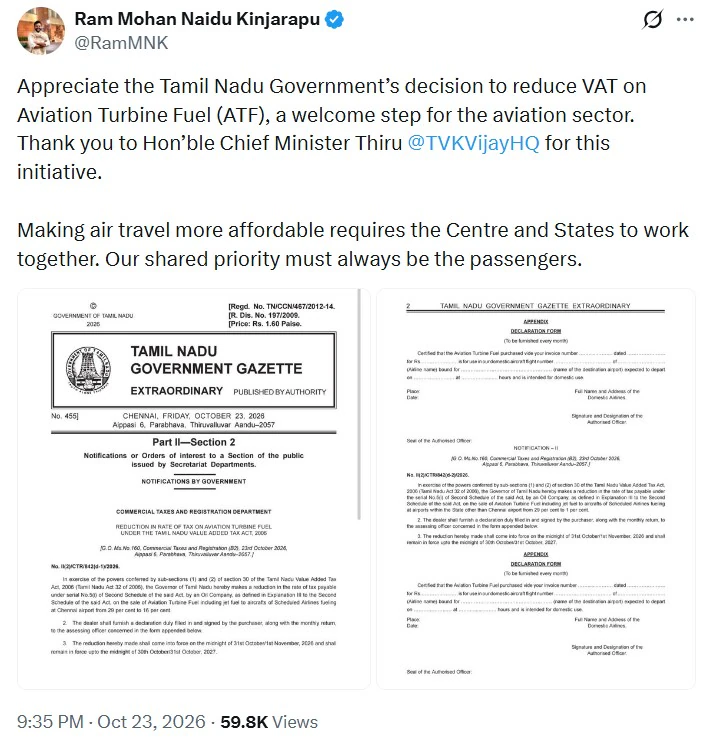
Chennai: Tamil Nadu Chief Minister Vijay has received praise from the Union government after his administration reduced value-added tax (VAT) on aviation turbine fuel (ATF), offering potential relief to airlines amid rising fuel costs. Union Civil Aviation Minister Ram Mohan Naidu welcomed the decision, highlighting the importance of cooperation between the Centre and state governments in making air travel more affordable.
Under the reported revision, Tamil Nadu has reduced ATF VAT in Chennai to 16% from 29%. At other airports across the state, the rate has been reduced to 1%. The move comes at a challenging time for the aviation industry, with airlines facing pressure from rising jet fuel prices, currency fluctuations and longer flight routes caused by airspace restrictions.
Naidu publicly acknowledged the state government’s decision in a post on social media, thanking Vijay for the initiative. His response marked a positive exchange between the Union government and the Tamil Nadu administration over a policy measure aimed at easing the operating costs faced by airlines.
“Appreciate the Tamil Nadu government’s decision to reduce VAT on Aviation Turbine Fuel (ATF), a welcome step for the aviation sector. Thank you, Chief Minister Vijay, for this initiative,” Naidu said.
The Union minister also stressed that cooperation between the Centre and states would be necessary to improve affordability for passengers.
“Making air travel more affordable requires the Centre and States to work together. Our shared priority must always be the passengers,” he said.
Why the ATF tax cut matters for airlines
Aviation turbine fuel is one of the largest operating expenses for airlines. Changes in fuel prices can significantly affect the cost of operating flights, particularly when carriers are already dealing with other financial pressures.
The Tamil Nadu government’s decision comes amid a period of volatility in global energy markets. According to the supplied report, jet fuel prices have been rising since the US-Iran war began in February, putting additional pressure on airlines operating internationally and within India.
Higher fuel expenses can affect airlines’ profitability and influence decisions on ticket pricing, route operations and capacity. When fuel prices rise sharply, carriers may find it difficult to absorb the additional costs without making changes elsewhere in their operations.
The reduction in ATF VAT could help lower the tax burden on fuel purchased at airports in Tamil Nadu. The extent of the benefit for individual airlines will depend on their fuel requirements, operating schedules and the applicable pricing arrangements.
The measure is particularly relevant for Chennai, one of the state’s major aviation hubs, where the VAT rate has been reduced from 29% to 16%. At other airports in Tamil Nadu, the reported reduction to 1% represents a substantially lower tax rate.
However, lower VAT does not automatically guarantee cheaper air tickets. Airlines consider several factors when setting fares, including fuel expenses, aircraft leasing, maintenance, airport charges, staffing and demand. The tax reduction could provide cost relief, but whether passengers see lower fares will depend on how airlines respond to the change and how other operating costs evolve.
Airlines face pressure from rising costs and airspace restrictions
The aviation sector is dealing with several challenges beyond the price of jet fuel. Indian carriers also face pressure from the weakening rupee, which can increase the cost of expenses denominated in foreign currencies.
Aircraft lease rentals and maintenance costs are commonly linked to the US dollar. When the rupee weakens against the dollar, airlines may need to spend more in domestic currency to meet the same foreign-currency obligations.
International operations have also been affected by airspace restrictions. The closure of Pakistani airspace has forced some flights travelling between India and Western destinations to take longer routes. Such diversions can increase flight times and fuel consumption, adding to operating expenses.
Longer routes can also affect aircraft utilisation and crew scheduling. When an aircraft spends more time completing a journey, it may have less time available for subsequent flights, potentially complicating airline schedules and increasing operational costs.
These pressures can be particularly difficult to manage when fuel prices are already elevated. Airlines must balance the additional expenses against passenger demand and competitive ticket pricing, while maintaining reliable operations.
Against this backdrop, Tamil Nadu’s ATF tax reduction offers a measure of relief at the state level. It does not address all the financial challenges facing airlines, but it could reduce one component of their operating costs at airports within the state.
Chennai receives a separate VAT rate
The revised tax structure distinguishes Chennai from other airports in Tamil Nadu. The reported VAT rate at Chennai has been reduced to 16% from 29%, while the rate at the state’s other airports has been cut to 1%.
The different rates mean that the potential impact will vary according to where airlines refuel. Carriers operating from Chennai could benefit from the lower tax compared with the previous rate, while airlines using other airports in the state would face the substantially lower reported rate of 1%.
Fuel taxation is an important consideration in aviation because airlines may evaluate refuelling costs when planning operations. The overall financial effect of a tax change depends on the amount of fuel purchased, the routes served and the applicable tax and pricing arrangements.
The decision also highlights the role state governments can play in influencing aviation costs through taxes under their jurisdiction. While international crude prices and currency movements are largely outside a state government’s direct control, changes to state-level fuel taxation can offer a way to ease some of the pressure on airlines.
The long-term impact of Tamil Nadu’s decision will depend on how fuel prices develop, how airlines adjust their operations and whether the revised rates remain in place.
Centre calls for cooperation to make air travel affordable
Naidu’s response placed the Tamil Nadu decision within a broader discussion about coordination between the Union government and state administrations. Aviation costs are shaped by several factors, and fuel taxation is one area in which state-level decisions can influence the operating environment.
The minister said that making air travel more affordable required both levels of government to work together, with passengers remaining the shared priority.
His statement welcomed Vijay’s initiative without suggesting that the tax reduction alone would resolve the industry’s wider cost pressures. Airlines continue to face exposure to fuel-price volatility, exchange-rate movements, aircraft-related expenses and operational disruptions.
For passengers, affordability depends on the combined effect of these costs and the pricing decisions taken by airlines. A reduction in fuel taxes may ease pressure on carriers, but the final impact on ticket prices is not automatic.
The exchange between Naidu and Vijay nevertheless signals support for measures intended to improve the operating environment for aviation. It also underlines how decisions made by state governments can have implications for a sector that connects businesses, tourists and families across India and overseas.
What the decision means for Tamil Nadu’s aviation sector
Tamil Nadu’s ATF VAT reduction comes at a time when airlines are navigating uncertainty in global energy markets and disruptions to international routes. By lowering the tax rate at Chennai and other airports in the state, the government has introduced a measure aimed at easing fuel-related expenses.
The immediate benefit will depend on how much fuel airlines purchase under the revised tax structure and how the savings compare with other rising costs. Any effect on ticket prices will likewise depend on airlines’ operating expenses, commercial strategies and market conditions.
The Centre’s public appreciation of the move highlights the importance of cooperation between state and Union governments in addressing aviation-sector challenges. For Vijay’s administration, the decision represents a state-level intervention intended to offer relief to airlines during a period of cost pressure.
While the reduction cannot eliminate the effects of rising crude prices, a weaker rupee or longer international routes, it could provide some financial breathing room for carriers operating in Tamil Nadu. The key question now is how the revised rates affect airline costs and whether any resulting savings translate into more affordable travel for passengers.