







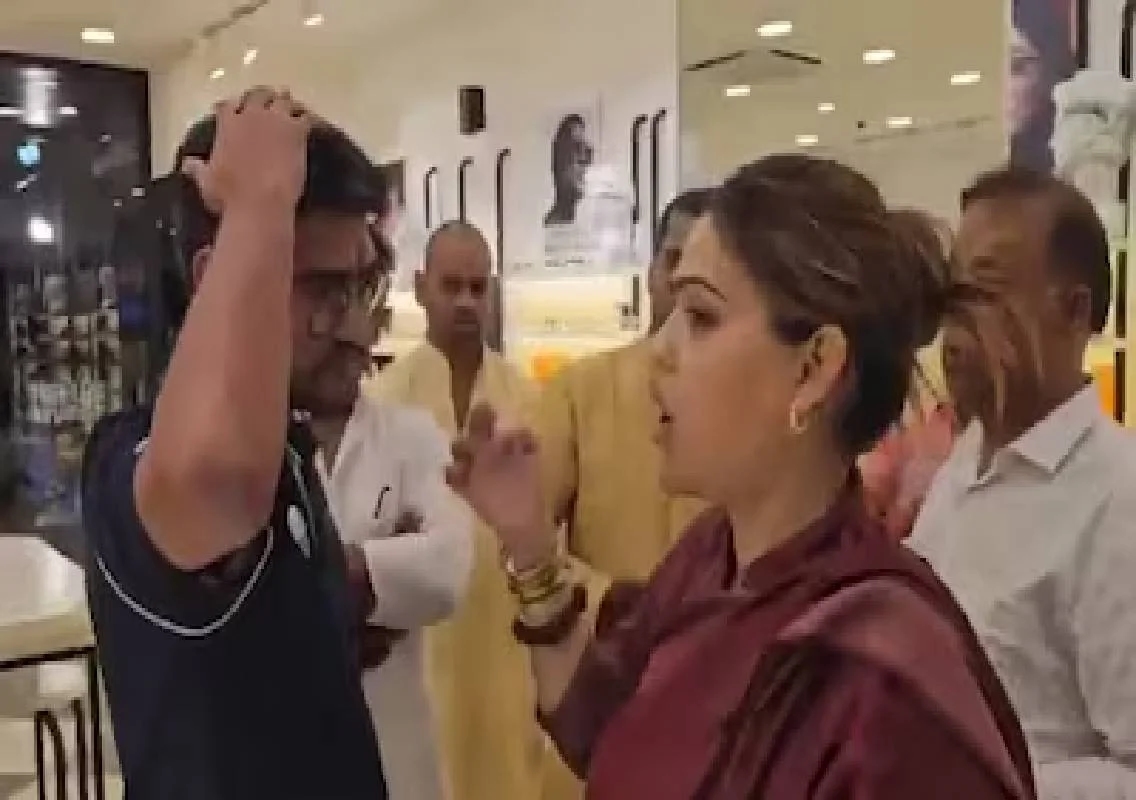


Mumbai: A controversy erupted after Nazia Elahi Khan entered a Lenskart outlet in Mumbai along with supporters, confronting staff over alleged restrictions on religious symbols and applying tilak on employees, as seen in a viral video.
The incident comes amid an ongoing debate around the company’s reported dress code policies and workplace guidelines on religious expression.
Viral video shows confrontation inside store
In the widely circulated clip, Nazia Elahi Khan is seen questioning the store’s floor manager, identified as Mohsin Khan, regarding alleged restrictions on wearing items such as bindi and tilak.
During the exchange, she accused the staff of enforcing discriminatory rules and asked people accompanying her to apply tilak on the manager’s forehead. The situation escalated further as she raised slogans and questioned whether hiring decisions were influenced by religion.
She was also seen applying tilak to other employees and tying sacred threads (kalawa), stating that individuals should not feel hesitant in expressing their religious identity.
However, the authenticity of the video has not been independently verified.
Claims of workplace restrictions
The controversy stems from allegations that Lenskart had imposed a dress code restricting certain Hindu symbols such as bindi, tilak, and mangalsutra, while permitting other forms of religious expression.
A showroom employee claimed that staff were instructed during training not to wear tilak or kalawa, and that even married women were discouraged from wearing mangalsutra.
These claims triggered criticism on social media, with users questioning the company’s policies and calling for clarity.
Company responds to backlash
Responding to the growing backlash, Lenskart CEO Peyush Bansal clarified that the document circulating online was outdated and did not reflect the company’s current guidelines.
The company subsequently released a revised in-store style guide, stating that employees are allowed to wear symbols of faith and identity at work.
Lenskart emphasised its commitment to inclusivity and said it aims to create a workplace environment that respects diverse cultural and religious expressions.
Political and social reactions
The incident has sparked debate across political and social circles, with opinions divided over the actions seen in the video as well as the alleged policies.
While some supported the demand for equal treatment of religious symbols, others criticised the manner of confrontation inside a workplace, raising concerns about employee safety and professional boundaries.
Conclusion
The Lenskart row highlights the sensitivities surrounding religious expression in workplaces and the importance of clear, inclusive policies. As the debate continues, the focus remains on balancing individual freedoms with organisational guidelines while ensuring a respectful environment for all employees.