







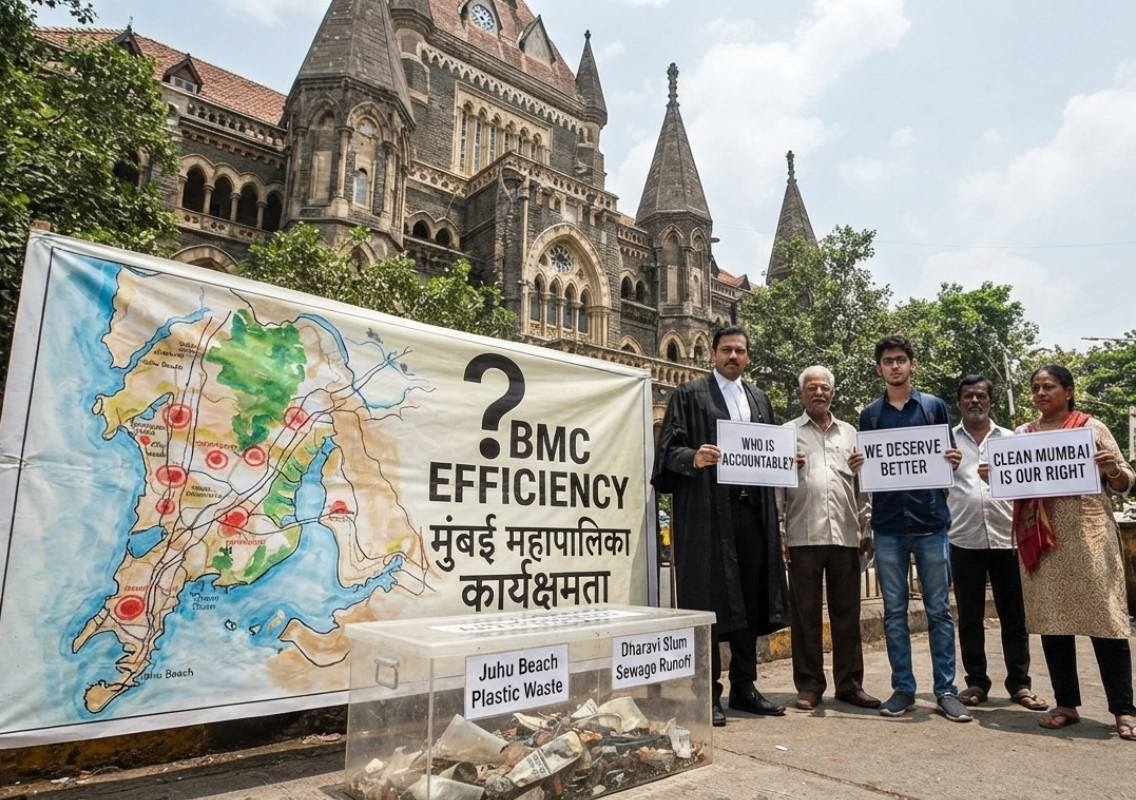


Mumbai: The Bombay High Court on Wednesday questioned the Brihanmumbai Municipal Corporation‘s (BMC) selective approach to maintaining cleanliness in the city, asking why roads and public spaces are thoroughly cleaned only when important visitors arrive, while ordinary residents continue to deal with garbage and poor civic conditions.
A bench of Justices Girish Kulkarni and Neela Gokhale criticised the civic body’s temporary clean-up measures, citing the example of Ballard Estate in south Mumbai. The area was cleaned and its roads washed with water ahead of the visit of Britain’s Prince William and Princess Catherine, who are on a three-day tour of India.
The judges asked why the same standards of cleanliness could not be maintained throughout the year for Mumbai’s residents.
“Look at Ballard Estate. How shining and polished it is. You have cleaned the streets with water because some important guests have come. Why should Mumbaikars not have such roads?” the bench asked.
Prince William and Princess Catherine began their India visit on Monday with an event at Ballard Estate, where they played gully cricket with cricket legend Sachin Tendulkar and local children. The event took place against the backdrop of colonial-era buildings, tree-lined streets and freshly cleaned roads.
Ahead of the royal visit, the BMC had also covered certain sections of the road with white cloth.
The High Court said it was unfortunate that a constitutional court had to address the problem of garbage accumulating on public roads. It questioned why the civic body could not maintain the same level of cleanliness for residents that it demonstrated during visits by prominent personalities.
High Court questions BMC’s temporary clean-up measures
The bench said the civic administration appeared capable of improving the appearance of public spaces when important guests visited Mumbai, but questioned why such efforts were not sustained.
“When important people visit the city, the BMC spruces the streets up. Why can’t this be done at all times for the people living in this city? Instead of indulging in such a two-day temporary show that our roads are neat and clean, the BMC can have a permanent show,” the judges remarked.
The court emphasised that cleanliness should not be limited to selected roads, neighbourhoods or locations visited by VIPs. It said the BMC should ensure that public spaces across all wards receive consistent attention.
The judges also observed that the Maharashtra government and the civic administration could bring about a significant improvement in Mumbai’s civic conditions if they demonstrated the willingness to act.
The remarks highlighted the difference between temporary beautification exercises and sustained civic management. The court indicated that residents should be able to expect clean roads and public spaces as a regular service rather than as a special arrangement made for high-profile visitors.
Kanjurmarg landfill pollution case before the court
The observations came while the High Court was hearing a petition concerning air pollution and the emission of toxic gases near the Kanjurmarg dumping ground in Mumbai’s eastern suburbs.
The bench linked the concerns surrounding landfill management to the larger problem of garbage being discarded on roads and beaches.
The judges had visited the Kanjurmarg landfill site on Tuesday. During the visit, they observed the extent of plastic waste at the dumping ground and raised concerns about the continued use of plastic despite the difficulties involved in its disposal and treatment.
The court questioned why authorities had not taken more decisive steps to reduce plastic consumption and prevent waste from accumulating at dumping sites.
“We are confronted with this kind of toxicity for years. Why are we still not giving up plastic?” the bench observed.
The judges pointed to heaps of garbage containing plastic at the landfill and stressed that the problem had persisted for years despite growing awareness of its environmental consequences.
The court’s concerns extended beyond the dumping ground, with the bench noting that plastic waste was also scattered across public roads and other parts of the city.
Court asks Maharashtra about a complete plastic ban
During the hearing, the bench asked the Maharashtra government whether it had a comprehensive policy to tackle plastic waste.
It also sought details of measures adopted by other states and Union Territories to impose a complete ban on plastic. The judges specifically asked whether plastic had been prohibited in tourist destinations such as Matheran and Mahabaleshwar in Maharashtra.
Questioning the BMC on whether it could take a stricter approach, the court said the civic body should not allow commercial interests to prevent stronger action against plastic pollution.
“Why, in so far as Mumbai is concerned, not take an aggressive step, not to succumb to any other commercial interests, but to ban in totality plastic? That would be the only way forward so that we save the planet, we save this city,” the bench said.
The remarks reflected the court’s concern that existing measures had not adequately addressed the generation and disposal of plastic waste.
A more comprehensive approach, the judges indicated, would require authorities to focus on preventing plastic waste from entering the environment rather than dealing with it only after it had accumulated.
The court’s questions also placed responsibility on the state government and civic administration to explain what policies were in place and whether stricter restrictions could be introduced.
Plastic waste on roads and beaches raises concern
The bench also drew attention to the large quantities of plastic bags found scattered across Mumbai’s roads.
It observed that the problem becomes particularly visible during the monsoon, when tonnes of accumulated plastic waste are washed back from the sea onto the shore.
“Look at the amount of plastic bags strewn on roads. Even during monsoon, tonnes of plastic are thrown back from the sea,” the judges said.
The court stressed that preventing non-degradable plastic waste from being generated in the first place was essential to addressing the problem.
Plastic discarded on roads, beaches and other public spaces can eventually enter drainage systems and water bodies. The court’s observations highlighted the need for stronger measures to reduce the use of such materials and improve waste management.
The judges also called for more aggressive public awareness campaigns to discourage littering and explain the environmental consequences of plastic pollution.
They indicated that enforcement measures alone would not be sufficient unless citizens were also made aware of the need to reduce plastic use and dispose of waste responsibly.
Court stresses year-round civic cleanliness
The High Court’s observations brought together two connected concerns: the BMC’s responsibility to maintain clean public spaces and the need for a more effective response to the city’s growing waste problem.
The judges questioned the practice of concentrating cleaning efforts around VIP visits, saying that ordinary residents should receive the same attention throughout the year.
The court also raised questions about whether the state and civic authorities were doing enough to reduce plastic consumption, manage landfill waste and prevent garbage from reaching roads and beaches.
The matter will be heard next on December 7.
Until then, the Maharashtra government and the BMC will face questions about their existing policies and the steps they can take to address plastic pollution and improve Mumbai’s civic conditions.
The court’s central message was that clean roads and public spaces should be a permanent feature of city life, not a temporary arrangement made for visiting dignitaries.