


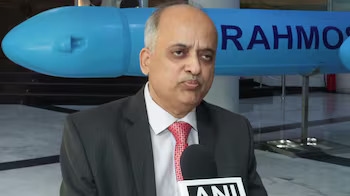


BrahMos: Aerospace CEO Dr Jaiteerth R Joshi has said international demand for the supersonic cruise missile has surged following its reported combat use during Operation Sindoor. In an exclusive interview with India Today, Joshi said the operation showcased the missile’s precision, radar-evasion capabilities and ability to be launched from multiple platforms, attracting greater attention from potential overseas customers.
The Philippines was the first foreign country to purchase the BrahMos missile, Joshi said, adding that Vietnam and Indonesia subsequently followed. The company is now working to meet growing interest in the weapon while developing a next-generation version and expanding its range.
“After Operation Sindoor, there is huge demand for BrahMos in the international market,” Joshi said.
Operation Sindoor puts BrahMos in the global spotlight
New Delhi: Operation Sindoor marked a significant moment for the BrahMos supersonic cruise missile, according to Joshi, who said its battlefield performance had attracted international attention. India deployed the missile during the operation against targets in Pakistan, including military installations and airbases, according to the account provided by Indian officials.
The Indian Air Force used BrahMos missiles launched from Sukhoi-30MKI fighter aircraft to strike targets inside Pakistan. The weapon is designed for high-speed flight and precision engagement, making it a key component of India’s conventional strike capabilities.
Joshi said the missile’s performance during the operation had demonstrated its accuracy and ability to evade enemy radar detection. He added that the results were being discussed internationally and had contributed to the increase in overseas interest.
“Its precision strikes are being discussed around the world. The missile evaded enemy radars and hit its target accurately. After Operation Sindoor, BrahMos has become the world’s most lethal missile,” he said.
The description of BrahMos as the world’s most lethal missile is Joshi’s assessment. Its combat use has nevertheless given the programme greater visibility as India seeks to expand its defence exports and strengthen domestic missile manufacturing.
Operation Sindoor was launched by India as a military response following the Pahalgam terror attack. The operation brought renewed attention to India’s long-range precision-strike systems and their role in modern military planning.
Philippines, Vietnam and Indonesia show overseas interest
The Philippines became the first international customer for the BrahMos missile, establishing an important milestone in India’s efforts to export advanced defence equipment. Vietnam and Indonesia have also emerged as overseas customers, Joshi said.
The growing customer base reflects India’s broader ambition to become a significant supplier of military technology. Defence exports have become an important part of the country’s strategy to expand domestic manufacturing, develop technological expertise and build defence partnerships with other nations.
BrahMos is jointly developed by India’s Defence Research and Development Organisation (DRDO) and Russia’s NPO Mashinostroyenia through BrahMos Aerospace. The missile programme combines technology and expertise from both countries, while India has progressively expanded its manufacturing and integration capabilities.
Joshi’s comments suggest that the missile’s use during Operation Sindoor has strengthened its visibility in the international defence market. Potential buyers are likely to assess several factors before placing orders, including operational requirements, cost, delivery schedules, training, maintenance and the terms of government-to-government agreements.
However, the CEO did not provide figures for the additional demand or identify the number of new orders received following the operation. The scale of the reported surge in interest therefore remains unquantified.
BrahMos deployed across all three armed services
Joshi also said that all three branches of the Indian armed forces were equipped with BrahMos missiles during Operation Sindoor for the first time.
The missile has been developed for use across different platforms. The Navy received an early version, followed by a land-based system for the Army and an air-launched variant designed for the Indian Air Force’s Sukhoi-30MKI fighter aircraft.
“During Operation Sindoor, all three services were equipped with the BrahMos missile. Thanks to its network-centric capabilities, all three services can use it. It can be launched from land, warships and fighter aircraft,” Joshi said.
The ability to deploy the missile from land-based launchers, naval platforms and fighter jets provides the armed forces with different options for carrying out precision strikes. It also allows the services to incorporate the system into their respective operational plans.
Network-centric capabilities are intended to support the sharing of information and coordination between military units. According to Joshi, these capabilities help the three services use the missile within a broader operational framework.
The deployment across all three services also underlines the importance of BrahMos in India’s conventional deterrence strategy. Its presence on multiple platforms gives the armed forces flexibility in selecting launch locations and responding to different operational requirements.
Next-generation BrahMos to offer enhanced capabilities
BrahMos Aerospace is working on a next-generation version of the missile, with plans to increase its range and make the system more indigenous, Joshi said.
The company is progressing with the deployment of the upgraded missile on the Sukhoi-30MKI fighter aircraft. The air-launched variant allows the Indian Air Force to use the aircraft’s mobility to carry the missile towards launch areas before engaging designated targets.
“We are now deploying the next-generation version of BrahMos on the Sukhoi. Work is progressing rapidly. We are also increasing the missile’s range,” Joshi said.
An extended-range missile could provide the armed forces with greater operational reach, depending on the final configuration and the requirements of the service using it. Further development is also expected to focus on increasing India’s role in manufacturing the missile and its components.
Indigenisation remains a major objective for India’s defence sector, as domestic production can help strengthen supply chains and reduce reliance on imported components. However, the transition towards a fully indigenous system involves technical development, testing and the gradual expansion of local manufacturing capabilities.
The next-generation programme is therefore significant both for the missile’s future operational role and for India’s broader defence manufacturing ambitions.
Production facilities and MSME network support expansion
BrahMos Aerospace currently operates three production facilities in Pilani, Nagpur and Lucknow, Joshi said. The company is supported by a network of more than 300 micro, small and medium enterprises (MSMEs).
According to the CEO, the existing manufacturing infrastructure can meet the requirements of the Indian Army, Navy and Air Force. The production network will be important as the company works to fulfil domestic requirements while responding to growing overseas interest.
The involvement of MSMEs also creates opportunities for Indian suppliers to participate in the defence manufacturing ecosystem. Such partnerships can support the production of components, expand industrial capabilities and contribute to the development of specialised engineering skills.
In October 2025, Defence Minister Rajnath Singh flagged off the first batch of BrahMos missiles manufactured at the Lucknow facility. The facility marked an important step in expanding domestic production capacity and strengthening India’s defence manufacturing base.
At the time, Singh made strong remarks about the missile’s reach and described Operation Sindoor as “just a trailer”. His comments reflected the government’s emphasis on the missile programme as part of India’s military preparedness.
Talks underway on possible supply to Russia
Joshi also said India was ready to supply BrahMos missiles to the Russian armed forces under an intergovernmental agreement between the two countries. Discussions on the proposal were underway, he added.
Any such supply would depend on the progress of talks and the applicable government approvals and arrangements. Joshi did not disclose a timeline, order size or delivery schedule.
Russia has been a longstanding defence and technology partner of India, and the BrahMos programme itself is a product of bilateral cooperation. The possibility of supplying the missile to Russian forces would represent another dimension of that relationship, although no final agreement or confirmed order details were provided in the interview.
BrahMos export prospects gain momentum
BrahMos Aerospace is seeking to expand its international presence while continuing to upgrade the missile and strengthen domestic production. Joshi’s remarks indicate that the missile’s reported use during Operation Sindoor has increased overseas interest, building on earlier export deals with countries such as the Philippines, Vietnam and Indonesia.
The company faces the task of balancing the requirements of India’s armed forces with potential export demand. Continued development of the next-generation version, greater indigenous manufacturing and the expansion of production capacity are expected to remain central to that effort.
While the CEO described a substantial increase in international demand, the number of prospective deals and their financial value have not been disclosed. The extent to which the reported interest translates into new contracts will become clearer as discussions progress.
For India, the BrahMos programme remains an important example of defence cooperation, domestic manufacturing and export ambitions coming together. Its future will depend on technological development, production capacity and the outcome of negotiations with potential overseas customers.