





New Delhi: The Centre has asked Meta to review how Facebook and Instagram recommend content, warning that algorithms should not amplify misleading posts, manipulated visuals or one-sided accounts of events, particularly during politically sensitive situations. In an advisory dated October 10, the Ministry of Electronics and Information Technology (MeitY) called for stronger checks on recommended content and faster action against material that could create public confusion, disturb public order or encourage violence.
The directive comes amid heightened political activity, including protests in Delhi by the Cockroach Janta Party (CJP) and opposition parties demanding the resignation of Chief Election Commissioner Gyanesh Kumar over the Special Intensive Revision (SIR) of electoral rolls. However, the advisory does not identify any particular incident as the reason for the government’s instructions.
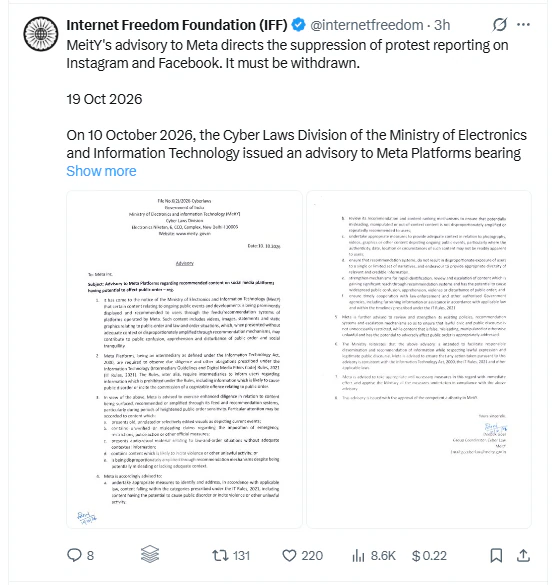
MeitY has asked Meta to examine how its recommendation systems determine which posts, photographs, videos and other material receive greater visibility. The ministry has also stressed that users should not be repeatedly exposed to a narrow range of narratives when following important political developments or public-order situations.
The advisory addresses the role social media platforms play in shaping the information users encounter, especially when events are unfolding rapidly and unverified claims can circulate widely.
Centre raises concerns over misleading social media content
One of the key concerns highlighted in the advisory is the potential for recommendation algorithms to give excessive visibility to misleading or manipulated material. Content that attracts significant engagement may reach a much larger audience, even when its accuracy or context has not been established.
During politically sensitive developments, old videos can resurface and be presented as footage of current events. If the original date, location or circumstances are not clear, viewers may mistake unrelated images for evidence of something happening in the present.
Similarly, unverified claims about emergency measures, restrictions or police action can spread rapidly before users have an opportunity to check their accuracy. Such posts may create confusion, particularly when people rely on social media for updates during demonstrations or other public events.
The ministry wants Meta to pay closer attention to how its ranking systems handle such content. The advisory calls for stronger scrutiny of material that could mislead users and for steps to prevent manipulated, outdated or unrelated visuals from repeatedly appearing in recommendations.
The government has also called for suitable context to accompany photographs, videos and graphics depicting ongoing events when their origin or circumstances may be unclear. The objective is to help users distinguish between current, verified information and material that could give a misleading impression of events.
Meta asked to review its recommendation systems
Facebook and Instagram use recommendation systems to determine which posts, videos and other content users may see beyond material shared directly by accounts they follow.
These systems can influence how widely information circulates on a platform. A post that is recommended to users who do not follow its original publisher can reach a much larger audience than one viewed only by the publisher’s existing followers.
MeitY has asked Meta to examine how these systems identify and distribute content that attracts substantial attention. The company is expected to strengthen its checks on material that could cause widespread confusion or contribute to unrest.
The advisory also raises concerns about the diversity of information presented to users. The ministry wants recommendation systems to provide access to relevant and credible information rather than disproportionately exposing people to a limited set of viewpoints.
This concern is particularly significant during political developments, when users may encounter competing claims, edited clips and commentary presented without sufficient context. Repeated exposure to similar narratives can limit the range of information people encounter while trying to understand an event.
The government’s request places greater emphasis on the responsibility of platforms to assess not only individual posts but also the way recommendation mechanisms influence the distribution of information.
Faster action sought on content affecting public order
The October 10 advisory calls for quicker scrutiny of material that could create public confusion, disturb law and order or encourage violence.
The government wants Meta to improve the processes through which potentially harmful posts are identified and reviewed, especially when such content receives significant visibility through recommendations.
This does not mean that every controversial political post should automatically be treated as unlawful. The advisory also stresses that measures against harmful material should not unnecessarily restrict legitimate public discussion.
That distinction is important because social media platforms host a wide range of content, including political criticism, public-interest reporting, commentary and debate. A system designed to address misinformation and unlawful material must also account for lawful expression.
MeitY has therefore asked Meta to review its policies and internal procedures to address misleading or unlawful content while allowing legitimate civic debate to continue.
The challenge for the platform will be to respond promptly to content that presents genuine risks without treating disagreement, criticism or differing political viewpoints as inherently harmful.
Government refers to IT laws and intermediary rules
The advisory refers to Meta’s obligations under the Information Technology Act, 2000, and the Information Technology (Intermediary Guidelines and Digital Media Ethics Code) Rules, 2021.
These legal provisions form part of India’s regulatory framework governing online intermediaries and their responsibilities in relation to content hosted on their services.
The ministry has directed Meta to take the necessary steps with immediate effect and inform the government about the measures it has implemented.
The request for a report on the steps taken means the government is seeking information about how the company intends to respond to the concerns raised in the advisory. The effectiveness of the response will depend on the measures Meta adopts and how they operate in practice.
The advisory also calls for cooperation with authorised government agencies and law enforcement in accordance with applicable laws. This requirement sits alongside the broader demand for more effective content review and recommendation practices.
The document, as described, does not specify a single technical change that Meta must make to its algorithms. Instead, it calls for a review of recommendation practices, stronger scrutiny of potentially misleading content and timely action where public-order concerns arise.
CJP protests and political developments form the wider context
The advisory comes amid protests in Delhi involving the Cockroach Janta Party and opposition parties seeking the resignation of Chief Election Commissioner Gyanesh Kumar over the Special Intensive Revision of electoral rolls.
The political backdrop has brought attention to how information about demonstrations, electoral processes and public responses circulates online. Videos, photographs and claims shared during such developments can influence public understanding, particularly when material is circulated without clear information about when or where it was recorded.
However, the advisory does not explicitly connect its instructions to the CJP protests or state that a particular post from the demonstrations prompted the action. The timing provides context, but it does not establish that the protests were the direct cause of the directive.
The government’s broader concern, as outlined in the advisory, is how recommendation systems can increase the reach of material that may be misleading or lack sufficient context during sensitive situations.
Balancing content moderation with freedom of discussion
The directive highlights a continuing challenge for social media companies: reducing the spread of misleading information while protecting lawful speech.
Recommendation algorithms influence which stories, videos and opinions receive attention. Changes to these systems can affect the visibility of public-interest information as well as potentially harmful content.
For that reason, the distinction between misinformation, manipulated material, unlawful content and legitimate political disagreement remains important. Effective moderation requires clear processes for evaluating context and accuracy, particularly when events are unfolding and information is still emerging.
MeitY’s advisory seeks stronger safeguards without unnecessarily curbing lawful public discussion. How Meta implements the requested changes will be important in determining how the company balances those objectives.
The Centre has asked the company to act immediately and report the steps taken. The next stage will be to establish what changes Meta makes to its recommendation and review systems and how those measures address the concerns raised by the ministry.
Ultimately, the advisory places renewed focus on the influence of social media algorithms over public access to information. It also underscores the need for platforms to provide appropriate context, respond promptly to potentially harmful material and preserve space for legitimate civic debate.