


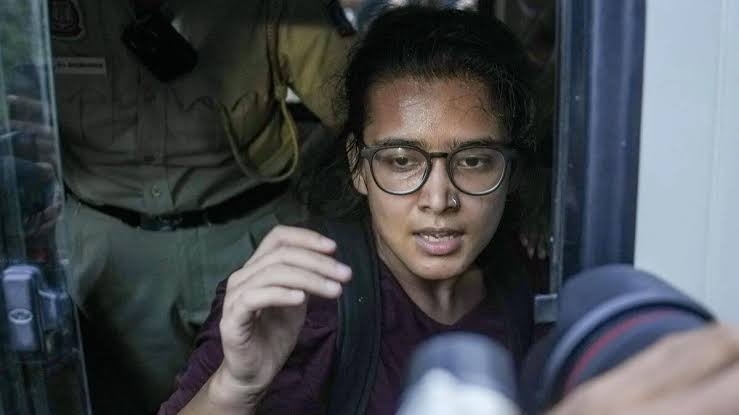


New Delhi: The Delhi High Court has rejected a petition filed by All India Students’ Association (AISA) president Neha Bora challenging a police notice directing her to execute a bond for maintaining peace before a Special Executive Magistrate. Bora had argued that the notice was vague, factually incorrect and unsupported by material establishing a likelihood of breach of peace.
In her petition, Bora alleged that the preventive proceedings were being used to suppress peaceful dissent and violated her fundamental rights under Articles 19(1)(a), 19(1)(b) and 21 of the Constitution. These provisions protect freedom of speech and expression, the right to assemble peacefully and the right to life and personal liberty.
The case arose from police action linked to demonstrations in Delhi on October 16, including a proposed ‘Lehra Do Tiranga’ march organised by the Cockroach Janata Party (CJP) at Central Park in Connaught Place. Bora was taken into preventive detention on October 16 while on her way to participate in the march and was released the following day.
Police notice directed Bora to execute a peace bond
The police issued the notice on October 17 under Section 126 of the Bharatiya Nagarik Suraksha Sanhita (BNSS). It directed Bora to appear before a Special Executive Magistrate on October 19 and explain why she should not be required to execute a personal bond of Rs 10,000, with one surety, for maintaining peace during the period of enquiry.
Preventive proceedings of this nature are intended to address situations in which authorities believe there may be a risk of a breach of peace. The notice challenged by Bora sought to require her to provide a bond as part of such proceedings.
Bora questioned the basis on which the police initiated the action. Her petition maintained that the notice did not adequately establish the likelihood of a breach of peace and relied on allegations that she disputed.
She also argued that the notice contained a factually incorrect assertion about her role in the proposed demonstration at Central Park. According to her petition, the gathering she had called for and the demonstration referred to in the police notice were different events.
The High Court’s rejection of the plea means Bora did not obtain the relief she sought against the notice through this petition. The specific reasoning behind the court’s decision is not detailed in the supplied report.
Bora challenges allegations linked to Delhi protests
According to Bora’s petition, the police proceedings were initiated on the basis of several allegations relating to protests and public gatherings in the capital.
These included alleged sloganeering at Mandi House on October 16, repeated protests around Jantar Mantar despite prohibitory orders imposed under Section 163 of the BNSS, and claims that she had instigated people to join a demonstration at Connaught Place on the same day.
Bora disputed the police account, particularly the allegation that she had instigated people to participate in the gathering at Central Park.
“The impugned notice rests on a prima facie incorrect fact, namely that the petitioner instigated people to participate in the demonstration at Central Park, CP on Oct 16,” her petition stated.
She further argued that her call for a gathering and the incident described in the notice were separate. According to the petition, she had called for a peaceful gathering at Mandi House at 5 pm on October 16.
“It is a matter of record that she was detained from Mandi House,” the petition said.
These statements represent Bora’s position as set out in her legal challenge. The allegations cited by the police and the objections raised by the AISA president formed part of the dispute over the preventive proceedings.
Counsel questions police objection over national flag
During Thursday’s hearing, Bora’s counsel also questioned the police notice’s allegation that she had hoisted the national flag without valid permission.
The lawyer argued that citizens do not require permission merely to hoist the national flag. The submission challenged the basis for treating the alleged act as part of the grounds for initiating preventive proceedings against Bora.
The issue formed part of the broader challenge to the notice, which Bora described as vague and unsupported by sufficient material. Her legal team argued that the authorities had relied on an incorrect account of the events and had not demonstrated why the proposed peace bond was necessary.
The court rejected the petition, but the supplied account does not provide the full text of the order or the court’s detailed assessment of the arguments concerning the national flag, the alleged protests and the legal requirements for preventive action.
AISA president alleges misuse of preventive powers
Bora’s petition characterised the police proceedings as a “colourable exercise of preventive powers to suppress peaceful dissent”. She alleged that the action infringed her constitutional protections under Articles 19(1)(a), 19(1)(b) and 21.
Article 19(1)(a) guarantees freedom of speech and expression, while Article 19(1)(b) protects the right to assemble peaceably and without arms. Article 21 safeguards life and personal liberty, subject to the procedure established by law.
The petition’s arguments placed the dispute within the wider question of how preventive powers are exercised when protests and public gatherings are involved. Such proceedings concern the authorities’ stated objective of preventing a possible breach of peace, while challenges to them may question whether the action is supported by adequate grounds and complies with legal safeguards.
In Bora’s case, the challenge centred on the police notice issued after her detention on October 16 and the allegations relating to demonstrations in Delhi. She maintained that the police had wrongly linked her call for a peaceful gathering at Mandi House to the proposed event at Central Park.
The High Court’s decision to reject her petition marks the outcome of this particular legal challenge. However, the details provided in the report do not establish whether the court separately addressed every factual allegation or constitutional argument raised by Bora.
What happened during the October 16 demonstration?
Bora was detained preventively on October 16 while travelling to participate in the CJP’s ‘Lehra Do Tiranga’ march at Central Park in Connaught Place. She was released on October 17, the same date on which the police issued the notice requiring her to appear before the Special Executive Magistrate.
The notice asked her to explain why she should not execute a personal bond of Rs 10,000 with one surety for maintaining peace during the period of enquiry. It cited Section 126 of the BNSS as its legal basis.
Bora challenged the notice on the grounds that the allegations were inaccurate and did not establish a sufficient basis for preventive action. Her counsel also questioned the allegation concerning the national flag and argued that the proceedings infringed constitutional freedoms.
With the Delhi High Court rejecting her plea, Bora’s challenge to the police notice has been unsuccessful at this stage. The case highlights the legal dispute over preventive proceedings connected to public demonstrations, but the precise implications of the ruling depend on the court’s full order and the status of any further legal steps.