







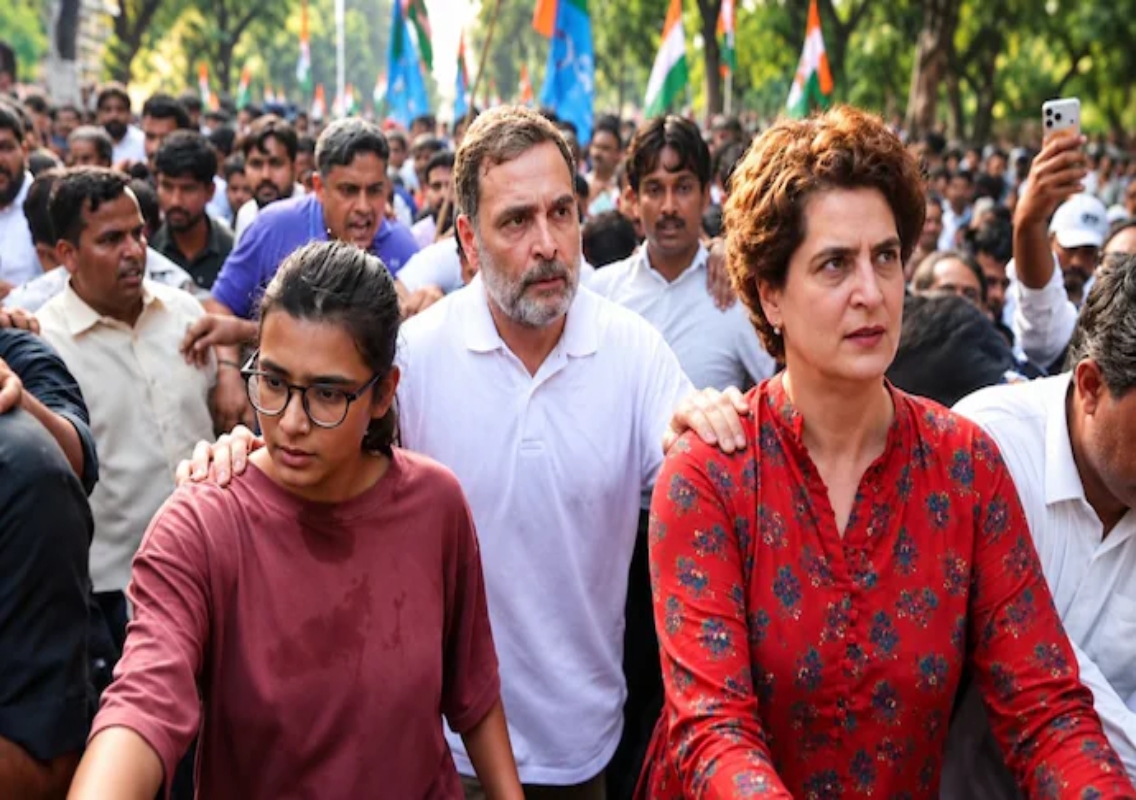


New Delhi: Congress leader Rahul Gandhi and AISA president Neha Bora’s appearance together during the INDIA bloc’s march towards the Supreme Court on October 12 has drawn attention to the relationship between the Congress and the Cockroach Janta Party (CJP), two groups involved in protests against Chief Election Commissioner Gyanesh Kumar.
Bora, a prominent face of the student-led protest movement, marched alongside Rahul Gandhi and Congress leader Priyanka Gandhi Vadra as opposition leaders sought action over alleged irregularities in the revision of electoral rolls. Her presence has prompted questions about whether the Congress is seeking closer engagement with activists associated with the CJP-led agitation.
However, there is no clear evidence that Bora’s participation was part of a specific strategy to weaken the CJP or absorb its movement into the Congress-led opposition campaign.
Neha Bora’s presence at the march draws attention
Bora, the president of the All India Students’ Association (AISA), has emerged as a recognisable figure in protests linked to the CJP. Her participation in the October 12 march placed her alongside senior Congress leaders during a major opposition mobilisation in the national capital.
The visual prominence of Bora, Rahul Gandhi and Priyanka Gandhi Vadra became a talking point because the CJP and the Congress have pursued separate protest programmes despite raising overlapping concerns about the Election Commission.
Bora’s association with Congress leaders is not new. She previously appeared alongside Rahul Gandhi at a press conference on July 25, when the Congress leader raised allegations of police excesses during a July 20 protest march to Parliament.
Her participation in earlier demonstrations, including hunger-strike actions and events involving student activists, has also increased her visibility within the broader opposition protest space.
Bora has maintained connections with activists associated with the CJP, including its leaders Abhijeet Dipke, Saurav Das and Ashutosh Ranka. She also participated in a joint press conference with Das and Ranka before the CJP’s planned October 10 mobilisation.
These overlapping associations have led to speculation that she could serve as a point of contact between the Congress and the CJP. Such a possibility, however, does not establish that the two groups have entered into a formal alliance or agreed to coordinate their political activities.
Why the Congress and CJP protests matter
The Congress-led march and the CJP agitation have developed around concerns over the Election Commission and Chief Election Commissioner Gyanesh Kumar. Both have questioned aspects of the electoral process, including the Special Intensive Revision (SIR) of voter rolls.
The CJP has built its public profile through street demonstrations, youth participation and an active social media presence. Its protests have attracted student organisations and activists, giving the movement a platform separate from established political parties.
The Congress, meanwhile, has a nationwide organisational network and has sought to bring opposition parties together around electoral concerns. The October 12 march provided an opportunity for Rahul Gandhi and other INDIA bloc leaders to publicly present their objections and pursue legal remedies.
Despite the overlap in their demands, the two protest streams have not operated as a single, formally unified platform. Their supporters have also exchanged criticism on social media, reflecting differences over leadership, strategy and the direction of the wider opposition campaign.
The CJP leadership’s detention during the October 10 protest and the disruption of its planned mobilisation added another dimension to the situation. The movement’s next steps remained linked to its efforts to organise further demonstrations, while the Congress-led march gave opposition leaders another platform to press their demands.
Congress-CJP coordination remains uncertain
Bora’s presence alongside Rahul Gandhi has fuelled discussion about whether the Congress could build closer links with the student activists involved in the CJP protests.
One possible interpretation is that the Congress could benefit from the participation of activists who have established visibility among younger demonstrators. A broader coalition could bring together established political organisations, student groups and independent campaigners around common concerns.
Another consideration is that the CJP has developed its own identity and support base. Any closer coordination would therefore involve questions about the movement’s independence, its leadership and the extent to which it would work with established political parties.
Political observers have discussed the possibility of communication between the two camps, with Bora viewed as a potential link because of her relationships with activists and Congress leaders. But a potential channel for communication should not be confused with a confirmed agreement or a coordinated political plan.
The Aam Aadmi Party (AAP) has also been associated with support for the CJP leadership, adding another layer to the relationships among opposition groups. The Congress and AAP have their own political differences, and their approaches to the ongoing protests have not been identical.
Supreme Court march focused on electoral concerns
The October 12 march was organised as part of the opposition’s campaign over alleged electoral irregularities and demands concerning the Election Commission.
Rahul Gandhi and other opposition leaders had sought a meeting with Chief Justice of India Surya Kant to submit a memorandum. The meeting did not take place, after which the leaders proceeded with a march towards the Supreme Court.
Police barricades stopped the procession before it reached the court. Separately, opposition leaders pursued the issue through a petition filed in the Supreme Court, seeking judicial intervention over their allegations and demands.
The allegations raised by opposition parties remain distinct from any final judicial determination. The petition and the underlying issues are matters for the relevant legal process.
Rahul Gandhi described the protests as part of a wider struggle rather than separate campaigns. His message emphasised common ground among groups questioning the Election Commission, although the political relationships between the Congress and the CJP remain unsettled.
A possible bridge, but no confirmed alliance
Bora’s participation in the march highlights the connections that can develop between student-led movements and established political parties. Her role in earlier protests and her appearance alongside Congress leaders have made her a significant figure in discussions about possible coordination.
Whether these links result in sustained cooperation remains unclear. The CJP continues to have its own leadership and protest identity, while the Congress is pursuing its campaign through opposition mobilisation and legal action.
For now, the October 12 march demonstrates a degree of visible overlap between activists and opposition leaders, but it does not establish that the Congress has taken control of the CJP movement or that the two sides have formed a formal alliance. Their future relationship will depend on subsequent decisions, public statements and any concrete steps towards coordinated action.