







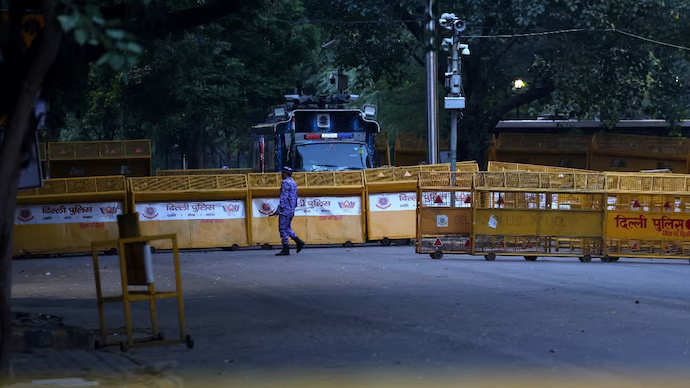


New Delhi: Delhi Police has removed Jantar Mantar from its list of designated venues for protests and demonstrations, naming three alternative locations across the capital. The decision was announced on Monday, October 12, through a standing order issued by Delhi Police Commissioner Anurag Kumar.
The newly designated venues are Ramlila Ground in Central Delhi, Burari Ground in North Delhi and CBD Ground in East Delhi. The order partially modifies an earlier standing order issued on April 28, 2022, which had designated Jantar Mantar as a site for demonstrations.
The change comes amid tensions over permission for protests in the capital, including a dispute involving the Cockroach Janta Party (CJP) and heightened security surrounding demonstrations against Chief Election Commissioner Gyanesh Kumar. However, the police order cites recommendations from a committee constituted by the Union Ministry of Home Affairs to examine alternative venues and does not explicitly link the decision to the ongoing dispute with CJP.
Three new venues designated for protests
According to the standing order, Ramlila Ground, Burari Ground and CBD Ground in East Delhi will replace Jantar Mantar as the designated venues for organising protests and demonstrations.
The three locations are spread across different parts of the national capital, rather than being concentrated around the central area where Jantar Mantar is situated.
The police order states that the Ministry of Home Affairs had constituted a committee to examine suitable alternative locations where citizens could exercise their right to organise demonstrations.
Based on the committee’s recommendations, Jantar Mantar has been de-notified as a designated protest venue. Delhi Police has said that detailed and revised standard operating procedures (SOPs) governing demonstrations at the three new locations will be issued separately.
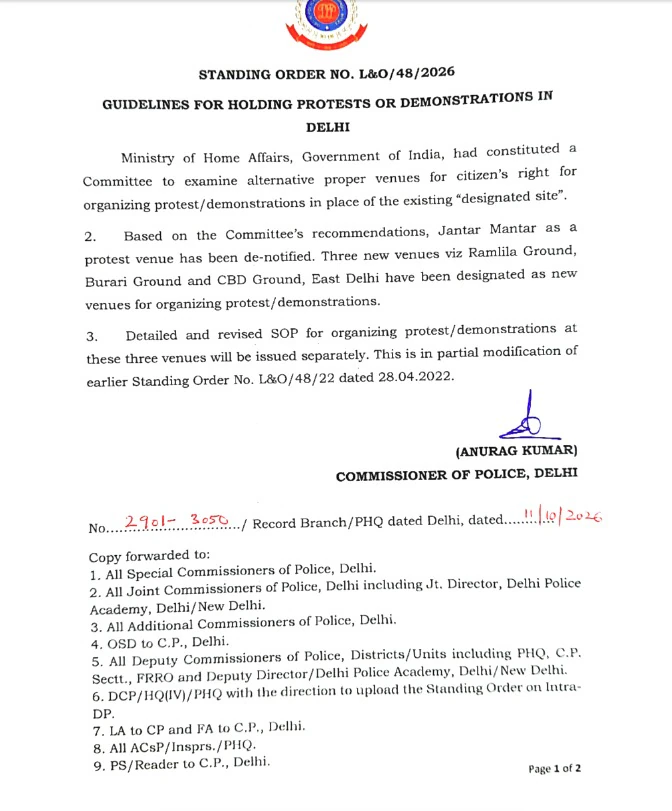
The revised procedures are expected to provide further details about how protests can be organised at the designated grounds, including the applicable arrangements and requirements.
Jantar Mantar has served as a prominent venue for public demonstrations in Delhi for years, hosting protests involving political parties, civil society groups and campaigners. Its removal from the list of designated sites marks a change in the arrangements governing organised demonstrations in the capital.
CJP seeks a date for peaceful protest
The decision comes amid a standoff between Delhi Police and the Cockroach Janta Party over permission to hold a peaceful demonstration at Jantar Mantar.
CJP leaders walked out of Parliament Street police station on Monday, reiterating their demand for a date for the proposed protest and seeking an explanation for the denial of permission.
The party’s chief spokesperson, Saurav Das, said CJP had formally informed the police of its intention to organise a peaceful demonstration and that the police had accepted the intimation. However, he said the party had not been given a date for the protest or an explanation for the restrictions.
“We have given them 24 hours to give us a date,” Das said, warning that the party would announce a march if the police did not respond within the deadline.
Das also accused police personnel of using excessive force during the recent crackdown on demonstrators. He alleged that protesters had been beaten inside buses and claimed that senior police officers had avoided speaking to the CJP delegation.
“The Government of India is waging a war on its own citizens,” Das said, adding that the party intended to continue its protests peacefully.
These allegations were made by the party and were not independently established in the material available at the time of reporting.
Decision comes amid heightened security in Delhi
The change in designated protest venues comes as security arrangements have been tightened in Delhi amid demonstrations linked to the revision of electoral rolls and demands for action against Chief Election Commissioner Gyanesh Kumar.
Opposition parties and groups, including CJP, have raised allegations of irregularities in the Special Intensive Revision (SIR) process. They have questioned the removal of names from electoral rolls and demanded accountability from the Election Commission.
The Election Commission has disputed allegations of political bias and said voters whose names have been removed can seek re-enrolment.
On Monday, opposition leaders and demonstrators also took part in a march towards the Supreme Court, with security measures affecting traffic and some metro services in central Delhi. The march was organised to raise concerns over the electoral-roll revision and the role of the Chief Election Commissioner.
The decision to remove Jantar Mantar from the list of designated protest venues therefore comes during a period of heightened political activity and disputes over access to public spaces for demonstrations.
However, the standing order itself cites the Home Ministry committee’s recommendations as the basis for the change rather than identifying the recent protests as the reason.
Delhi High Court to hear plea over Jantar Mantar closure
The Delhi High Court is scheduled to hear a petition on Tuesday, October 13, challenging the closure of Jantar Mantar as a venue for peaceful protests.
Counsel for the petitioner had argued that no alternative location had been earmarked for demonstrations. The police order issued on October 11 has since designated three new venues, although the revised SOPs governing protests at those sites are yet to be issued.
The High Court has also listed a separate petition concerning protests held in Delhi on October 10 and 11 for Tuesday. It declined to grant an urgent hearing, noting that the Supreme Court was already considering the matter and had sought affidavits from the Union government.
The hearing could bring further attention to the arrangements for demonstrations in the capital and the conditions under which protest organisers can seek permission to assemble.
What the change means for protest organisers
With Jantar Mantar no longer a designated protest site, organisers seeking to hold demonstrations will have to consider the three newly notified venues under the revised arrangements.
The practical implications will depend on the SOPs that Delhi Police issues for Ramlila Ground, Burari Ground and CBD Ground. Those procedures are likely to be important in determining how organisers apply for permission and what requirements they must meet.
The locations also differ in their distance from central Delhi, where many government offices and political institutions are situated. The shift could therefore affect the logistics of demonstrations and the ability of participants to reach the designated venues, although the actual impact will depend on transport access, permissions and the arrangements made for each protest.
For CJP, the immediate issue remains its demand for a date to hold a peaceful demonstration and an explanation for the restrictions it says it has faced. The party has warned that it could announce a march if police do not respond within the deadline it set.
A change in Delhi’s protest arrangements
The removal of Jantar Mantar from the list of designated venues represents a significant change in how organised protests are to be accommodated in Delhi.
The police have identified three replacement sites following recommendations from a committee established by the Ministry of Home Affairs. The detailed procedures for holding demonstrations at those locations remain to be announced.
The development comes amid disputes over protest permissions, recent police action against demonstrators and opposition demands for accountability over electoral-roll revisions. The Delhi High Court is also scheduled to consider a plea concerning the closure of Jantar Mantar.
For now, the new order establishes the designated locations, while questions about implementation, protest permissions and the legal challenge are expected to receive further attention in the coming days.