







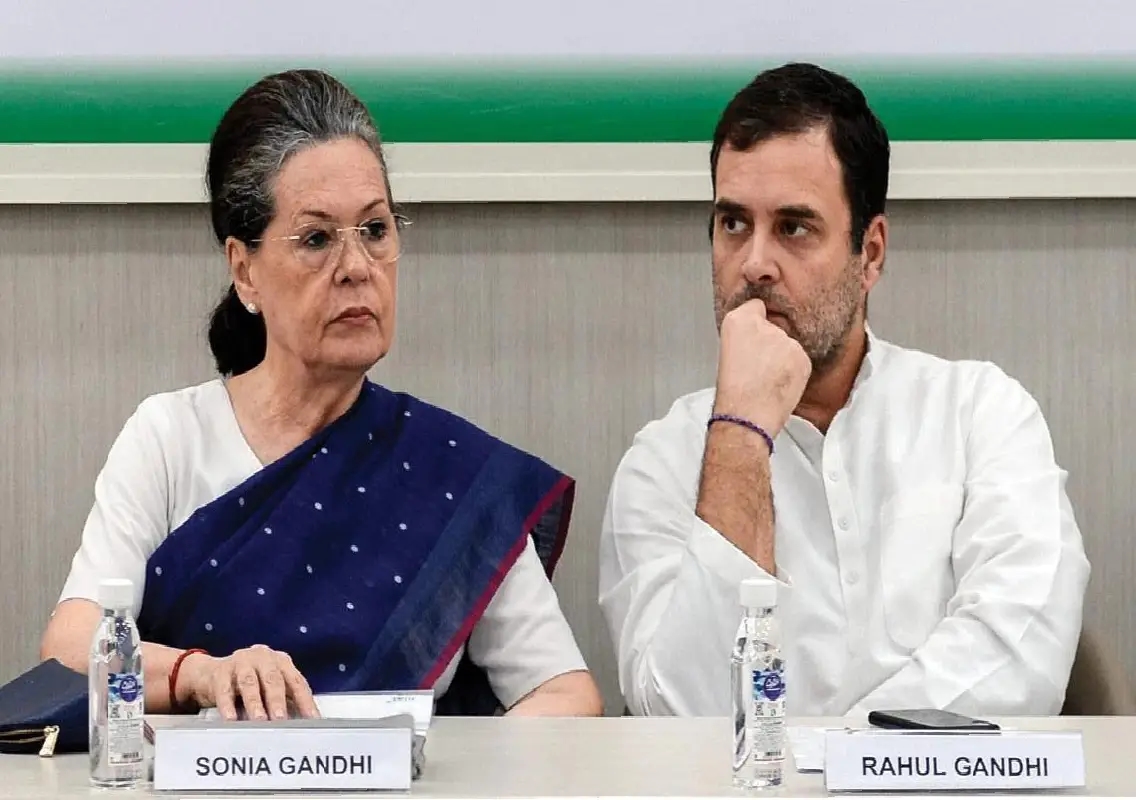


New Delhi: The Delhi High Court on Monday issued notices to Congress leaders Sonia Gandhi, Rahul Gandhi and other accused in the National Herald case on a plea filed by the Enforcement Directorate (ED), challenging a trial court order that refused to take cognisance of its prosecution complaint. The high court also sought their response to the ED’s application seeking a stay on the trial court’s December 16 order and listed the matter for further hearing on March 12, 2026.
High Court issues notice on ED plea
Justice Ravinder Dudeja issued notice on the main petition filed by the ED as well as on its interim application seeking a stay of the lower court’s order. The trial court had earlier declined to take cognisance of the ED’s chargesheet, holding that the complaint was “impermissible in law” as it was not based on a registered First Information Report (FIR).
The high court’s order requires the Gandhis and other respondents to file their replies before the next date of hearing. The matter is expected to be closely watched, given the political and legal significance of the case.
Representation by senior legal counsel
During the hearing, the ED was represented by Solicitor General Tushar Mehta, while senior advocates Abhishek Singhvi and R S Cheema appeared on behalf of Sonia Gandhi, Rahul Gandhi and the other accused. The submissions at this stage were limited to the question of issuing notice and listing the matter for detailed arguments at a later date.
The court did not pass any interim order staying the trial court’s ruling but agreed to examine the ED’s challenge in detail.
Trial court’s reasoning questioned
The ED’s plea challenges the trial court’s finding that an investigation and the consequent prosecution complaint under the Prevention of Money Laundering Act (PMLA) are not maintainable in the absence of an FIR for the scheduled offence. In its December 16 order, the trial court held that cognisance could not be taken because the ED’s probe stemmed from a private complaint and not from an FIR registered by the police.
The trial court had observed that since the question involved a pure issue of law, there was no need to examine the merits of the allegations at that stage. It ruled that the prosecution complaint was liable to be rejected solely on legal grounds.
Background of the National Herald case
The National Herald case has its origins in a private complaint filed in 2012 by BJP leader Subramanian Swamy. The complaint alleged financial irregularities in the manner in which Young Indian Private Limited, a company in which Sonia and Rahul Gandhi are shareholders, acquired control over Associated Journals Limited (AJL), the publisher of the National Herald newspaper.
Following the complaint, a trial court issued summons in 2014. However, despite the complaint and the summoning order, the Central Bureau of Investigation (CBI) did not register an FIR in relation to the alleged scheduled offence under the PMLA. This aspect formed the basis of the trial court’s decision to refuse cognisance of the ED’s complaint.
ED’s allegations in the case
The ED has accused Sonia Gandhi and Rahul Gandhi, along with late Congress leaders Motilal Vora and Oscar Fernandes, Congress leader Sam Pitroda, journalist Suman Dubey, and the company Young Indian, of criminal conspiracy and money laundering.
According to the ED, Young Indian acquired assets worth around ₹2,000 crore belonging to AJL. The agency has alleged that the acquisition was carried out through fraudulent means, with Young Indian allegedly taking over AJL’s properties in exchange for a loan of ₹90 crore.
The ED has further claimed that Sonia and Rahul Gandhi together held a majority 76 per cent shareholding in Young Indian, giving them effective control over the company and its assets.
Legal issue at the centre of dispute
At the heart of the dispute is the legal requirement under the PMLA that a money laundering investigation must be linked to a scheduled offence registered through an FIR. The trial court held that in the absence of such an FIR, the ED could not proceed with prosecution.
The ED, however, has argued that its powers under the PMLA are broader and that the absence of an FIR in the scheduled offence does not automatically invalidate its investigation or prosecution complaint. This legal question is now expected to be examined by the high court in detail.
Political and legal implications
The case has remained a flashpoint in national politics for over a decade, with the Congress consistently alleging political vendetta and misuse of investigative agencies, while the ruling party has maintained that the law is being applied equally.
Legal experts note that the high court’s eventual ruling could have wider implications for the manner in which money laundering cases are initiated and prosecuted, particularly those arising from private complaints.
Conclusion
With the Delhi High Court agreeing to hear the ED’s challenge and seeking responses from the Gandhis and other accused, the National Herald case has entered a new legal phase. The outcome of the proceedings, scheduled for further hearing in March 2026, is likely to have significant consequences both for the parties involved and for the interpretation of the PMLA framework.