







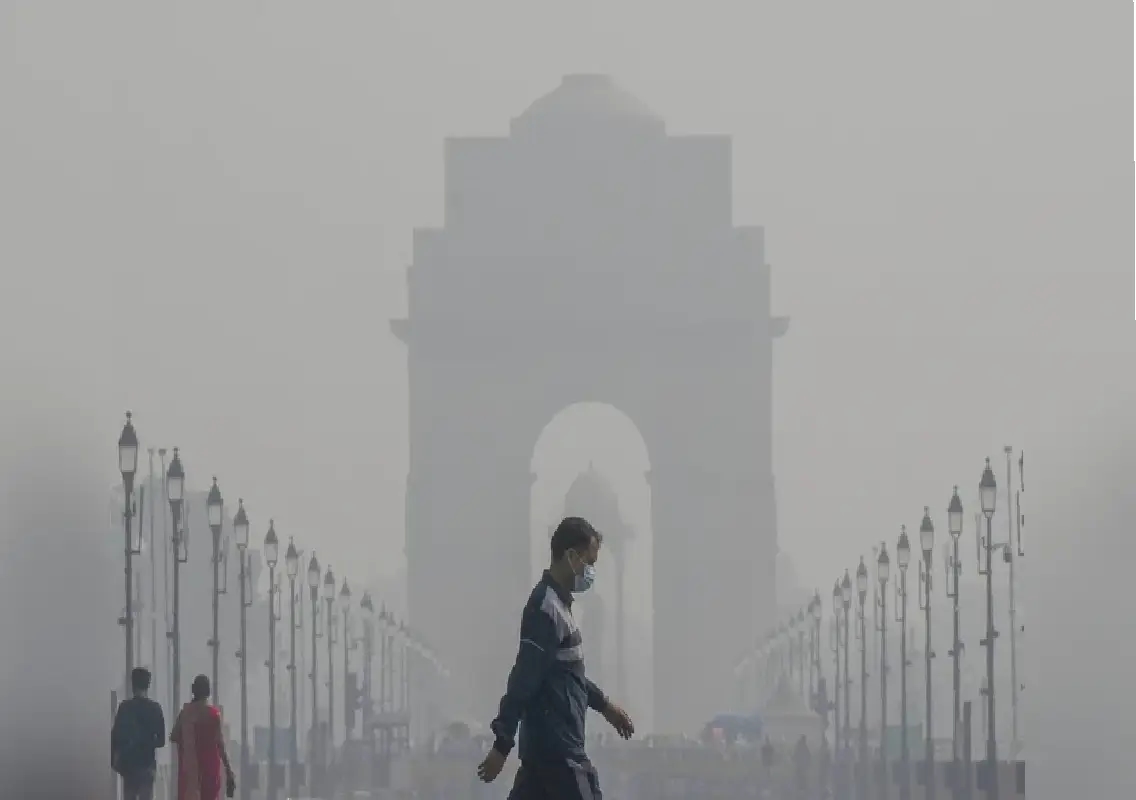


New Delhi: As Delhi’s air quality plunged into the ‘Severe’ category for the first time this season, the Commission for Air Quality Management (CAQM) on Monday imposed Stage 3 of the Graded Response Action Plan (GRAP) across the National Capital Region (NCR). The decision came after the city’s average Air Quality Index (AQI) touched 425, indicating hazardous levels of pollution.
AQI levels across Delhi
According to the Central Pollution Control Board (CPCB) data, several key areas in Delhi recorded alarming AQI levels. Anand Vihar registered an AQI of 412, Alipur 442, and Bawana the highest at 462. In central parts of the city, Chandni Chowk recorded 416, while RK Puram and Patparganj reported 446 and 438, respectively.
The CAQM noted that this sharp deterioration in air quality was driven by adverse meteorological conditions, low wind speed, and an increase in local pollution sources.
Yearly air quality shows slight improvement
Despite the current spike, the Ministry of Environment, Forest and Climate Change reported a moderate improvement in Delhi’s overall air quality compared to last year. From 1 January to 9 November 2025, the average AQI stood at 175, down from 189 in the same period last year.
Particulate matter levels have also slightly reduced, with PM2.5 concentrations at 75 µg/m³ and PM10 at 170 µg/m³, compared to 87 µg/m³ and 191 µg/m³, respectively, in 2024. Officials attributed this decline to coordinated pollution control efforts and a significant reduction in farm fire incidents in neighbouring states.
Sharp decline in stubble burning incidents
In Punjab, 4,062 farm fires were recorded between 15 September and 9 November 2025, marking a 35.2% decrease from 6,266 cases during the same period last year. Haryana also reported a 65.3% decline, with only 333 incidents this year compared to 959 in 2024.
CAQM officials said they are working closely with the state governments of Punjab and Haryana to monitor on-ground situations and ensure the strict enforcement of anti-stubble burning directives.
What is GRAP?
The Graded Response Action Plan (GRAP) is a preemptive regulatory framework designed to combat air pollution in Delhi-NCR through tiered restrictions based on AQI levels. It consists of four stages:
- Stage 1 – Poor (AQI 201–300)
- Stage 2 – Very Poor (AQI 301–400)
- Stage 3 – Severe (AQI 401–450)
- Stage 4 – Severe Plus (AQI above 450)
Currently, Delhi has entered Stage 3, which triggers stricter restrictions to reduce emissions from vehicular, industrial, and construction sources.
Restrictions under GRAP-3
Under GRAP Stage 3, the following measures are enforced immediately:
- Complete ban on non-essential construction and demolition activities, including earthwork, piling, trenching, and operation of Ready-Mix Concrete (RMC) plants.
- Prohibition on BS-3 petrol and BS-4 diesel four-wheelers in Delhi and NCR districts.
- Ban on transportation of construction materials such as sand and cement on unpaved roads.
- Closure of stone crushers, mining, and hot-mix plants not operating on clean fuel.
- Ban on diesel generator sets, except for emergency and essential services.
- Restriction on inter-state diesel buses entering or operating within Delhi.
- Advisory to private companies to implement work-from-home or hybrid work models to curb vehicular emissions.
- Closure of schools up to Class 5, with classes shifted online to protect children from toxic air exposure.
Exemptions under GRAP-3
Essential public infrastructure projects such as metro, railways, airports, defence, sanitation, and healthcare facilities are exempt from the ban, provided they adhere to strict dust control and waste management norms.
Authorities on high alert
Officials said that the CAQM, along with state pollution control boards and local agencies, is conducting continuous field inspections to ensure compliance. Teams are also monitoring construction sites and vehicle emissions through real-time surveillance systems.
Environmental experts have urged citizens to limit outdoor activities, use masks, and prefer public or shared transport options to reduce emissions.
Conclusion
While Delhi’s air quality remains a pressing concern, authorities have expressed cautious optimism due to the declining trend in stubble burning and improving year-on-year averages. However, immediate and collective action remains critical to ensure that the capital does not slip into the ‘Severe Plus’ category, which could trigger even harsher curbs under GRAP Stage 4.