









Mumbai: Mumbai Police have registered a case against organisers of the Cockroach Janta Party’s (CJP) protest at Shivaji Park on October 2, after the gathering was held despite authorities denying permission for the event.
The case, registered at Shivaji Park police station, names several CJP organisers along with 400-500 unidentified participants. Police have invoked provisions of the Bharatiya Nyaya Sanhita (BNS) relating to unlawful assembly and disobedience of an order issued by a public servant, along with provisions of the Maharashtra Police Act.
The CJP, led by founder Abhijeet Dipke, had organised the demonstration to demand the resignation of Chief Election Commissioner Gyanesh Kumar. The protest focused on the Election Commission’s Special Intensive Revision (SIR) of electoral rolls and the party’s concerns about changes to voter lists.
Police had denied permission for the gathering, citing restrictions applicable to assemblies at Shivaji Park as well as concerns about traffic, public inconvenience and noise. Despite the denial, the organisers went ahead with what they described as a “Jail Bharo Andolan” on Gandhi Jayanti.
Police register case after unauthorised gathering
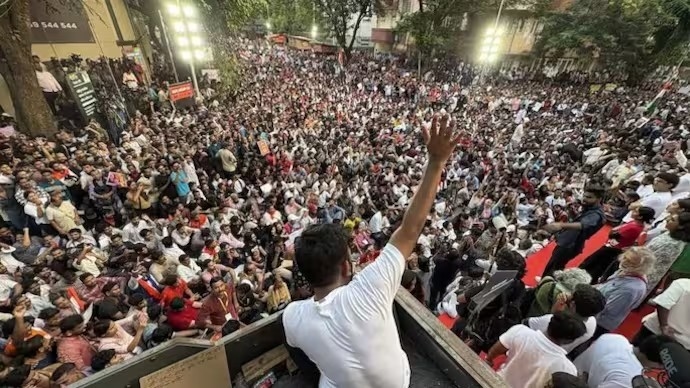
According to police, a large group of CJP supporters gathered at Gate No. 6 of the Shivaji Park grounds in Dadar West on Friday.
The Times of India reported that the gathering began around 2 pm and continued until approximately 7 pm. Police alleged that protesters assembled on a public road, disrupted the movement of traffic and used loudspeakers without the required permission.
The FIR names CJP members including Ajinkya Shinde, Pranay Ahire, Ashutosh Ranka, Abhijeet Dipke, Saurav Das, Afreen Nawaz, Soumya Korde, Ankit Bhardwaj, Vijay Malangi and Yogesh Ingale, along with 400-500 unidentified persons.
No arrests had been reported in connection with the case at the time of the latest reports, with the investigation continuing.
The registration of an FIR does not establish guilt. Police will have to investigate the circumstances of the gathering and determine the individual roles, if any, of those named in the case.
Protest held despite police denial
The CJP had announced the Mumbai demonstration despite the police refusing permission.
The party called for supporters to gather at Shivaji Park on October 2 and participate in a “Jail Bharo Andolan” demanding action against the Election Commission. The central demand was the resignation of Chief Election Commissioner Gyanesh Kumar.
Large numbers of supporters eventually gathered at the venue, carrying the national flag and displaying placards related to electoral rolls and the Election Commission. Reports described the turnout as being in the thousands, although the FIR separately refers to 400-500 unidentified participants.
The demonstration also attracted public figures, including actors Naseeruddin Shah and Shabana Azmi, singer Vishal Dadlani and filmmaker Vishal Bhardwaj. Tushar Gandhi, the great-grandson of Mahatma Gandhi, was also present.
Shabana Azmi told the gathering that voting was a right and said people should use democratic means to protest if their names were removed from electoral rolls.
CJP demands resignation of Gyanesh Kumar
The protest was primarily directed at the functioning of the Election Commission and the ongoing SIR exercise.
The CJP has alleged irregularities in the revision of electoral rolls and has demanded greater transparency in the functioning of the Election Commission. The allegations are political claims by the protesters and have not been established by the FIR itself.
Among the demands raised by the organisation is that the 2025 voter list be frozen to prevent what it describes as further changes. The party has also raised objections to the 2023 legislation governing the appointment of Election Commissioners.
Addressing the protesters, CJP leader Ajinkya Shinde demanded the resignation of Gyanesh Kumar and called for criminal proceedings against him.
Dipke also warned of another major protest, which he described as “Jantar Mantar 2.0”, if the CEC did not resign.
The organisation has indicated that the Mumbai demonstration is part of a broader campaign rather than an isolated protest. Reuters reported that the CJP planned further demonstrations in other cities as part of its campaign concerning electoral-roll changes.
Police cite traffic and public-order concerns
The denial of permission before the protest was based on concerns beyond the political demands raised by the organisers.
Police had cited existing restrictions governing assemblies at Shivaji Park and concerns over traffic movement, public inconvenience and noise.
The FIR subsequently included allegations relating to unlawful assembly, obstruction of traffic and the use of loudspeakers without permission.
These issues have also become a point of contention among residents living around Shivaji Park.
Some residents objected to the disruption caused by the large gathering, including noise and inconvenience. At the same time, some residents said their objection was not to the right to protest itself but to demonstrations being conducted in a manner that affects people living and working in the neighbourhood.
The competing concerns highlight the practical issues that arise when large political or civic demonstrations are held in densely populated parts of Mumbai.
Political support for the demonstration
The CJP protest also received support from opposition political parties.
Shiv Sena (UBT) and Maharashtra Navnirman Sena (MNS) extended support to the agitation, while their leaders later participated in political activity related to the Election Commission issue.
The October 2 gathering therefore preceded the joint protest by Uddhav Thackeray and Raj Thackeray on October 4, when the two leaders marched in Mumbai against the Election Commission’s handling of electoral-roll revision.
The CJP demonstration also came amid wider protests in different parts of the country over the SIR exercise and demands concerning the Election Commission.
In Delhi, protesters from opposition parties and civil society groups also attempted demonstrations around Jantar Mantar during the same period, with police detaining several participants.
Javed Akhtar comments on residents’ concerns
The Shivaji Park protest also triggered a public exchange over the use of the venue for large gatherings.
Lyricist and screenwriter Javed Akhtar responded on social media to objections raised by local residents. He questioned whether similar concerns would be raised when political parties organised large public meetings at Shivaji Park.
His comments added another dimension to the debate, which has centred on the balance between the right to hold public demonstrations and the impact of large gatherings on residents and traffic.
The CJP, meanwhile, maintained its position that the protest was necessary to highlight what it described as concerns over electoral transparency.
Investigation now underway
With the FIR registered, Mumbai Police will investigate the circumstances surrounding the October 2 gathering and examine the roles of the organisers and other participants.
The case includes named CJP members as well as 400-500 unidentified individuals. Police are expected to examine available evidence, including video footage and other material from the protest, while determining whether specific participants committed the offences alleged in the FIR.
At this stage, the registration of the case is a procedural step in the investigation and does not amount to a finding of guilt against the organisers or unidentified participants.
The CJP’s protest was part of a wider campaign demanding the resignation of Chief Election Commissioner Gyanesh Kumar and raising objections to the SIR process. The police action has now added a legal dimension to the Mumbai demonstration.
Further action will depend on the investigation, evidence collected by the police and any subsequent proceedings before the courts.