







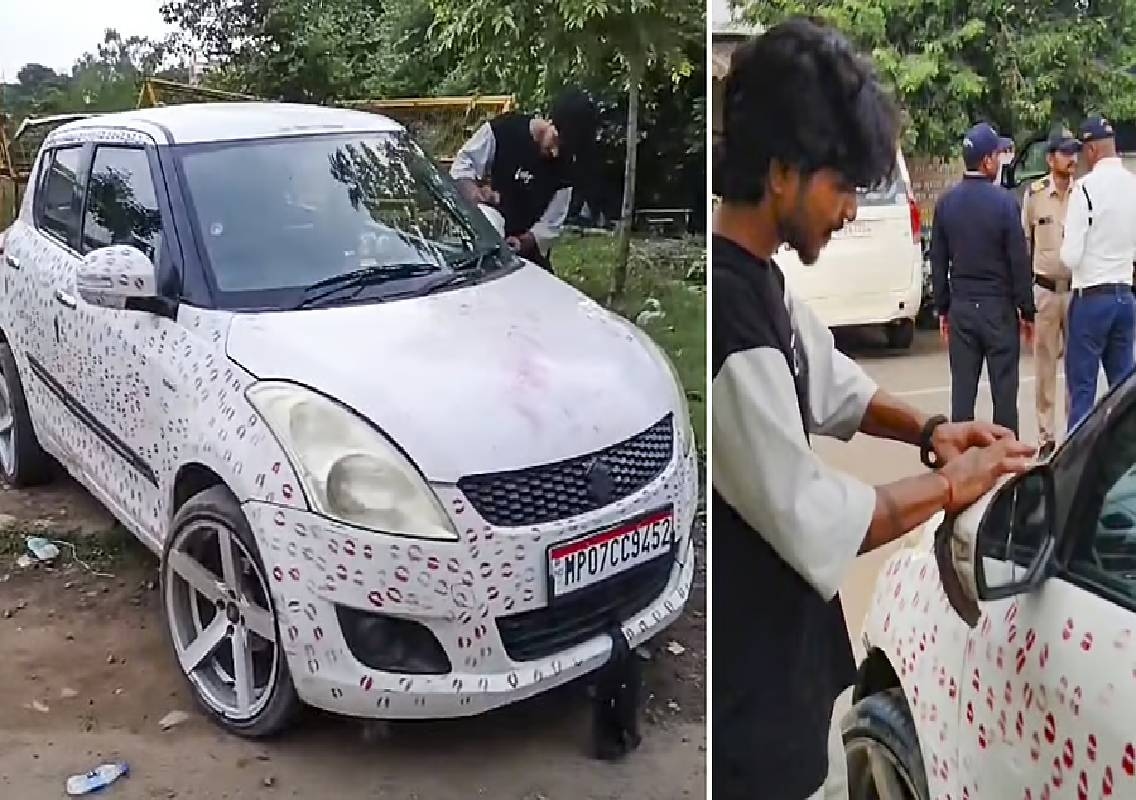


Gwalior: A romantic gesture in Gwalior took an unexpected turn after a man’s girlfriend covered his car with around 3,400 lipstick kiss marks, only for traffic police to trace the vehicle and issue a Rs 5,500 fine. The unusual car, decorated as part of a social media trend, went viral before attracting the attention of authorities.
The incident involved Gwalior resident Aditya Sikarwar, whose girlfriend reportedly spent several hours covering the exterior of his car with lipstick marks. What was intended as a quirky expression of affection and a bid to create a viral social media moment instead ended with the vehicle being seized, the marks being removed and a challan being issued.
Girlfriend covers car with 3,400 kiss marks
According to reports, Sikarwar’s girlfriend wanted to recreate a foreign social media trend in which cars are decorated with lipstick kiss impressions.
She reportedly spent around three-and-a-half to four hours creating approximately 3,400 marks across the vehicle. The unusual appearance was then filmed and shared online, with images and videos of the car quickly attracting attention.
The car was subsequently seen travelling through Gwalior, where its distinctive appearance made it difficult to miss.
Viral video catches police attention
The stunt might have remained an unusual social media post had the vehicle not attracted the attention of traffic authorities.
A video of the car circulating online showed the vehicle covered almost entirely in lipstick impressions. Police reportedly used the registration number visible in the footage to identify the vehicle and trace it to the Thathipur area of Gwalior.
The vehicle was then brought to the attention of traffic police.
Owner fined Rs 5,500
The romantic makeover eventually proved expensive for Sikarwar.
Traffic police imposed a Rs 5,500 challan under the Motor Vehicles Act after determining that the vehicle’s appearance amounted to a violation of traffic regulations. The car was also required to be cleaned and the lipstick marks removed.
The incident demonstrates how modifications or decorations that appear harmless can attract regulatory action when a vehicle is being driven on public roads.
Car had to be cleaned
Following the police action, Sikarwar was instructed to remove all the lipstick marks from the vehicle.
The thousands of impressions that had taken hours to create therefore had to be cleaned off after the police intervention.
Reports said Sikarwar accepted the action and acknowledged that he had not realised the decoration could lead to a violation of traffic rules.
Social media trend behind unusual stunt
Sikarwar reportedly said his girlfriend had been inspired by a trend from outside India.
The couple’s attempt appears to have been driven partly by the desire to create a distinctive social media video. The incident, however, shows the unpredictable consequences of attempting to recreate viral online trends in public spaces.
A stunt designed to generate views ended up generating attention from traffic authorities instead.
Why police took action
The fine was linked to the vehicle’s altered appearance while it was being driven on public roads.
Legal reports have pointed to provisions of the Motor Vehicles Act, including rules relating to vehicle alterations and road safety. A vehicle’s appearance or modification can become a concern if it violates prescribed requirements or creates a potential distraction for other road users.
In this case, authorities treated the decorated vehicle as a traffic-rule violation and imposed the Rs 5,500 penalty.
A romantic gesture turns into a costly lesson
For Sikarwar, the incident became an unusual reminder that social media trends can have consequences outside the internet.
The girlfriend’s gesture took hours to complete, but the resulting attention brought police intervention and a financial penalty.
The episode also highlights the difference between creating content for social media and carrying out the same stunt on public roads. What may look entertaining in a controlled setting can attract regulatory attention once a vehicle enters traffic.
Internet reacts to the ‘kissing car’
The unusual incident quickly became a talking point online.
The combination of romance, thousands of lipstick marks and a traffic challan generated plenty of humorous reactions from social media users. The car’s appearance itself became the centre of jokes, while others pointed out that the attempt to go viral had resulted in an unexpected fine.
The incident has also prompted discussions about the growing influence of social media challenges on everyday behaviour.
Viral trends can have real-world consequences
Social media challenges often encourage users to recreate unusual stunts in order to generate views and engagement.
While many such trends are harmless, others can involve public spaces, vehicles or activities that may violate local rules.
The Gwalior incident is a clear example of how quickly an online trend can move into the real world — and how authorities may respond when it affects road safety or traffic regulations.
The unusual price of going viral
The car’s thousands of kiss marks may have been intended to attract attention, but the attention came from an unexpected direction.
Instead of simply receiving likes and views, the owner ended up with a Rs 5,500 challan and a mandatory car wash.
The incident has since become another example of how attempts to recreate viral social media trends can sometimes produce consequences that participants did not anticipate.
Conclusion
A Gwalior man’s attempt to turn his car into a viral social media attraction ended with a Rs 5,500 traffic fine after his girlfriend covered the vehicle with around 3,400 lipstick kiss marks. The stunt reportedly took several hours and was inspired by a foreign social media trend.
Police traced the vehicle after videos of it circulated online and ordered the owner to remove the lipstick marks. The case has since gone viral for its unusual combination of romance, social media trends and traffic enforcement.
The incident serves as a reminder that online trends can have real-world consequences, particularly when they involve vehicles being driven on public roads.