







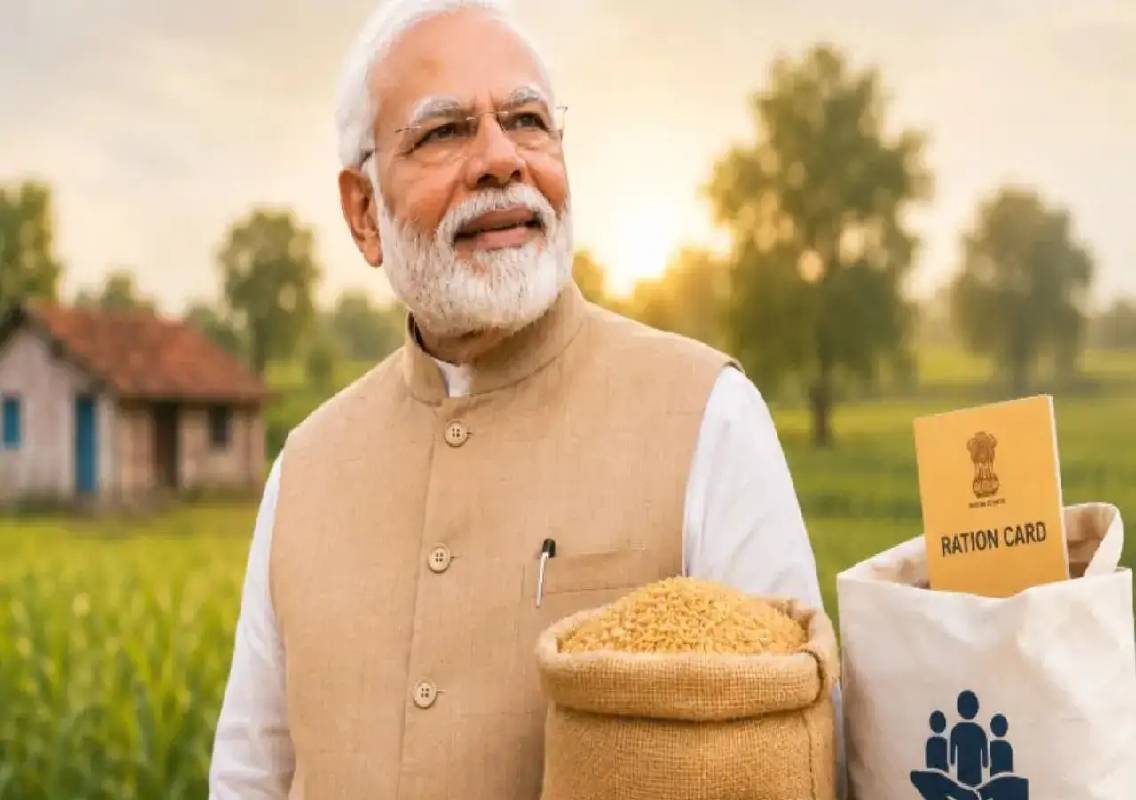


New Delhi: Poverty alleviation has remained a central theme of Indian politics for decades. While earlier governments focused on slogans and broad policy frameworks, the last decade has witnessed a significant emphasis on direct welfare delivery, financial inclusion and targeted social support schemes. The transformation from the era of “Garibi Hatao” to “Garib Kalyan” has become a defining feature of the welfare model pursued under Prime Minister Narendra Modi’s government.
The discussion gained renewed attention after British journalist Sam Stevenson highlighted India’s pace of poverty reduction, noting that millions of people have benefited from welfare initiatives aimed at improving food security, healthcare, sanitation, housing, banking access and rural development.
Food security remains the cornerstone
One of the government’s flagship initiatives has been the Pradhan Mantri Garib Kalyan Anna Yojana (PMGKAY), which was launched during the COVID-19 pandemic and later extended as a long-term welfare programme.
In January 2024, the Centre approved the continuation of PMGKAY for five years, providing free food grains to more than 81 crore beneficiaries under the National Food Security Act. The programme is among the largest food security initiatives globally and seeks to ensure that vulnerable households have access to essential food supplies.
The scheme supplements existing entitlements under the National Food Security Act and the Antyodaya Anna Yojana, strengthening the country’s food distribution network.
Direct Benefit Transfer changed welfare delivery
A major component of the government’s welfare strategy has been the expansion of Direct Benefit Transfer (DBT).
By linking welfare payments directly to beneficiaries’ bank accounts, the government aims to reduce leakages and eliminate intermediaries. According to official data, more than ₹44 lakh crore has been transferred through DBT mechanisms across various schemes over the years.
Supporters of the programme argue that technology-driven welfare delivery has improved transparency and efficiency while ensuring that benefits reach intended recipients.
Financial inclusion through Jan Dhan
The launch of the Pradhan Mantri Jan Dhan Yojana (PMJDY) in 2014 marked a significant step towards financial inclusion.
The scheme sought to provide banking access to previously unbanked households through zero-balance accounts. Over the years, Jan Dhan has expanded into one of the world’s largest financial inclusion programmes.
Today, more than 58 crore Jan Dhan accounts have been opened, with deposits exceeding ₹3 lakh crore. A substantial share of account holders are women, including beneficiaries from Scheduled Castes and Scheduled Tribes.
The programme has also enabled the efficient transfer of welfare benefits directly into beneficiaries’ accounts.
Healthcare access expanded significantly
Healthcare has emerged as another major pillar of the government’s welfare agenda.
The Ayushman Bharat programme has provided health insurance coverage to economically vulnerable families, while the Pradhan Mantri Bhartiya Janaushadhi Pariyojana has expanded access to affordable medicines through thousands of Janaushadhi Kendras across the country.
The availability of low-cost medicines and healthcare services has helped reduce out-of-pocket expenditure for many households, particularly those in rural and economically weaker sections.
Rural development and basic amenities
The government has also focused on improving access to essential services.
The Jal Jeevan Mission, launched in 2019, aims to provide functional household tap water connections across rural India. According to official figures, coverage has expanded substantially since the programme’s launch.
Similarly, the Swachh Bharat Mission led to the construction of more than 12 crore toilets, helping improve sanitation infrastructure and public health outcomes.
Urban sanitation initiatives under the Atal Mission for Rejuvenation and Urban Transformation (AMRUT) have also sought to strengthen sanitation systems in cities and towns.
Support for farmers and entrepreneurs
Farmers have received financial support through the Pradhan Mantri Kisan Samman Nidhi (PM-KISAN), under which eligible farmer families receive direct income support.
According to government data, more than ₹4.27 lakh crore has been disbursed to over 11 crore farmers under the scheme.
On the entrepreneurship front, the Pradhan Mantri Mudra Yojana has provided collateral-free loans to small businesses and self-employed individuals. Women account for a significant share of beneficiaries, highlighting the programme’s role in promoting financial independence and self-employment.
The Stand-Up India scheme has similarly encouraged entrepreneurship among women and members of marginalised communities.
Poverty indicators show improvement
India has witnessed a decline in multidimensional poverty over the past decade. According to official estimates, multidimensional poverty fell from 29.17 per cent in 2013-14 to 11.28 per cent in 2022-23.
The reduction translates into more than 24.8 crore people moving out of multidimensional poverty during the period.
Rural and urban poverty indicators have also shown improvement, reflecting gains across multiple dimensions including health, education and living standards.
However, economists continue to debate the pace, sustainability and measurement of poverty reduction, with differing assessments emerging from various institutions and methodologies.
Conclusion
India’s welfare landscape has undergone a major transformation over the past decade, driven by large-scale programmes focused on food security, healthcare, sanitation, financial inclusion and direct benefit transfers. While debates continue over the effectiveness and long-term impact of various schemes, welfare delivery has become a central component of India’s poverty reduction strategy. As the country works towards its development goals, the success of these programmes will continue to shape discussions around inclusive growth and social welfare.