







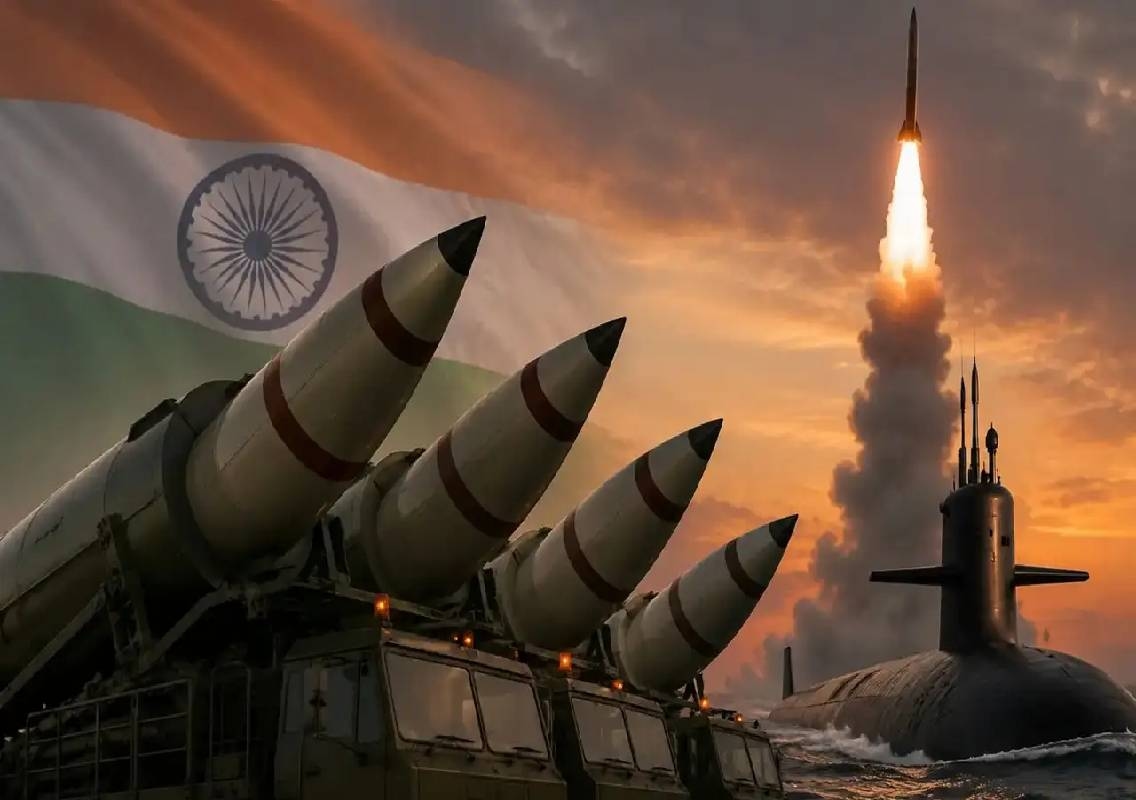


New Delhi: India has reportedly deployed a portion of its nuclear arsenal for the first time, marking a notable development in the country’s nuclear posture, according to the Stockholm International Peace Research Institute (SIPRI) Yearbook 2026. The report states that India now possesses an estimated 190 nuclear weapons, with 12 believed to be operationally deployed.
The assessment represents the first time SIPRI has identified any part of India’s nuclear stockpile as being deployed rather than entirely held in reserve. The finding has drawn attention from strategic analysts, although the Indian government has not publicly commented on the report’s conclusions.
India’s nuclear stockpile grows to 190 warheads
According to SIPRI’s annual assessment of global armaments, disarmament and international security, India’s nuclear arsenal increased from an estimated 180 warheads in 2025 to 190 in 2026.
The report notes that India continues to strengthen its nuclear triad, comprising aircraft, land-based missile systems and sea-based deterrent capabilities. A nuclear triad is considered a key component of strategic deterrence, allowing a country to launch nuclear weapons from multiple platforms.
While the increase in the number of warheads is relatively modest, the reported deployment of 12 warheads marks a significant shift from India’s traditionally cautious operational posture.
Change from traditional storage practices
For decades, analysts have generally believed that India stored nuclear warheads separately from their delivery systems during peacetime. This approach was viewed as consistent with the country’s stated nuclear doctrine and emphasis on restraint.
However, SIPRI suggests that technological developments could be changing that practice.
“It has long been assumed that India stores its nuclear warheads separate from its deployed launchers during peacetime,” the report stated. It added that India’s increasing reliance on canister-launched missile systems and sea-based deterrent patrols may allow some warheads to remain mated with their launchers even during peacetime.
Such a shift could potentially reduce response times and strengthen deterrence capabilities, though it may also attract greater scrutiny from international arms control observers.
Focus on China and Pakistan
The SIPRI report notes that India’s strategic planning is increasingly focused on developing long-range missile capabilities capable of reaching targets throughout China.
At the same time, the report highlights that Pakistan continues to remain a central consideration in India’s security calculations due to the long-standing rivalry between the two neighbouring countries.
The evolving security environment in Asia, combined with regional military modernisation efforts, has encouraged continued investments in advanced missile systems and strategic deterrence capabilities.
Sea-based deterrence receives major boost
A significant aspect of India’s nuclear modernisation programme is the expansion of its sea-based deterrent force.
According to SIPRI, India is expected to commission its fourth nuclear-powered ballistic missile submarine by 2027. Such submarines are regarded as a crucial element of a credible second-strike capability because they can remain concealed underwater for extended periods.
The expansion of the submarine fleet is expected to strengthen India’s strategic deterrence posture and enhance operational flexibility.
Defence expenditure rises sharply
The report also highlights a substantial increase in India’s defence spending. SIPRI estimates that India’s military expenditure reached approximately $92.1 billion in 2025, reflecting an increase of 8.9 per cent compared to the previous year.
The rise comes amid ongoing efforts to modernise military capabilities, strengthen border security and expand indigenous defence production.
India remains among the world’s largest defence spenders, with investments spanning conventional military systems, emerging technologies and strategic capabilities.
Operation Sindoor referenced in report
The SIPRI Yearbook also references Operation Sindoor, launched by India following the Pahalgam terror attack in 2025.
The report describes the episode as an “unusually severe military crisis” between the two nuclear-armed neighbours, India and Pakistan. The incident underscored concerns among international observers about the risks associated with military confrontations between countries possessing nuclear weapons.
Conclusion
The SIPRI Yearbook 2026 suggests that India is gradually transitioning towards a more mature and operationally flexible nuclear deterrent. While the reported deployment of 12 nuclear warheads does not indicate a change in India’s stated ‘No First Use’ doctrine, it highlights the continued evolution of the country’s strategic capabilities amid a complex regional security environment.
As India expands its nuclear triad and strengthens sea-based deterrence, developments in its nuclear posture are likely to remain closely watched by policymakers, military planners and international security experts alike.