







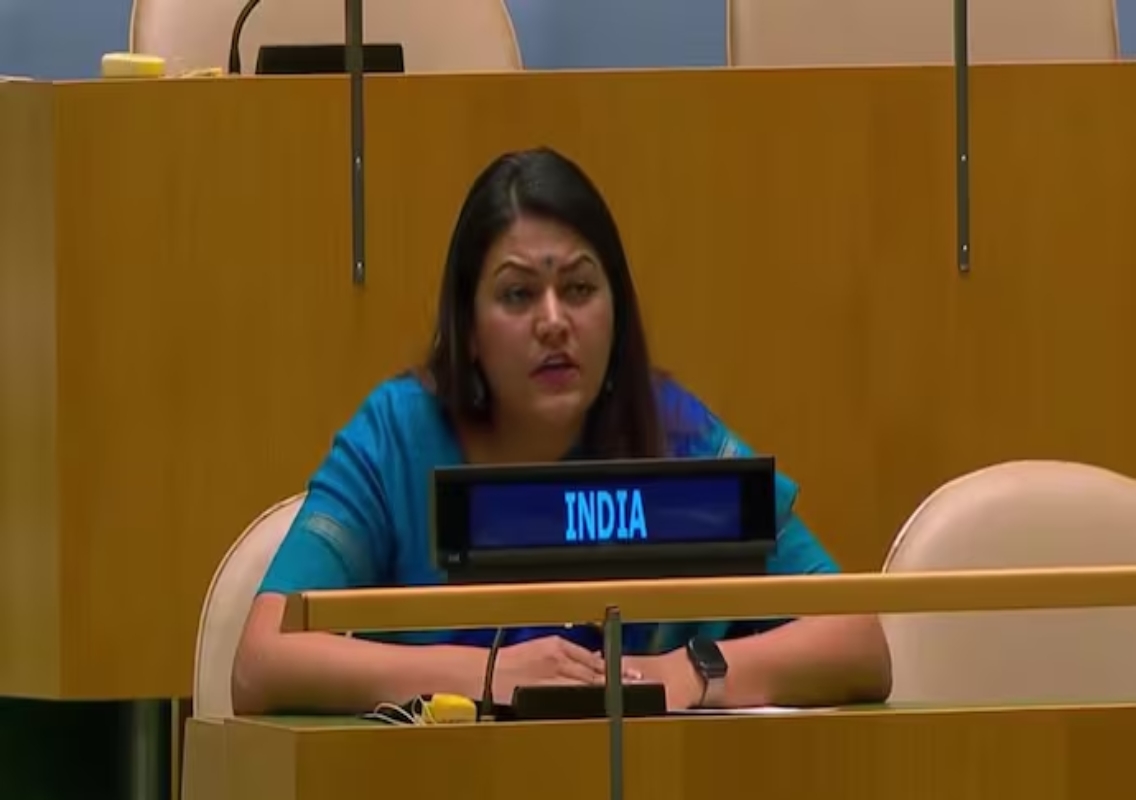


New Delhi: India exercised its Right of Reply at the United Nations General Assembly after Pakistan Prime Minister Shehbaz Sharif raised Kashmir, the Indus Waters Treaty and the 2025 India-Pakistan conflict during his address, with Indian diplomat Petal Gahlot accusing Pakistan of using the global forum to advance its narrative on terrorism and regional security.
Gahlot, First Secretary at India’s Permanent Mission to the UN, said the international community should have no confusion about the role of Pakistan’s military in the country’s affairs. Her response came after Sharif’s speech at the 81st session of the UN General Assembly in New York.
The exchange once again brought the India-Pakistan dispute over Jammu and Kashmir and cross-border terrorism into focus at the UN, with both countries presenting sharply different accounts of the issues.
India responds to Sharif’s Kashmir remarks
Sharif used his UNGA address to reiterate Pakistan’s position on Jammu and Kashmir, calling for what he described as a “just and fair solution”. He also referred to the 2025 military confrontation between India and Pakistan and credited US President Donald Trump with intervening to help end the conflict.
India has consistently rejected Pakistan’s position on Kashmir and maintains that Jammu and Kashmir is an integral part of India. New Delhi has also rejected claims of third-party mediation in India-Pakistan matters, saying outstanding issues should be addressed bilaterally.
In her Right of Reply, Gahlot challenged Sharif’s account and focused India’s response primarily on Pakistan’s alleged support for terrorism.
The Indian diplomat said Pakistan should address terrorism-related concerns rather than raise accusations against India at international forums.
India links terrorism to future ties
A central part of Gahlot’s response was India’s demand that Pakistan take action against terrorist infrastructure.
She said that if Islamabad genuinely wants peace with India, it should shut down terrorist camps and hand over individuals wanted in India. The comments reflect New Delhi’s longstanding position that cross-border terrorism must be addressed before relations can substantially improve.
India has repeatedly accused Pakistan of supporting or providing space to militant groups operating against India. Pakistan has rejected such accusations and has itself raised allegations concerning India’s conduct in Jammu and Kashmir.
The competing positions remain a major obstacle in the bilateral relationship.
Shehbaz Sharif raises Indus Waters Treaty
The Indus Waters Treaty was another issue raised by Sharif during his UN speech.
The Pakistani Prime Minister said Pakistan would continue to defend what he described as its share of the Indus waters. Pakistan’s official broadcaster reported that Sharif warned that any attempt to divert Pakistan’s share of the waters would be considered an “act of war”.
India placed the treaty in abeyance following the April 2025 Pahalgam terror attack and has linked its position to concerns over cross-border terrorism.
The water-sharing agreement, signed in 1960 with World Bank involvement, governs the use of the Indus river system by India and Pakistan. The two countries have disagreed over several aspects of the treaty and related water projects for years.
India rejects Pakistan’s account of 2025 conflict
Sharif also referred to the military escalation between India and Pakistan in May 2025.
According to India Today, Sharif credited Trump with playing a role in bringing the conflict to an end and described the American intervention as important in preventing a wider confrontation.
India has maintained a different account of how the cessation of hostilities was reached. New Delhi has said the understanding was reached through direct communication between the Directors General of Military Operations of the two countries.
The differing accounts have remained a point of contention between New Delhi and Islamabad.
Pakistan continues to raise Kashmir at UN
Sharif’s speech reiterated Pakistan’s longstanding diplomatic position on Kashmir. Pakistan’s official Associated Press report said Sharif told the UN that Islamabad would continue to provide diplomatic, political and moral support to Kashmiris until what Pakistan describes as their right to self-determination is addressed.
India rejects this position and maintains that Pakistan has no legitimate claim over Jammu and Kashmir.
The issue has been repeatedly raised at international forums by Pakistan, while India has responded by highlighting terrorism and Pakistan-administered territory.
The latest exchange followed the established pattern of the two countries using their Right of Reply at the UN to respond to each other’s statements.
India focuses on Pakistan’s military role
Gahlot’s response also focused on the role of Pakistan’s military establishment.
According to India Today, she said the international community should have no “illusion” about who exercises power in Pakistan. Her remarks came after Sharif’s speech included repeated references to Pakistan’s military leadership and its role in national security and diplomacy.
Sharif had praised Pakistan’s Chief of Defence Forces and Chief of Army Staff Field Marshal Asim Munir during his UN address, crediting his efforts in creating what the Pakistani Prime Minister described as space for diplomacy.
The contrast between the two speeches underlined the different political narratives presented by New Delhi and Islamabad at the UN.
Terrorism remains central to India’s response
India’s response comes amid its continued emphasis on counter-terrorism following the April 2025 Pahalgam attack.
India has said the attack, which killed 26 civilians, prompted Operation Sindoor on May 7, 2025, targeting what New Delhi described as terrorist infrastructure in Pakistan and Pakistan-occupied Kashmir.
Indian security forces have also continued counter-terror operations in Jammu and Kashmir. India Today reported in August that security forces had carried out around 30 major counter-terror and anti-infiltration operations in the region following Operation Mahadev in July 2025.
Pakistan has disputed India’s allegations concerning its role in terrorism and has continued to raise concerns about the situation in Jammu and Kashmir.
No change in India’s bilateral position
The latest UN exchange does not indicate a change in India’s longstanding position that disputes with Pakistan should be addressed bilaterally.
New Delhi has repeatedly rejected third-party mediation on Kashmir and other bilateral matters. Pakistan, meanwhile, has continued to seek international attention on Kashmir and has called for a settlement based on its interpretation of UN resolutions and the principle of self-determination.
The two countries therefore remain divided on Kashmir, terrorism, the Indus Waters Treaty and the interpretation of the 2025 conflict.
The UNGA speeches have provided another international platform for both sides to put forward their respective positions.
Conclusion
India’s Right of Reply at the UN followed Pakistan Prime Minister Shehbaz Sharif’s remarks on Kashmir, the Indus Waters Treaty and the 2025 India-Pakistan conflict. Indian diplomat Petal Gahlot responded by focusing on terrorism and Pakistan’s military establishment, while reiterating India’s position on bilateral dialogue.
The exchange reflects the continuing differences between New Delhi and Islamabad over Kashmir, cross-border terrorism, water sharing and the events surrounding the 2025 military escalation. Both countries continue to present contrasting positions on these issues at international forums.