







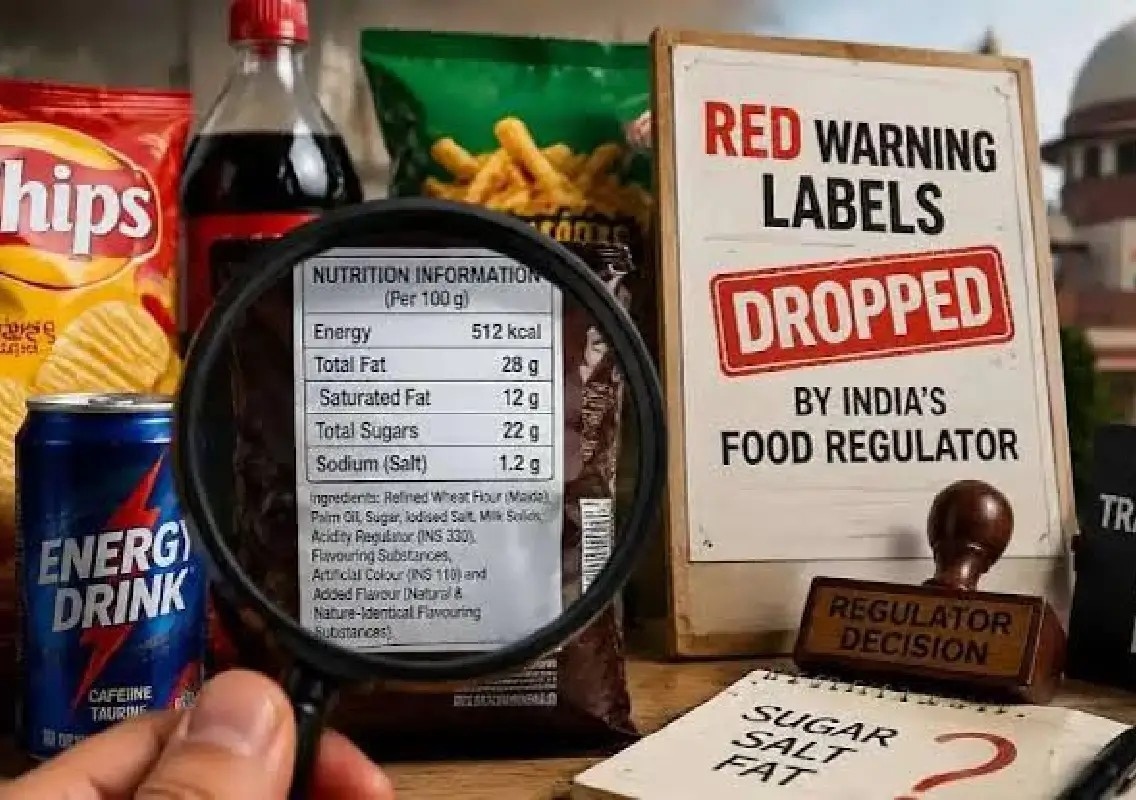


India’s food regulator has proposed introducing prominent warning labels on packaged food and beverages that contain high levels of sugar, salt or saturated fat, marking a significant shift in its earlier position.
The Food Safety and Standards Authority of India (FSSAI) proposed the use of a red-coloured hexagonal warning symbol in a filing before the Supreme Court on Friday.
Red labels to warn consumers
Under the proposal, packaged products high in any two or more of saturated fat, sugar or salt would carry a warning label.
The labels could state ‘HIGH FAT’, ‘HIGH SUGAR’, ‘HIGH SALT’ or ‘HIGHLY SWEETENED BEVERAGE’, allowing consumers to identify products containing high levels of specified nutrients more easily.
FSSAI said the proposed system would help consumers make informed food choices, particularly children and other vulnerable groups.
Food companies had opposed the move
The proposal follows years of debate over front-of-pack warning labels in India. Major food and beverage companies and industry groups have opposed such warnings, arguing that they could confuse consumers.
Health activists, meanwhile, have repeatedly pushed for stronger labelling requirements, citing concerns over obesity and diet-related health problems.
The Supreme Court has also urged the government to act on the issue.
Government changes its earlier position
FSSAI had previously told the Supreme Court that matching international packaging standards was difficult. The latest filing indicates a change in its position.
The proposed Indian system would differ from some warning-label models by applying the red warning when two or more specified nutrients are high in a product.
Currently, food manufacturers are required to provide ingredients and basic nutritional information on the back of packaging.
New system may be introduced in phases
According to the filing, the proposed labelling system would be introduced in phases, giving food manufacturers time to comply.
Single-ingredient food products would be exempt from the proposed requirement.
The move comes amid growing concern over obesity and unhealthy diets in India. A recent study published in The Lancet estimated that around 450 million Indians could be overweight or obese by 2050.
The proposed labels could therefore give consumers a more visible way to assess packaged foods before making purchasing decisions.