


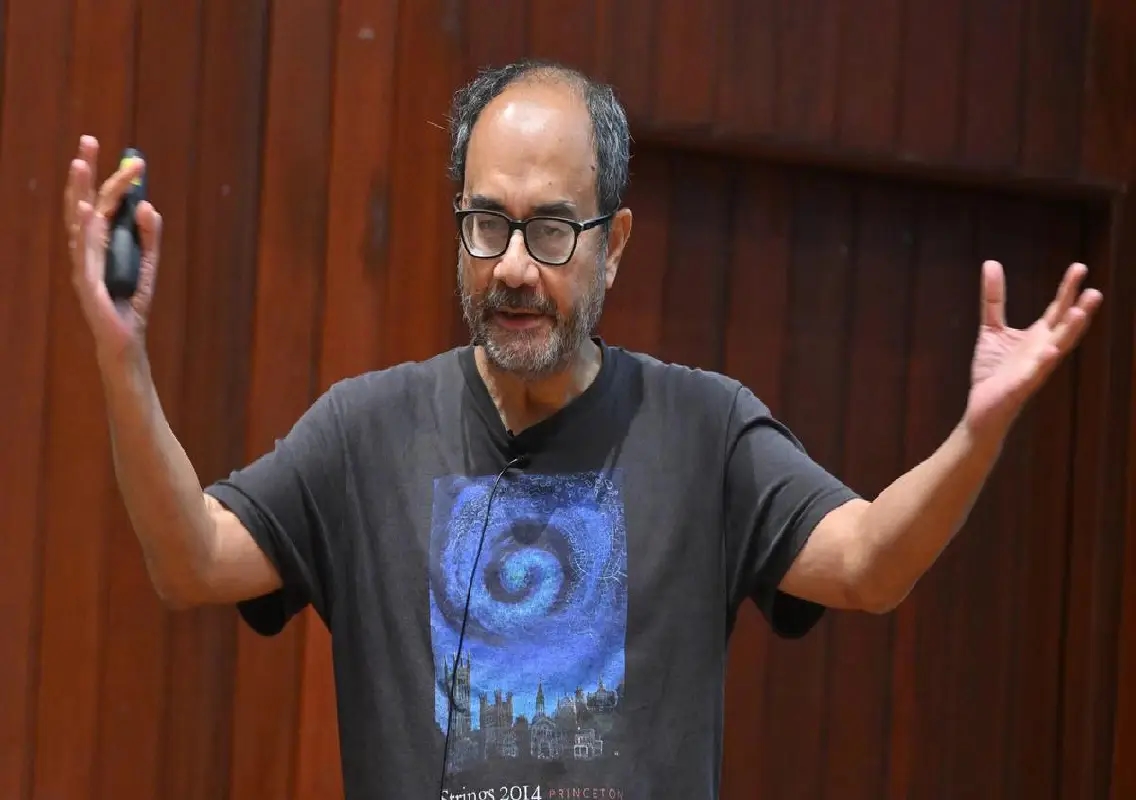


Bengaluru: Indian theoretical physicist Ashoke Sen has been awarded the 2026 Oskar Klein Medal for his influential contributions to theoretical physics, particularly string theory and research into black holes. The honour recognises his work in advancing scientific understanding of fundamental physical laws and the relationship between gravity and quantum physics.
Sen is an ICTS-Infosys Madhava Chair professor at the International Centre for Theoretical Sciences (ICTS), part of the Tata Institute of Fundamental Research (TIFR), in Bengaluru. He is widely recognised for research that has helped shape modern string theory and deepen scientists’ understanding of the mathematical structures underlying the universe.
The medal is awarded in connection with the Oskar Klein Memorial Lectures at Stockholm University, with the Nobel Committee for Physics of the Royal Swedish Academy of Sciences associated with the honour. Sen delivered his memorial lecture, titled Gravity from strings and strings from gravity, on October 22 at the AlbaNova University Centre in Stockholm.
The award places Sen among distinguished physicists recognised for contributions to fundamental physics and highlights the international reach of theoretical research conducted by Indian scientists.
What is string theory, and why does it matter?
String theory is a theoretical framework that attempts to describe the universe at its most fundamental level. Unlike conventional models that treat elementary particles as point-like objects, string theory proposes that the basic constituents of nature are extremely small, one-dimensional objects called strings.
According to the theory, strings can vibrate in different ways, with each vibrational pattern corresponding to a different particle. This offers a possible framework for describing the range of particles and forces that make up the physical universe.
One of the central motivations behind string theory is the challenge of reconciling gravity with quantum mechanics. Quantum physics explains the behaviour of matter and energy at extremely small scales, while Einstein’s general theory of relativity describes gravity and the structure of space-time on larger scales.
Both theories have been extensively tested within their respective domains, but combining them into a single, consistent framework remains a major challenge in theoretical physics.
The problem becomes particularly significant in extreme environments such as black holes, where gravity is exceptionally strong and quantum effects are expected to play an important role.
Sen’s research has contributed to efforts to understand these questions, particularly through investigations into string theory, quantum gravity and the microscopic properties of black holes.
Ashoke Sen’s contributions to theoretical physics
Sen has made influential contributions to several areas of string theory, including S-duality, string field theory and the microscopic understanding of black-hole entropy. His research has helped scientists explore how apparently different theoretical descriptions can be connected and how quantum principles can explain properties of gravitational systems.
S-duality is a concept that establishes relationships between different descriptions of a physical system. In string theory, these relationships can reveal connections between theories that may appear distinct when studied separately. Sen’s work on dualities has helped researchers investigate the deeper mathematical structures linking different formulations of string theory.
His contributions to string field theory have also advanced efforts to develop a more comprehensive description of string interactions. String field theory provides a framework for studying how strings interact and how their dynamics can be expressed mathematically.
Another important area of Sen’s research is black-hole entropy. In physics, entropy is associated with the number of microscopic configurations that can correspond to a system’s overall properties. Black holes present a particularly challenging problem because their thermodynamic properties must be reconciled with the principles of quantum mechanics.
Sen’s work on the microscopic counting of black-hole states has contributed to efforts to explain black-hole entropy within string theory. Such research is important to understanding how gravity, quantum mechanics and the information associated with black holes might fit into a consistent theoretical framework.
These areas of investigation are central to some of the most difficult questions in modern theoretical physics. Although a complete, experimentally confirmed theory of quantum gravity remains elusive, research into string theory and black-hole physics continues to provide mathematical tools and insights for exploring the problem.
Breakthrough Prize and Padma honours
The Oskar Klein Medal adds to a list of major honours recognising Sen’s contributions to science.
In 2012, he received the Breakthrough Prize in Fundamental Physics for his work in string theory. His research contributed to the understanding that different string theories could be interpreted as different limits of a deeper underlying theoretical framework.
This idea has been significant in efforts to understand the relationships between different formulations of string theory and whether they might form part of a more comprehensive description of nature.
Sen was also awarded the Padma Shri in 2001 and the Padma Bhushan in 2013 for his contributions to science. The two civilian honours recognise his work and standing in the scientific community.
His career illustrates the international impact of theoretical research carried out by Indian scientists. Work in fundamental physics often involves complex mathematical problems whose implications may extend across several fields, including quantum theory, cosmology and the study of black holes.
Oskar Klein Medal and its distinguished recipients
The Oskar Klein Medal was established in 1988 in honour of Swedish theoretical physicist Oskar Klein, known for his contributions to theoretical physics. It is associated with the Oskar Klein Memorial Lectures, which bring distinguished researchers to Stockholm to discuss important developments in physics.
Previous recipients include several prominent figures in the field. Physicist Stephen Hawking received the medal in 2003, while Peter Higgs was honoured in 2009. Kip Thorne received it in 2016.
Other recipients include Nobel laureates Hans E. Bethe, who received the honour in 1990, Steven Weinberg in 1989 and Chen Ning Yang in 1988.
The award recognises contributions to fundamental physics and provides a platform for researchers to discuss questions at the frontiers of scientific understanding.
Sen delivered his lecture, Gravity from strings and strings from gravity, on October 22 at the AlbaNova University Centre in Stockholm. The title reflects a central theme in his research: exploring the relationship between string theory and gravity, and how insights from one may help explain the other.
Announcing the achievement, the International Centre for Theoretical Sciences highlighted Sen’s pioneering work on S-duality, black-hole entropy and string field theory, noting their role in shaping modern string theory.
Recognition for Indian theoretical physics
Sen’s award brings international attention to India’s contribution to fundamental research. Theoretical physics often advances through long-term investigations into mathematical relationships and physical principles, even when the practical applications of that work are not immediately apparent.
Research into string theory and black holes has helped scientists develop new ways of examining questions about the origin, structure and behaviour of the universe. Sen’s work has contributed to this wider effort by exploring connections between theories and investigating how quantum mechanics may explain the properties of gravitational systems.
His recognition with the 2026 Oskar Klein Medal underscores the significance of these contributions and his place in the international theoretical physics community.