







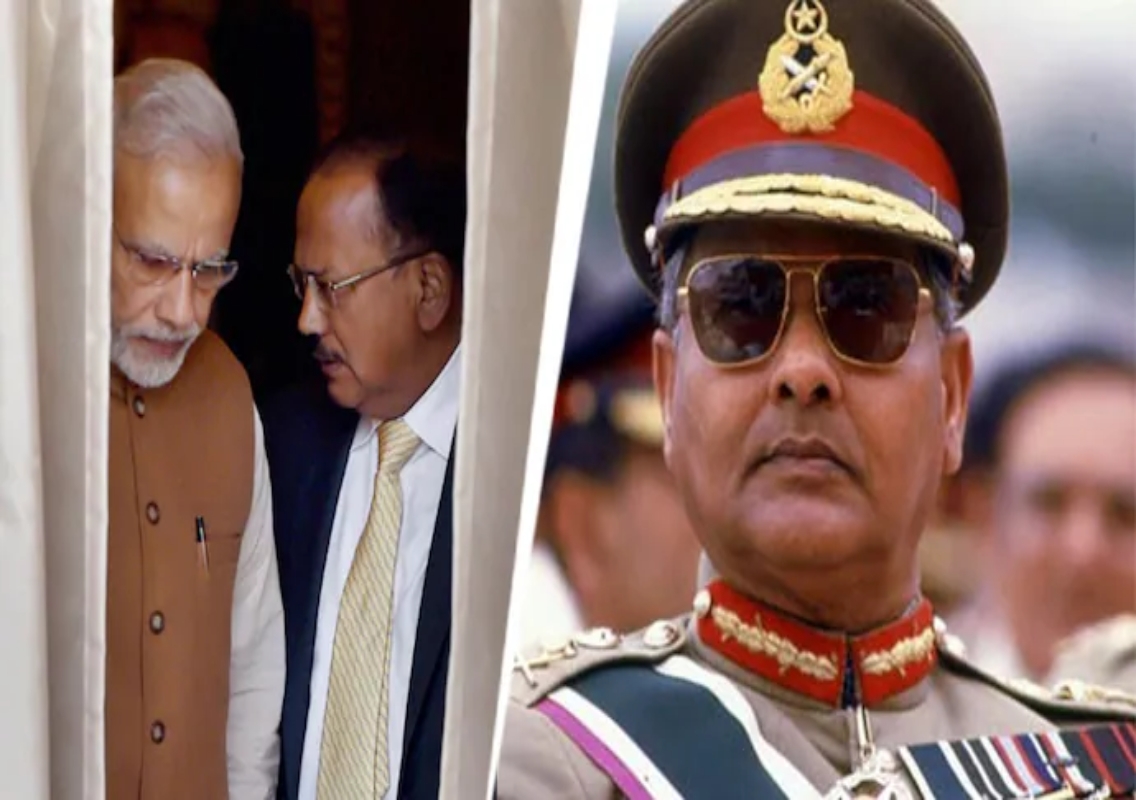


New Delhi: Ten years after India carried out the 2016 surgical strikes across the Line of Control (LoC), the country’s approach to cross-border terrorism has evolved from a policy of restraint towards a strategy that publicly emphasises retaliation and deterrence.
An India Today analysis published on September 29 examines this shift through what it describes as the Modi-Doval doctrine and contrasts it with the earlier strategy associated with former Pakistan Army chief General Mirza Aslam Beg. The analysis links the change to India’s responses to cross-border terrorism, including the 2016 surgical strikes, the 2019 Balakot airstrike and Operation Sindoor in 2025.
The comparison centres on the challenge posed by Pakistan’s nuclear capability and the question of whether nuclear deterrence could restrict India’s conventional military response to terrorist attacks.
2016 surgical strikes marked a public shift
The September 28-29, 2016 surgical strikes followed the terrorist attack on an Indian Army camp in Uri on September 18, in which 19 soldiers were killed.
Indian special forces crossed the LoC and targeted terrorist launchpads in Pakistan-occupied Kashmir. Unlike earlier covert cross-border operations, the 2016 action was publicly acknowledged by India.
On September 29, the then Director General of Military Operations, Lieutenant General Ranbir Singh, announced that the Army had conducted what officials described as counter-terrorist operations and reported significant casualties among terrorists and those supporting them.
The public acknowledgement was significant because it came after both India and Pakistan had acquired nuclear weapons capability in 1998. India had previously conducted cross-border operations, including the reported 2011 Operation Ginger, but those operations were not officially acknowledged at the time.
What is the General Beg doctrine?
The India Today analysis traces an earlier Pakistani strategic concept to General Mirza Aslam Beg, who served as Pakistan Army chief from 1988 to 1991.
The concept described in the report is commonly referred to by Indian strategic analysts as Nuclear Weapons Enabled Terrorism (NWET). Its basic premise, according to the analysis, was that Pakistan’s nuclear capability could provide a strategic umbrella under which conventional activity and lower-intensity conflict could continue without triggering a full-scale Indian military response.
Beg oversaw Pakistan’s Zarb-e-Momin military exercises in 1989, which were based on a concept of offensive defence. The exercises took place against the backdrop of growing Pakistan-supported militancy in Jammu and Kashmir.
The analysis argues that the combination of nuclear deterrence and support for militant groups created a difficult strategic problem for India because a conventional response carried the risk of escalation between two nuclear-armed states.
Years of Indian restraint
India faced several major terrorist attacks during the period in which this strategic calculation was prominent.
The India Today analysis points to the December 2001 attack on Parliament, the Mumbai attacks of 2006 and 2008, and other attacks attributed to Pakistan-based militant groups. It notes that India did not respond to these attacks with publicly acknowledged cross-border military strikes.
The analysis also places the 1990s and early 2000s in the context of concerns over nuclear escalation. Pakistan’s development of nuclear weapons altered the strategic environment, while the Kargil conflict of 1999 further demonstrated the risks associated with military confrontation between the two countries.
According to the analysis, Pakistan’s military subsequently expanded its use of militant proxies, including Lashkar-e-Taiba and Jaish-e-Mohammed, while the possibility of nuclear escalation remained a central consideration.
From surgical strikes to Balakot
The 2016 operation was followed by another publicly acknowledged cross-border strike in 2019, when India carried out an airstrike at Balakot after the Pulwama terrorist attack.
The sequence represented a progression in India’s publicly stated willingness to use military force beyond the immediate LoC area in response to terrorism.
India’s stated position was further articulated after Operation Sindoor in May 2025. Prime Minister Narendra Modi said India would respond to terrorist attacks on its own terms and would not accept nuclear threats as a reason to refrain from targeting terrorist infrastructure.
The government has described Operation Sindoor as a change in India’s counter-terrorism approach. Prime Minister Modi outlined principles including a decisive response to terrorism, opposition to what he called nuclear blackmail, and a refusal to distinguish between terrorist masterminds and those sponsoring terrorism.
Operation Sindoor raised the threshold further
Operation Sindoor became another important point in the evolution of India’s publicly stated counter-terrorism doctrine.
According to the Prime Minister’s official account, the operation involved strikes against terrorist infrastructure and followed the April 2025 Pahalgam terror attack. The government subsequently described the operation as establishing a new standard for India’s response to cross-border terrorism.
The exact military and strategic interpretations of the operation remain subject to competing accounts and analysis. However, the government’s publicly stated position is that nuclear threats will not prevent India from responding to terrorism.
In September 2026, Defence Minister Rajnath Singh also said India’s counter-terrorism approach had evolved from “deterrence by denial” towards “deterrence by punishment”. He further said that a terror attack originating from Pakistani soil would be treated as an act of war against India.
These statements provide a current official description of the strategic thinking behind India’s counter-terrorism posture.
Why nuclear deterrence remains central
The India-Pakistan security relationship remains particularly sensitive because both countries possess nuclear weapons.
The central strategic question is how far either country can escalate a conventional confrontation without creating risks of a wider conflict.
The strategy attributed to General Beg relied on the belief that nuclear weapons could constrain India’s willingness to respond militarily. India’s more recent public doctrine, as described by its government, seeks to challenge that assumption by maintaining that nuclear threats will not prevent targeted action against terrorist infrastructure.
This does not remove the risks associated with escalation. Instead, it changes the signalling around how India says it intends to respond to future terrorist attacks.
Ajit Doval’s role in the strategic shift
National Security Advisor Ajit Doval has been closely associated with India’s national security decision-making during the period in which the country’s counter-terrorism policy became more publicly assertive.
The India Today analysis frames the Modi-Doval approach as an attempt to overcome what it describes as the strategic constraints created by Pakistan’s nuclear capability and its support for militant proxies.
The article links this evolution to a series of responses rather than to a single operation. The 2016 surgical strikes, 2019 Balakot airstrike and 2025 Operation Sindoor are presented as stages in an increasingly explicit policy of retaliation.
A decade after the surgical strikes
The 10th anniversary of the 2016 surgical strikes has brought renewed attention to the evolution of India’s counter-terrorism policy.
Prime Minister Modi, in his September 27, 2026 Mann Ki Baat address, described the surgical strikes as a decisive response to terrorism and said India had repeatedly demonstrated its willingness to respond strongly, from Balakot to Operation Sindoor.
The government has therefore presented the last decade as a period in which India’s response to terrorism became more overt and deterrence-focused.
The India Today analysis, meanwhile, places that evolution against the earlier Pakistani nuclear strategy associated with General Beg. While the two doctrines represent different approaches to the nuclear-security dilemma, the practical consequences of any future India-Pakistan confrontation will depend on the actions of both governments and military establishments.
For now, India’s official position is that terrorist attacks will invite a response and that nuclear threats will not prevent the country from taking action.