







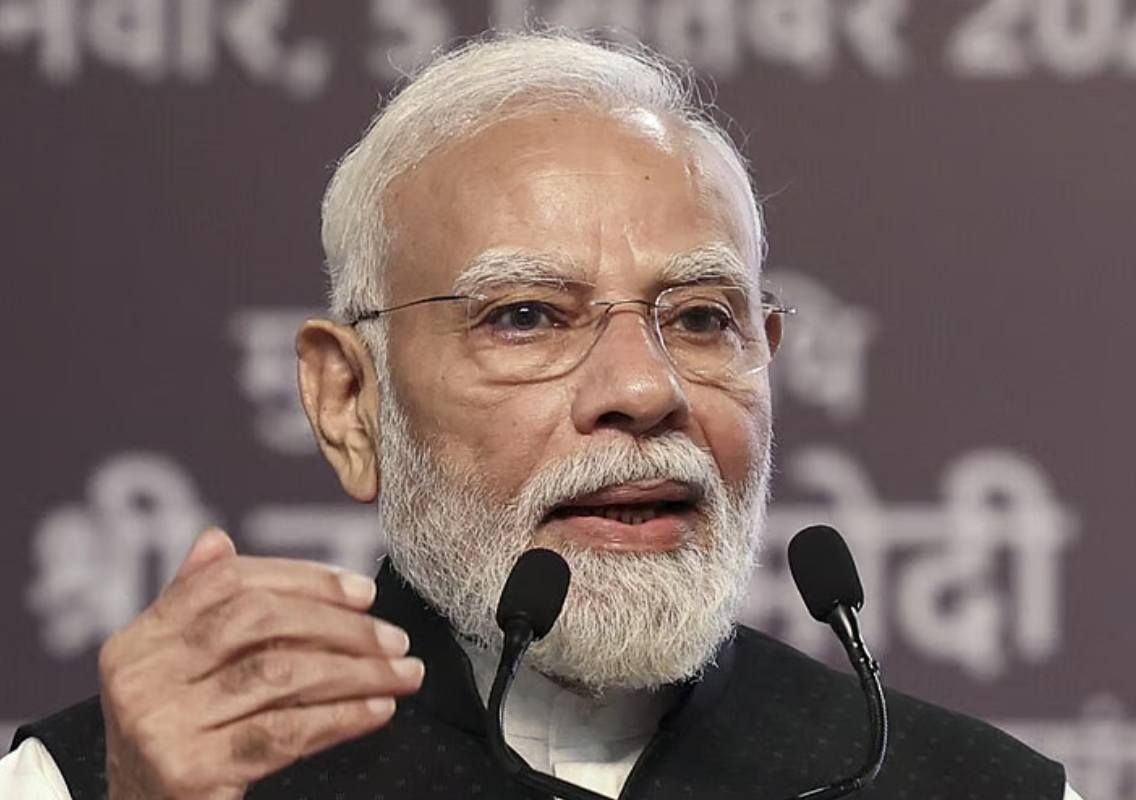


New Delhi: Prime Minister Narendra Modi on Sunday described the Census as a national responsibility and urged citizens to participate in the ongoing exercise, particularly by using the online self-enumeration facility. Addressing the 138th episode of his monthly radio programme Mann Ki Baat, Modi said the first phase of Census 2027 is nearly complete across all states and Union Territories, with data from more than 32 crore families already recorded.
The Prime Minister said more than 2.6 crore people had already entered their details through the Census portal using mobile phones and completed the self-enumeration process. He said accurate information about individuals and families would help create a clearer picture for planning the country’s future.
Census 2027 is being conducted in two phases. The first phase covers houselisting and housing-related information, while the second phase will involve population enumeration. The Office of the Registrar General and Census Commissioner has officially listed the first-phase houselisting period as April 1 to September 30, 2026.
Over 32 crore families covered in first phase
During his address, Modi said the first phase of the Census exercise had nearly been completed nationwide. He noted that information relating to more than 32 crore families had already been recorded.
The Prime Minister also highlighted the progress of the exercise in remote and difficult-to-access regions. Census work is continuing in snow-clad and remote areas of Ladakh, Himachal Pradesh, Jammu and Kashmir and Uttarakhand.
He referred to the beginning of the Census process in Mana village in Uttarakhand’s Chamoli district and mentioned individual experiences from the region as examples of participation in the exercise.
The scale of the operation is substantial. The Union Cabinet approved Census 2027 in December 2025 at an estimated cost of Rs 11,718.24 crore. The government said around 30 lakh field functionaries would be involved in completing the exercise.
More than 2.6 crore complete self-enumeration
A key feature of the current Census exercise is the option for citizens to provide their household information through an online self-enumeration facility.
Modi said more than 2 crore 60 lakh people had already completed self-enumeration using mobile phones. The facility is designed to allow individuals to enter information about themselves and their families before the enumerator visits their homes.
According to the Prime Minister, the facility is available in Hindi and 16 other languages. Citizens can access the Census online portal, log in using their mobile number, enter their location and provide the required family information.
Modi said the online process takes around 15 to 20 minutes and does not require users to upload documents.
Once the information is submitted, a special identification number is generated. Citizens can provide this ID to the Census enumerator when the enumerator visits their residence. The information submitted online is then subject to verification before becoming part of the Census record.
The official Census website also lists self-enumeration and the various notifications governing the Census 2027 process, including the first-phase houselisting operations and the second-phase population enumeration questionnaire.
Why accurate Census data matters
The Census is a major source of demographic information used for public administration, development planning and policy formulation. Data on households, population characteristics and housing conditions can help governments understand changing requirements across regions.
The first phase itself has a specific focus on houses and household conditions. Official Census documentation says houselisting and housing data can provide information on human settlements, housing requirements, amenities and assets, which can be useful for planning at local and state levels.
The second phase will focus on population enumeration. The government has also emphasised the use of digital technology in the exercise, including mobile-based data collection and centralised monitoring.
For citizens, accurate responses are therefore important because the quality of official demographic information depends on the completeness and accuracy of the information collected.
Census work reaches remote regions
The Prime Minister used his address to highlight the logistical scale of the exercise, particularly in areas where geography and weather can make field operations more difficult.
According to Modi, work is continuing in remote and snow-bound regions of Ladakh, Himachal Pradesh, Jammu and Kashmir and Uttarakhand. The government has separately issued notifications setting out the schedule for population enumeration in Ladakh and snow-bound areas of Jammu and Kashmir, Himachal Pradesh and Uttarakhand.
The Office of the Registrar General and Census Commissioner has also issued notifications for population enumeration in other parts of the country, including Goa, Uttar Pradesh, Punjab and non-snow-bound areas of Uttarakhand.
This staggered approach reflects the different logistical requirements involved in conducting the nationwide exercise.
Modi also highlights environment and conservation
Beyond the Census, Modi’s Mann Ki Baat address covered environmental conservation and community-led initiatives.
He referred to the Sonai Rupai Wildlife Sanctuary in Assam, saying elephants had returned to areas from which they had moved away after human interference increased. He attributed the return to efforts to clear encroachments from forest land.
The Prime Minister also highlighted conservation efforts for the pygmy hog in Assam. He said a conservation programme that began with six pygmy hogs and included efforts to restore suitable grassland habitats had helped increase the population to more than 190.
In West Bengal’s Sundarbans, Modi spoke about women from Jharkhali who are involved in creating mangrove forests. He said several of the women had lost their husbands in tiger attacks and had found a livelihood through activities connected to the Sundarbans.
According to the Prime Minister, the mangroves also provide a natural protective barrier for villages while creating an income source for the women involved.
Focus on sports and nutrition
Modi also highlighted efforts to identify sporting talent in rural areas. He referred to former hockey player Rajinder Singh, a member of India’s gold-medal-winning hockey team at the 1980 Olympics, and his work through the Round Glass Hockey Academy.
The Prime Minister said the initiative was helping create hockey facilities in villages and identify children who did not have easy access to quality coaching.
The address also touched upon efforts to combat malnutrition during September. Modi referred to initiatives in Chhattisgarh, Gujarat, Maharashtra and Mizoram and praised the work of Anganwadi centres.
He said the Poshan Tracker has digitally connected Anganwadi centres and has around nine crore beneficiaries registered on the platform. According to Modi, the system is helping improve monitoring and care for children, pregnant women and breastfeeding mothers.
A nationwide exercise requiring public participation
Census 2027 represents a large administrative exercise involving millions of households, field workers and digital systems. The government has introduced self-enumeration as an additional way for citizens to provide household information through their mobile phones.
With the first phase nearing completion, Modi’s appeal places renewed emphasis on citizen participation and accurate information. Official Census documents confirm that the exercise is being carried out in phases, with houselisting and housing census operations forming the first stage and population enumeration following as the second phase.
The Prime Minister’s message was that participation is not merely an administrative formality but an important part of building reliable demographic information. As the Census progresses towards its population-enumeration phase, accurate household information and proper verification will remain central to the exercise.