







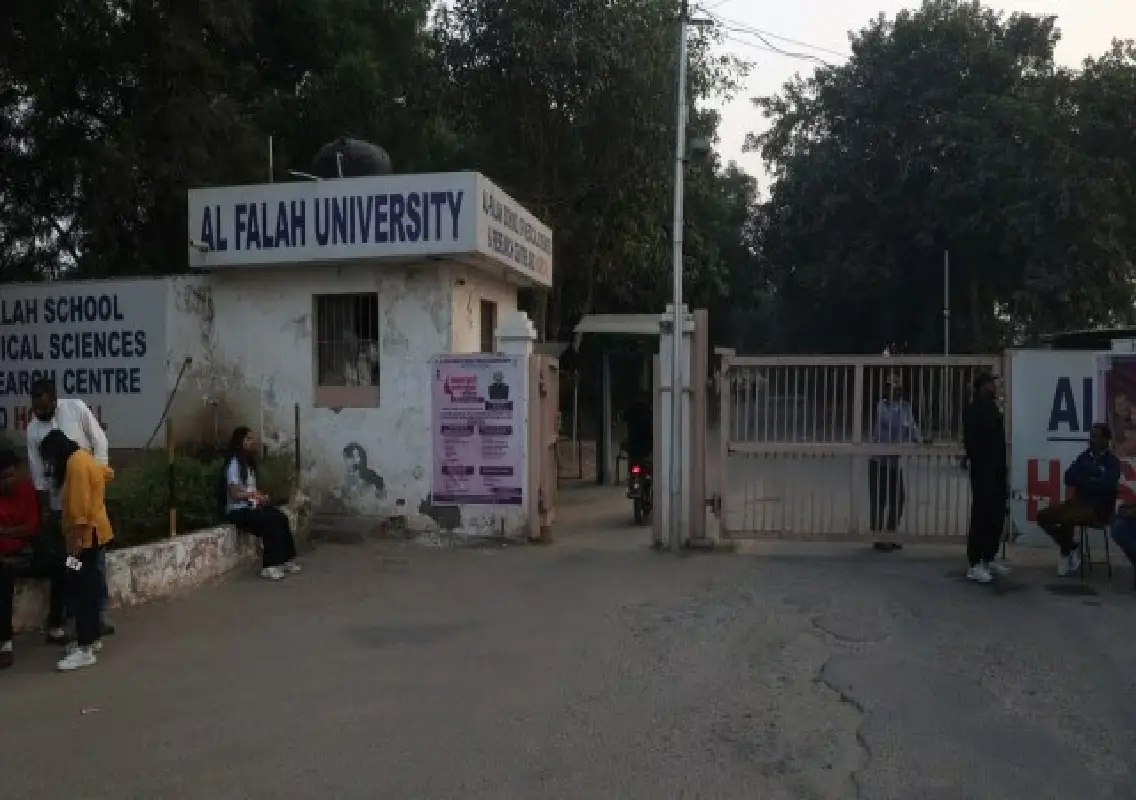


Faridabad: Nearly three weeks after the blast outside Delhi’s Red Fort, investigators have intensified scrutiny of Faridabad’s Al Falah University, where three of the accused were employed. Officials involved in the multi-agency probe said that nearly 48 staff members, including around 30 doctors, have been questioned as agencies attempt to map the movements and interactions of alleged bomber Umar Nabi in the days leading up to the attack.
University employees under scanner as new details emerge
The dismantled Jaish-e-Mohammed module includes Umar Nabi; Pahalgam resident Dr Muzammil Ganai; Lucknow resident Dr Shaheen Shahid Ansari; and Dr Adeel Rather, who was employed at a private hospital in Saharanpur. Another accused, Kashmiri cleric Mufti Irfan Wagay, is also in custody.
On Wednesday, the National Investigation Agency (NIA) arrested a ward boy at Al Falah University, identified as Soyab, for allegedly providing logistical support to Umar before the blast. Investigators believe he assisted Umar with accommodation, movement and other arrangements during his stay.
Multiple staff testimonies have described Umar as withdrawn, unpredictable and difficult to read, often alternating between abrupt rudeness and unexpected friendliness. Officials say the questioning aims to reconstruct his behavioural pattern and identify any covert connections he may have maintained on campus.
Probe extends to private hospitals across Delhi
As the investigation broadens, agencies have directed private hospitals across Delhi to submit records of doctors who earned MBBS degrees in Bangladesh, the UAE, China or Pakistan and are currently practising in the city. Officials said the intent is to map professional networks that may reveal links relevant to the case.
“We suspect Umar’s network extended beyond Al Falah,” an investigator said, while cautioning that this line of enquiry remains at a preliminary stage.
The directive reflects agencies’ growing concern that academic and professional affiliations may have been exploited to widen operational reach or recruit sympathisers.
Umar’s recovered phone emerges as key evidence
A major breakthrough came when Jammu and Kashmir Police recovered Umar’s mobile phone from a drain in Pulwama. The device, now with investigators, has provided crucial call detail records and communication logs. These are being examined to identify individuals Umar interacted with or received instructions from.
The Delhi Police Special Cell, which has opened a parallel case to investigate what it calls a “deeper conspiracy”, is analysing the data to determine whether the accused were part of a larger network operating across states.
University rooms sealed, CCTV footage reviewed
Investigators have sealed two rooms in Building No. 17 of the boys’ hostel at the university, previously occupied by Umar and Dr Ganai. Authorities also searched a rented room near the campus where several hundred kilos of explosive-making material had been discovered earlier.
CCTV footage from within the university premises is being examined to trace Umar’s movements, visitors and any suspicious interactions. Staff members have been questioned at multiple locations, including their homes, the campus and agency offices.
Al Falah University has distanced itself from the accused, stating earlier that it has “no connection with the said persons apart from their official roles” and calling reports linking the institution to the case “baseless and defamatory”.
Investigators continue to track wider conspiracy
Officials say multiple agencies are now working to determine whether the module acted independently or was connected to a broader network with inter-state or foreign links. With new evidence emerging regularly, the enquiry is expected to continue for several weeks.
Given the symbolic significance of the Red Fort and the nature of the attack, agencies are prioritising detailed background checks, forensic analysis and verification of every individual linked to the accused.