







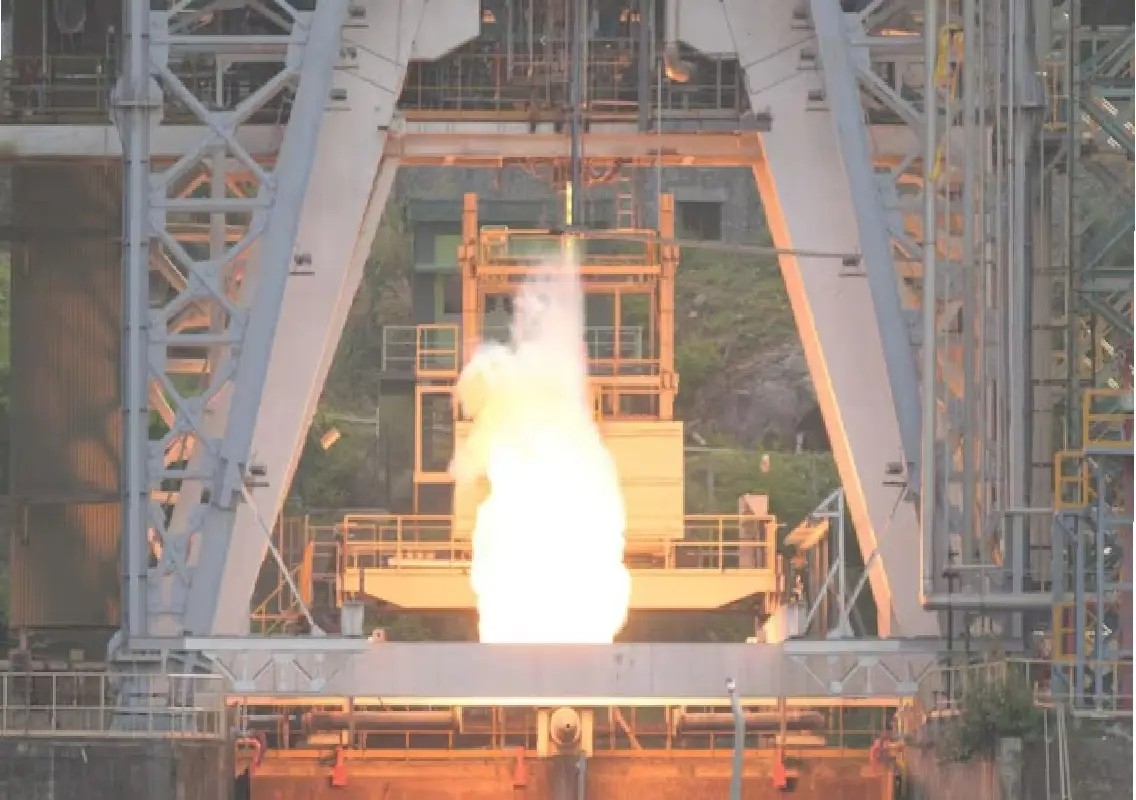


Bengaluru: India has moved a step closer to launching its first human spaceflight mission after the successful hot test of a new semi-cryogenic rocket engine, with Indian Space Research Organisation (ISRO) Chairman V. Narayanan describing the achievement as a major milestone for the country’s space programme.
Speaking to reporters on June 27, Narayanan said the successful test conducted on June 24 at the ISRO Propulsion Complex marked another important step towards the ambitious Gaganyaan mission.
What exactly did ISRO test?
The space agency tested only the power head of the semi-cryogenic engine, the section responsible for pumping fuel and oxygen into the engine at extremely high pressure.
The thrust chamber, where the propellants ignite and generate thrust, was deliberately left out of the test.
During the trial, engineers successfully operated the power head at 175 tonnes of thrust, equivalent to around 88 per cent of the engine’s full capacity. It was the eighth test in the development programme, following earlier runs at 47 per cent and 60 per cent of full power.
Why was only the power head tested?
The power head is considered the most complex and critical part of the engine.
At its core are turbopumps that force fuel and oxygen into the combustion chamber at pressures of around 400 and 500 bar. By testing this section independently, scientists can verify the performance of these systems without exposing the entire engine assembly to risk.
Narayanan said the successful test has given ISRO confidence to proceed towards firing the complete engine in the next phase.
What is a semi-cryogenic engine?
Unlike fully cryogenic engines that use both fuel and oxidiser at extremely low temperatures, a semi-cryogenic engine uses liquid oxygen along with refined kerosene as fuel.
The use of kerosene offers several advantages, including lower costs, easier storage and higher fuel density.
The technology is expected to provide more thrust at lower costs and will play a key role in enabling India to launch heavier satellites, develop future space stations and undertake more ambitious deep-space missions.
What did the ISRO chief say about Gaganyaan?
Narayanan reiterated that the Gaganyaan mission is highly technology-intensive and cannot be rushed.
Before sending astronauts into space, ISRO plans to conduct three uncrewed missions to validate every critical system involved in human spaceflight.
According to the ISRO chairman, work on the first uncrewed mission is already under way and launch dates are expected to be announced shortly. He also indicated that the required satellites are ready.
What comes next for the new engine?
The next major milestone will be to test the power head at its full capacity of 200 tonnes of thrust.
Following that, ISRO will proceed with testing the complete semi-cryogenic engine.
The successful June 24 test has provided sufficient confidence for the agency to move towards these advanced stages of development.
Which rocket will use the engine?
The engine is being developed for a new booster stage known as the SC120 stage, powered by the 2,000-kilonewton SE2000 engine.
The stage is designed to replace the existing L110 core stage of the LVM3 rocket, which has been selected for the Gaganyaan mission.
The upgrade is expected to significantly enhance the rocket’s payload-carrying capability and operational efficiency.
Cleaner and indigenous technology
The engine uses liquid oxygen and a purified indigenous kerosene developed by ISRO, named Isrosene.
Both propellants are considered safer and more environmentally friendly than older hydrazine-based fuels, which are highly toxic.
ISRO described the successful test as a major milestone in the indigenous development of semi-cryogenic propulsion technology, a capability currently possessed by only a handful of countries.
What is human-rating?
Human-rating refers to the process of certifying a launch vehicle originally designed for carrying cargo as safe enough to transport astronauts.
The process requires additional safety systems, multiple layers of redundancy and an escape mechanism capable of pulling astronauts to safety in the event of an emergency.
If the Gaganyaan mission succeeds, India will become only the fourth nation after Russia, the United States and China to independently launch humans into space.
Conclusion
The successful semi-cryogenic engine test marks another significant step in India’s journey towards human spaceflight. With the Gaganyaan programme progressing steadily and critical technologies being validated, ISRO is moving closer to achieving one of the country’s most ambitious scientific milestones.