







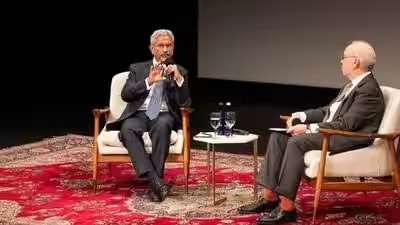


New Delhi: External Affairs Minister S Jaishankar has identified India’s concerns over cross-border terrorism and difficulties in trade negotiations as key issues affecting the country’s relationship with the United States.
Speaking at an Asia Society event in New York following the United Nations General Assembly’s High-Level Week, Jaishankar said India expects its partners to understand the importance it attaches to terrorism, particularly because of its experience with attacks originating from a neighbouring country.
Jaishankar’s comments come at a time when India-US relations are dealing with several areas of cooperation as well as differences, including trade, tariffs, energy and broader geopolitical developments.
Terrorism remains a core Indian concern
Jaishankar said terrorism originating from India’s neighbourhood remains one of New Delhi’s primary concerns.
He argued that India’s experience of cross-border terrorism over several decades makes the issue particularly sensitive for the country. According to the minister, when partners do not sufficiently understand or appreciate this concern, it can affect the wider bilateral relationship.
The comments come amid India’s continued focus on terrorism in international forums. At the UN General Assembly on September 26, Jaishankar referred to a country without naming Pakistan as a “serial practitioner of terrorism” and said attempts to normalise terrorism or claim immunity from its consequences would not be accepted.
At the Asia Society event, Jaishankar said the issue was not simply about diplomatic disagreements but about India’s security experience and how that is understood by its partners.
His remarks also came against the backdrop of recent US engagement with Pakistan, an issue that has attracted attention in discussions about India-US relations.
Trade talks face a new complication
Trade negotiations were another issue Jaishankar highlighted while discussing the relationship with Washington.
He said India and the US had reached “more or less an understanding” on a trade agreement but that changes in the US tariff framework had introduced a new complication.
Jaishankar pointed to the US shift away from the earlier reciprocal tariff framework and the use of Section 301 as a new basis for tariff action. He said the ongoing Section 301 process had created an additional hurdle in determining how and when the broader agreement could be concluded.
The minister described the trade negotiations as complicated partly because of differences between the two economies.
India has a large base of small farmers, producers and factories, while the US economy has a different production structure and substantially higher per-capita income. Jaishankar said these differences meant negotiations required patience and detailed discussions.
India’s Trade Minister Piyush Goyal is scheduled to visit the US from September 29 to October 5 for discussions aimed at advancing the proposed India-US Bilateral Trade Agreement. Reuters reported that the two sides had not yet reached a final consensus despite months of negotiations.
Tariff changes add uncertainty
The trade issue has become more complicated as US tariff policies have evolved.
Jaishankar said the change in the legal basis for tariff imposition had created what he described as “bumps” in the relationship.
He indicated that concluding the trade agreement could remove one source of uncertainty and contribute to improved bilateral ties.
The comments follow recent discussions between Jaishankar and US Secretary of State Marco Rubio in New York. The two sides discussed bilateral relations as well as the implications of a US law authorising tariffs of up to 100 per cent on countries purchasing Russian oil and gas, including India.
India has said it would protect its economic interests and energy security in response to the US measures.
Public opinion increasingly shapes diplomacy
Jaishankar also pointed to the growing role of public opinion in international relations.
He said diplomacy was no longer conducted only by governments, ministers and diplomats. Social media, he noted, had created a much larger public-opinion component, particularly in democratic countries.
According to Jaishankar, economic mobility and the politics surrounding mobility can sometimes move in different directions, creating challenges for governments trying to manage international relationships.
The minister said India would like the relationship with the US to move in an upward direction, while acknowledging that this would require both countries to address the issues creating friction.
India-China ties show signs of improvement
Jaishankar also spoke about India’s relationship with China, saying it had improved compared with 2025 and even more significantly compared with 2024.
He linked the improvement to the easing of the border standoff that followed the tensions of 2020.
According to Jaishankar, India had consistently conveyed to Beijing that a prolonged border standoff and deterioration in bilateral relations would not benefit either country.
He said the two sides had arrived at a basic principle that the state of the border has a direct bearing on the overall state of the relationship.
“When the border comes back more towards normalcy, the relationship comes back more towards normalcy,” Jaishankar said, according to reports of his remarks.
The relationship between India and China had been severely affected by the 2020 border crisis and the subsequent prolonged military standoff. Jaishankar said the restoration of greater normalcy along the border created conditions for broader bilateral engagement to improve.
Ukraine and Iran-Gulf conflicts raise economic concerns
Jaishankar also discussed the effects of international conflicts on developing economies, particularly through energy and food security.
He highlighted the Ukraine conflict and the Iran-Gulf conflict as sources of pressure on the Global South.
According to the minister, disruptions in energy supplies can increase prices at a time when economies are already dealing with market uncertainty. He also pointed to the interaction between geopolitical tensions and the politics surrounding energy supplies.
Food security was another concern raised by Jaishankar. He referred to potential disruptions involving major grain exporters and fertiliser shortages, while also warning about weather-related risks.
The comments reflect broader concerns India has raised at the UN over the spillover effects of conflicts on countries that are not directly involved in them. During his UNGA address, Jaishankar called for de-escalation and the protection of uninterrupted energy and trade routes.
Jaishankar sees a more multipolar world
The external affairs minister also said the world was moving visibly towards greater multipolarity.
He argued that countries in an increasingly competitive international environment would seek reliable and stable partners while also diversifying their relationships.
Jaishankar said countries could strengthen their position by building a reputation for being stable, consistent and predictable. He also suggested that diversification and the identification of common interests could create a broader balancing structure in international affairs.
The minister said major trading economies would have an interest in avoiding excessive volatility because their economies are deeply connected to international trade and supply chains.
His comments reflect India’s broader approach of maintaining relationships with multiple major powers rather than relying exclusively on any single strategic or economic partner.
India navigates a changing global order
Jaishankar’s remarks in New York covered several interconnected challenges facing Indian diplomacy, from terrorism and trade to relations with China and the economic consequences of conflicts.
For India-US ties, terrorism concerns and trade negotiations remain important areas where New Delhi is seeking greater understanding and progress. At the same time, the two countries continue to engage on strategic and regional issues.
The proposed trade agreement remains under negotiation, while US tariff policy and India’s concerns over energy security have added complexity to the economic relationship.
India’s relationship with China, meanwhile, has shown signs of improvement following steps towards easing the border standoff, although the broader relationship remains closely linked to developments along the frontier.
Jaishankar’s broader message was that the international system is becoming more competitive and fragmented, making diversification, stability and predictable partnerships increasingly important for countries such as India.