







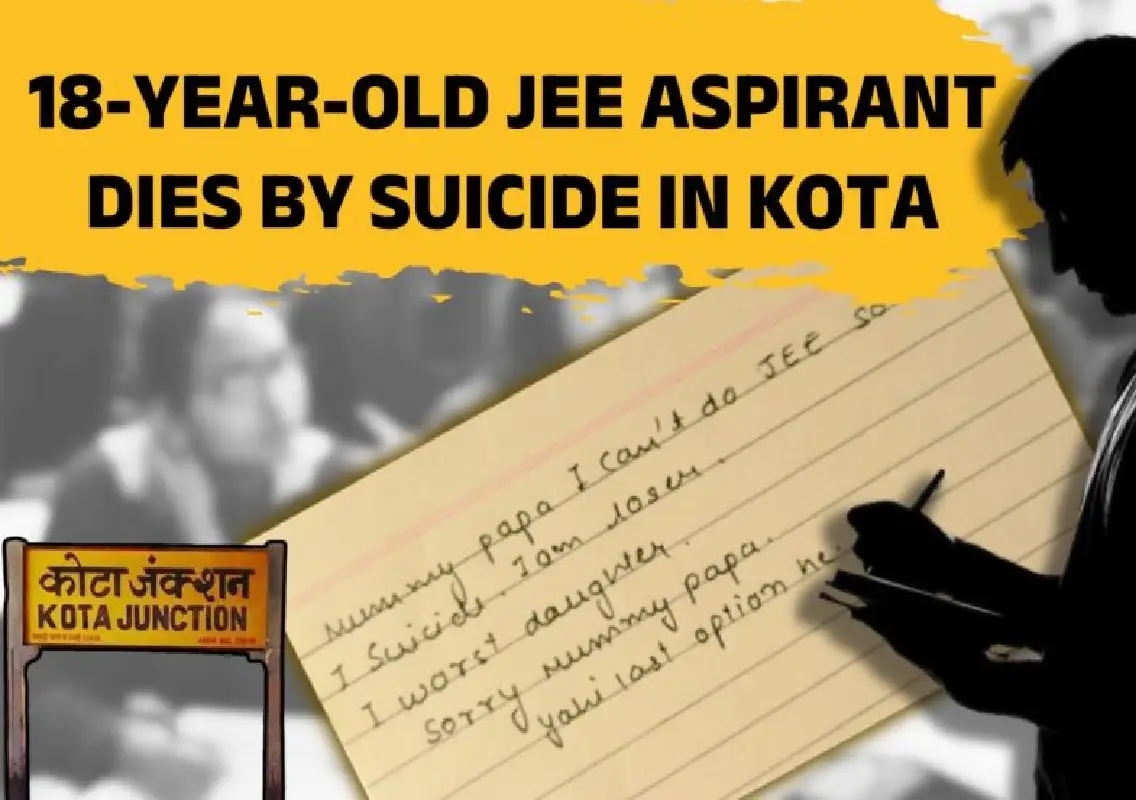


A 17-year-old student preparing for the Joint Entrance Examination (JEE) died by suicide in Kota on Sunday night, marking the first such incident reported this year in the country’s largest coaching centre.
Police said the teenager, a resident of Sirsa district in Haryana, jumped before a moving train near the Delhi–Mumbai railway track in the Udhyog Nagar area around 8.30 pm. He had been living in a hostel in Rajeev Gandhi Nagar for the past two years while preparing for the highly competitive engineering entrance exam.
Incident near railway track
Udhyog Nagar SHO Jitendra Singh said the student was supposed to return to his village on Sunday. “In his last phone call, he told his parents that his train was delayed by nearly three hours. Soon after the call, he reached the station area and jumped before a train,” the officer said.
The body was sent for post-mortem, and police said no suicide note was recovered. Further inquiry is underway to understand the circumstances leading to the incident.
Kota’s continuing struggle with student suicides
Kota, widely regarded as India’s test-preparation capital, attracts thousands of students every year for coaching related to JEE and NEET. The coaching industry in the district is estimated to be worth nearly ₹10,000 crore annually, according to district officials.
Despite repeated assurances and initiatives, student suicides remain a major concern. Last year, at least 18 students died by suicide in Kota, while similar cases were also reported from Sikar and Jodhpur. In 2024 alone, around 20 student deaths were recorded in Kota.
Students often relocate to the city after Class X, enrol in residential coaching institutes, and face intense academic pressure, isolation and performance anxiety.
Renewed calls for support systems
The latest incident has once again sparked calls for stronger mental health support, better monitoring of student wellbeing, and accountability among coaching institutes and hostels.
Experts have repeatedly stressed the need for counselling services, peer support mechanisms and early intervention to prevent such tragedies.