







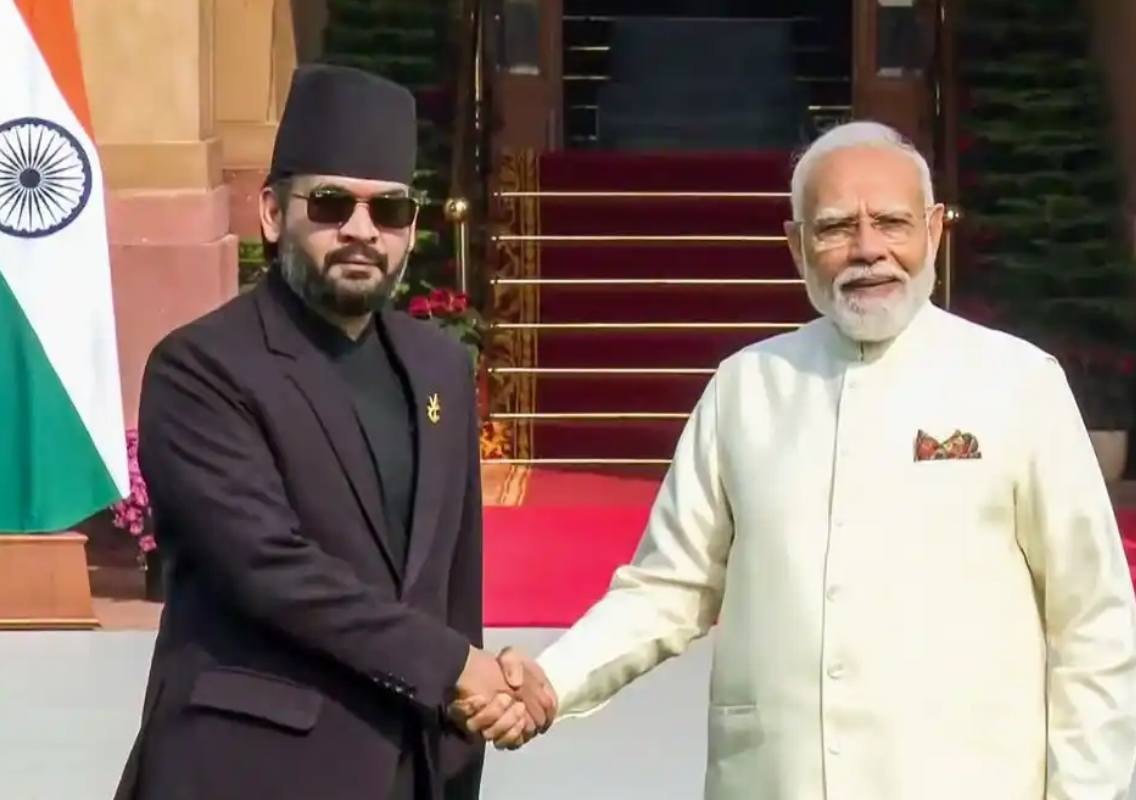


New Delhi: Prime Minister Narendra Modi on Monday highlighted the deep religious and cultural ties between India and Nepal, saying that “Nepal ke bina hamare Ram bhi adhure hain” (Lord Ram is incomplete without Nepal), as he welcomed Nepal Prime Minister Balendra Shah on his first bilateral visit to India.
Addressing a joint press conference after bilateral talks, Modi said the relationship between the two countries was built on shared history, faith, culture and strong people-to-people connections. He recalled his 2018 visit to Janakpur in Nepal, where he had spoken about the close connection between India’s sacred pilgrimage sites and the story of Lord Ram.
“India and Nepal’s relationship is woven through threads of shared history, faith, culture and deep people-to-people ties. Lord Ram and Mata Sita are symbols of our shared civilisation and faith,” Modi said.
The two leaders also flagged off the Sarayu-Kamala Express, connecting Ayodhya Dham in India with Janakpur Dham in Nepal. The service is expected to strengthen religious tourism and make travel easier for pilgrims visiting the two important sites associated with the Ramayana.
Ayodhya-Janakpur train to strengthen religious ties
The launch of the Sarayu-Kamala Express was among the key highlights of Shah’s visit.
The train service is expected to help devotees from Nepal travel to Ayodhya to seek the blessings of Ram Lalla. Similarly, pilgrims from India will be able to visit Janakpur, revered as the birthplace of Goddess Sita.
Modi said the new rail connection would give another dimension to the long-standing cultural and religious relationship between the two countries.
The Prime Minister also recalled his earlier visit to Janakpur and said India’s religious traditions could not be viewed separately from Nepal’s cultural heritage.
The reference to Lord Ram and Mata Sita underscored the shared significance of the Ramayana across the two countries. Janakpur is closely associated with Sita, while Ayodhya is revered as the birthplace of Lord Ram.
Modi said the relationship between India and Nepal went beyond conventional diplomatic ties, reflecting a shared civilisational connection.
Modi welcomes Balen Shah on first bilateral visit
Welcoming Shah, Modi said their discussions had given him a clearer understanding of the Nepalese leader’s vision for his country and its relationship with India.
“I am very happy to welcome Balen Shah to India on his first bilateral visit after becoming the Prime Minister of Nepal. A few months ago, when he addressed the United Nations as the world’s youngest Prime Minister, we had a clear glimpse of his vision,” Modi said.
He added that Shah’s electoral mandate reflected the aspirations and expectations of Nepal’s younger generation.
The visit marks an important diplomatic engagement between the neighbouring countries, with discussions covering development cooperation, trade, infrastructure, energy and education.
India announces Rs 15,000 crore development package
Modi announced a development cooperation package worth 24,000 crore Nepalese rupees, equivalent to approximately Rs 15,000 crore, to support Nepal’s reconstruction and long-term development.
The announcement comes after Nepal suffered significant loss of life and damage during devastating floods in August.
“We express our deep condolences for the loss of lives caused by the devastating floods in Nepal in August. India will always be a partner in Nepal’s development journey towards a strong and prosperous nation,” Modi said.
He said India and Nepal shared a relationship based on mutual trust and support, with both countries standing by each other during difficult times.
The package is intended to strengthen India’s development partnership with Nepal and support its efforts to rebuild infrastructure and pursue long-term economic growth.
New road and border infrastructure projects announced
Connectivity was another major focus of the discussions, with the two leaders reviewing projects involving roads, railways and border infrastructure.
Modi announced the inauguration of the Dharchula road bridge connecting Uttarakhand with Nepal. The bridge is expected to improve cross-border movement and strengthen local connectivity.
He also announced the laying of the foundation stone for an integrated check post at Banbasa. India will accelerate the development of the Dodhara-Chandani integrated check post in Nepal, he said.
These projects are expected to improve the movement of people and goods across the border and support trade between the neighbouring countries.
Modi also announced that India would provide Nepal access to the ports of Kandla and Paradip to facilitate transit trade.
Improved access to these ports is expected to support Nepal’s trade requirements by expanding its options for transporting goods through Indian infrastructure.
The Prime Minister said better connectivity and increased investment would contribute to Nepal’s economic development.
India-Nepal energy cooperation to receive fresh push
The two countries also discussed expanding cooperation in the energy sector, particularly Nepal’s hydropower potential.
Modi announced the foundation stone for the Lower Arun hydroelectric project and reiterated India’s commitment to completing the Arun-3 project according to schedule.
Hydropower has remained an important area of economic cooperation between India and Nepal, with the latter possessing substantial potential to generate electricity from its rivers.
Modi also said India had continued supplying fuel, fertilisers and essential commodities to Nepal despite serious challenges related to oil supplies during the year.
The two sides announced further steps to strengthen energy infrastructure. These include the inauguration of Phase 2 of the Motihari-Amlekhgunj petroleum pipeline and the laying of the foundation stone for a petroleum terminal in Jhapa.
The projects are expected to improve the reliability of fuel supplies and deepen energy cooperation between the countries.
IIT campus, startup incubator and scholarships for Nepal
Education, innovation and entrepreneurship also featured in the discussions.
Modi announced that India would establish a startup incubator and an innovation hub in Nepal. An offshore campus of the Indian Institute of Technology (IIT) will also be established in the country.
The two countries will expand scholarship opportunities for Nepalese students pursuing studies in law and technology.
The initiatives are intended to strengthen educational exchanges, encourage innovation and provide greater opportunities for young people in Nepal.
India and Nepal will also cooperate in developing agro-industrial parks to promote food processing and value addition. Such facilities are expected to support agricultural businesses and improve opportunities for processing locally produced goods.
Modi expresses confidence in a new chapter in bilateral ties
Concluding his remarks, Modi said India and Nepal had clear goals, mutual trust and the ability to translate their shared vision into concrete achievements.
“We have clear goals, mutual trust and the capability to achieve them. Above all, we have the blessings of Mata Sita, Lord Ram and Lord Buddha,” he said.
The Prime Minister expressed confidence that the two countries would continue working together to strengthen their partnership and open a new chapter in bilateral relations.
Shah’s visit and the announcements made during the talks underline the broad scope of India-Nepal cooperation, extending from religious tourism and cross-border infrastructure to hydropower, education and trade.