







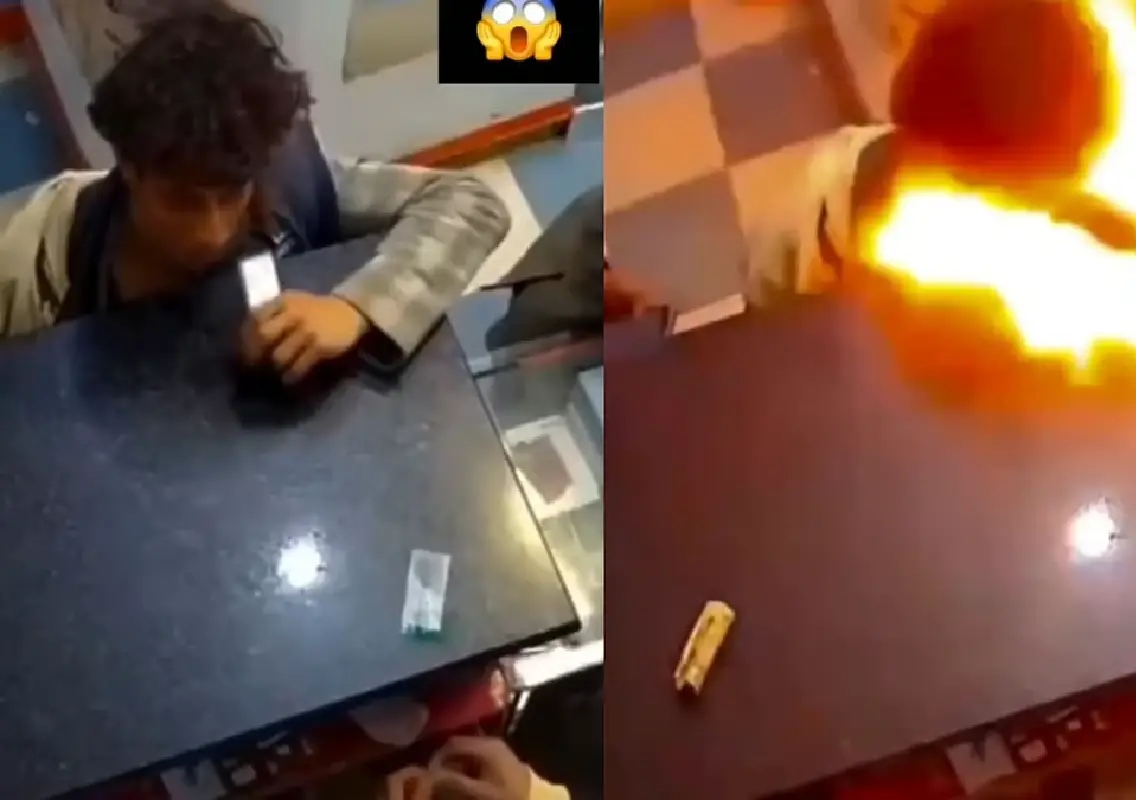


A routine visit to a mobile phone repair shop reportedly turned dangerous after a young boy sustained serious injuries when a lithium phone battery exploded in his mouth, triggering widespread concern over battery safety.
The incident, captured on CCTV and widely shared on social media, shows the boy standing at a shop’s service counter before placing a loose phone battery near his mouth. Moments later, he bites into it, causing the battery to burst into flames.
CCTV clip goes viral, details unclear
The video, first reported by Moneycontrol, could not be independently verified for date or location. However, the footage clearly shows the battery igniting immediately after being bitten.
In the clip, the boy drops the burning battery while the visibly panicked shop owner quickly throws it away to prevent further damage. The boy is reportedly rushed for medical treatment after sustaining serious injuries.
Online reactions highlight dangers
The disturbing visuals prompted strong reactions online, with users warning about the extreme hazards posed by lithium-based batteries. Several commenters explained that lithium-ion batteries store high energy and can explode if punctured, crushed, or exposed to sudden pressure.
One user explained that biting the battery likely caused a structural breach, triggering “thermal runaway” — a rapid chain reaction that leads to fire or explosion. Others urged parents and shop owners to keep loose batteries away from children at all times.
Why lithium batteries are dangerous
Lithium-ion batteries are widely used in phones and electronic devices because they can store large amounts of energy in compact sizes. However, experts warn that damaged or swollen batteries are highly unstable.
If the internal layers are pierced or compressed, the battery can overheat, ignite, or explode. Such batteries should never be handled casually and must be disposed of only at authorised recycling centres.
The incident has served as a stark reminder that lithium batteries are not toys and even brief mishandling can result in life-threatening injuries.