







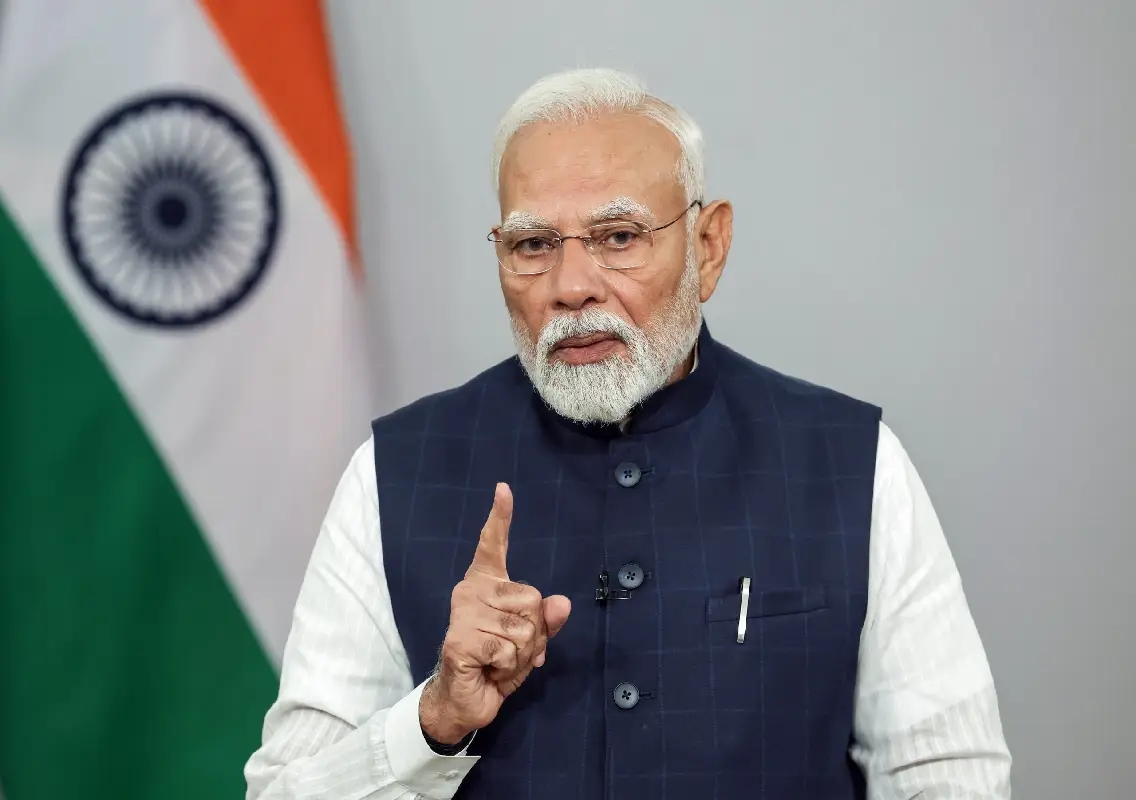


New Delhi: Narendra Modi on Thursday urged an early end to the wars in Ukraine and the wider Middle East conflict involving the United States, Israel and Iran, stressing that dialogue and diplomacy remain the only sustainable ways to resolve global disputes. His remarks came during a joint press conference with Alexander Stubb, President of Finland, highlighting growing global instability and the need for international cooperation to restore peace.
The Prime Minister said both India and Finland shared a strong commitment to the rule of law and peaceful conflict resolution. He emphasised that military confrontations rarely lead to lasting solutions and that nations must prioritise diplomatic engagement.
“India and Finland share a strong commitment to the rule of law, dialogue and diplomacy. We firmly believe that military conflicts cannot resolve disputes. This applies equally to situations in Ukraine and West Asia. We hope for an early end to the wars and will continue to support efforts aimed at achieving lasting peace,” Modi said.
India–Europe partnership for global stability
During the briefing, Modi also highlighted the evolving strategic partnership between India and European nations. According to him, the present geopolitical climate — marked by wars and economic uncertainties — has created a need for stronger diplomatic alliances.
He noted that India and Europe were entering what he described as a “golden era” of cooperation aimed at strengthening global stability, economic development and shared prosperity.
“Today, the world is going through a period of instability and uncertainty. Conflict persists in many parts of the world, from Ukraine to West Asia. In such a global environment, India and Europe, two of the world’s major diplomatic powers, are entering a golden era in our relationship,” Modi said.
He added that increasing collaboration between India and Europe could play an important role in supporting peace initiatives and strengthening international institutions.
Background: Russia–Ukraine war
The war in Ukraine began in February 2022 after Vladimir Putin ordered Russian forces to launch a full-scale invasion of Ukraine. The conflict soon escalated into the largest military confrontation in Europe since World War II.
Over the past four years, the war has caused tens of thousands of deaths and displaced millions of civilians. Several Western nations, including the United States and members of the European Union, have provided extensive military and financial support to Kyiv.
Russia has maintained that the invasion was driven by security concerns linked to Ukraine’s increasing alignment with Western powers and its aspirations to join the North Atlantic Treaty Organization. Despite multiple diplomatic efforts by global powers and international organisations, the conflict has largely remained a prolonged war of attrition with no clear end in sight.
Rising tensions in the Middle East
Alongside the war in Europe, tensions in the Middle East have escalated sharply in recent weeks. The latest crisis began on February 28 when the United States and Israel launched coordinated airstrikes on Iran under an operation reportedly aimed at limiting Tehran’s nuclear programme and weakening its military infrastructure.
The strikes targeted several strategic sites across Iran, including installations in and around the capital city of Tehran. The attack marked one of the most serious confrontations in the region in recent years.
Iran responded with large-scale retaliatory strikes, firing ballistic missiles and drones towards Israeli targets and US-linked military bases across the Gulf region. The escalation triggered widespread security concerns among neighbouring countries.
Several Gulf states — including the United Arab Emirates, Saudi Arabia and Qatar — temporarily restricted airspace operations and activated air defence systems to intercept projectiles that crossed their territory.
The conflict has reportedly resulted in more than 1,000 deaths so far and disrupted commercial aviation routes and energy infrastructure across the Gulf. International flights have faced major diversions as airlines avoid airspace in the conflict zone.
Wider regional conflict
The current tensions are unfolding against the backdrop of the ongoing instability linked to the Israel–Hamas War that began on October 7, 2023. The conflict erupted after Hamas militants launched attacks inside Israel, killing around 1,200 people and taking more than 250 hostages.
Israel subsequently launched a large-scale military offensive in the Gaza Strip. According to reports, more than 40,000 Palestinians were killed during months of intense fighting.
Although a ceasefire was reached in October 2025, the truce has remained fragile. Analysts believe the broader regional tensions involving Iran and Israel could further destabilise the Middle East if diplomatic efforts fail.
Calls for diplomacy grow worldwide
Governments across the world, including India and several European nations, have repeatedly urged restraint and called on all parties to pursue diplomatic channels. Global leaders warn that continued escalation could widen the conflict and disrupt global trade, energy markets and international security.
India has maintained a consistent stance advocating dialogue and peaceful negotiations, while also supporting humanitarian efforts and diplomatic engagement through international forums.
With wars continuing in both Europe and the Middle East, Modi reiterated that sustained diplomatic efforts remain essential to prevent further escalation and to achieve long-term peace.
Conclusion
As global tensions rise due to simultaneous conflicts in Ukraine and the Middle East, India has positioned itself as a strong advocate for diplomacy and dialogue. Modi’s remarks underline the country’s consistent foreign policy approach that prioritises peaceful conflict resolution and international cooperation in an increasingly uncertain world.