


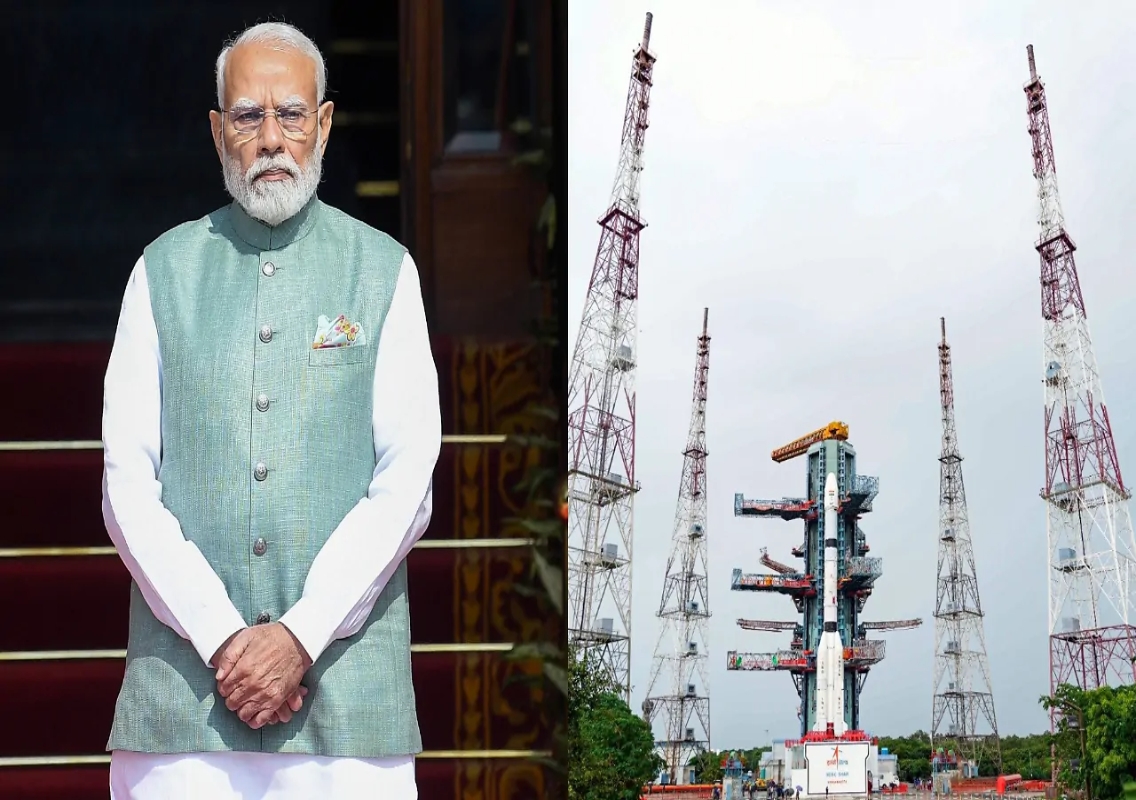


New Delhi: Prime Minister Narendra Modi has welcomed the successful launch of the NVS-03 navigation satellite, describing it as an important step in India’s pursuit of self-reliance in critical technologies. The satellite was launched aboard the Indian Space Research Organisation’s (ISRO) GSLV-F18 rocket from Sriharikota on October 30, strengthening the country’s efforts to develop and maintain an independent satellite navigation system.
The Prime Minister congratulated ISRO scientists and engineers for the achievement and highlighted the significance of indigenous capabilities in space technology. His remarks followed the successful launch of the next-generation navigation satellite, which is designed to improve the continuity and reliability of India’s Navigation with Indian Constellation (NavIC) system.
The mission is significant for India’s civilian and strategic requirements, as satellite-based positioning and timing services are increasingly important for transport, communications, disaster management and national security.
Modi highlights importance of indigenous technology
In his message following the launch, Modi praised the dedication and ingenuity of India’s space scientists and engineers. He said the NVS-03 mission would contribute to the country’s efforts to achieve self-reliance in critical technologies.
The emphasis on indigenous development is particularly relevant to satellite navigation, where precise timing, positioning signals and specialised onboard components are essential.
NavIC was developed to provide India with an independent regional navigation capability rather than relying entirely on systems operated by other countries. The programme has applications in civilian services as well as areas where dependable positioning and timing information is strategically important.
NVS-03 carries an indigenously developed atomic clock alongside procured atomic clocks. The inclusion of this technology reflects India’s efforts to strengthen domestic capabilities in components that are essential to navigation satellites.
The mission also introduces the L1 navigation signal alongside the existing L5 and S-band signals. This is expected to improve compatibility with a wider range of navigation receivers and consumer devices.
GSLV-F18 successfully places NVS-03 in transfer orbit
The GSLV-F18 rocket lifted off from the Second Launch Pad at the Satish Dhawan Space Centre in Sriharikota at 11.51 pm on October 30.
The mission carried the approximately 2,250-kg NVS-03 satellite and successfully injected it into its intended Geosynchronous Transfer Orbit (GTO).
The flight marked the 20th mission of India’s Geosynchronous Satellite Launch Vehicle programme. It was also ISRO’s third space launch of 2026.
The GSLV is a three-stage launch vehicle that uses solid, liquid and cryogenic propulsion systems. It is designed to carry satellites into geosynchronous transfer orbits, from where spacecraft can use their onboard propulsion systems to reach their designated operational positions.
The successful injection of NVS-03 is an important milestone, although the satellite must complete further orbital manoeuvres and in-orbit checks before it can begin providing operational navigation services.
NVS-03 aims to strengthen India’s NavIC system
NavIC, or Navigation with Indian Constellation, is India’s regional satellite navigation system. It provides positioning, navigation and timing services across the Indian mainland and an area extending approximately 1,500 km beyond the country’s boundaries.
The system was developed as an indigenous alternative to international satellite navigation networks such as the United States’ GPS, Russia’s GLONASS and China’s BeiDou.
Its applications include road and maritime navigation, emergency response, disaster management, surveying, infrastructure development and location-based services. It also has strategic applications that require dependable positioning and timing information.
NVS-03 is the third satellite in ISRO’s second-generation navigation satellite series. The series is intended to improve the availability and continuity of NavIC services.
The addition of the L1 frequency is an important development because the signal is widely supported by navigation receivers and consumer devices. Alongside the existing signals, it is expected to expand the range of equipment that can use NavIC.
The satellite’s atomic clock technology is equally important. Navigation systems depend on extremely accurate time measurements to calculate the distance between satellites and receivers. Even small timing errors can affect positioning accuracy.
Launch follows challenges faced by the NavIC constellation
The NVS-03 mission comes after technical problems affected the availability of India’s navigation satellite constellation.
A government statement to Parliament in July 2026 indicated that only three satellites were providing positioning, navigation and timing services, while at least four operational satellites are required for basic standalone positioning.
One of the major setbacks was the NVS-02 mission, launched in January 2025. Although the satellite entered its initial transfer orbit, it could not complete the orbit-raising manoeuvres required to reach its intended operational position.
An investigation traced the problem to a failure in the signal path to a pyrotechnic valve in the satellite’s oxidiser line. The propulsion system could not operate as required to complete the manoeuvre.
The shortage of operational navigation satellites affected NavIC’s ability to provide standalone positioning services, although its timing service remained functional.
NVS-03 is expected to help address this gap once it reaches its designated orbit, completes testing and is formally commissioned. However, its successful launch alone does not immediately restore the full navigation constellation.
Further satellites planned to strengthen NavIC
NVS-03 forms part of ISRO’s second-generation navigation satellite programme, which includes five satellites, designated NVS-01 to NVS-05.
NVS-01 was launched in May 2023 and was the first satellite in the series to carry an indigenous atomic clock. NVS-02 followed in January 2025 but could not reach its intended operational orbit because of the propulsion-system anomaly.
The government has indicated that NVS-04 and NVS-05 are at an advanced stage of development. Additional satellites will be required to strengthen the constellation and improve service continuity.
The programme is important for applications that depend on accurate and reliable navigation data. These include transport networks, maritime operations, emergency services and strategic requirements.
A step towards greater technological independence
The successful NVS-03 launch represents progress in India’s efforts to strengthen its indigenous space infrastructure. The satellite’s atomic clock technology and additional navigation signal are intended to improve NavIC’s capabilities and expand its potential applications.
Modi’s remarks place the achievement within the broader objective of developing critical technologies domestically. The mission also demonstrates the role of ISRO’s launch vehicles and satellite engineering capabilities in supporting India’s navigation requirements.
The next stages will involve placing NVS-03 in its designated operational orbit, checking its systems and integrating it into the NavIC constellation. The development and launch of additional satellites will remain important for ensuring long-term reliability.