







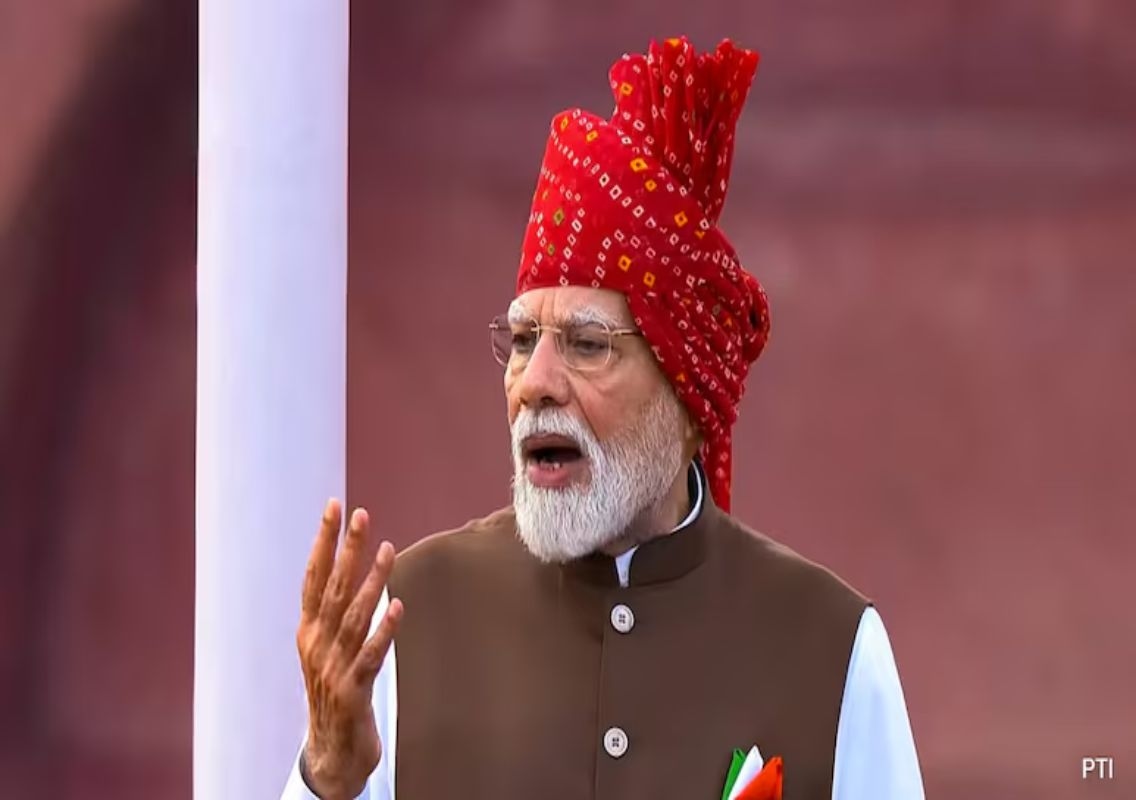


New Delhi: Prime Minister Narendra Modi addressed the nation from the ramparts of the Red Fort on Saturday as India celebrated its 80th Independence Day, highlighting the country’s economic progress, development ambitions and national resolve. In his address, Modi said India had moved from being counted among the world’s “Fragile Five” to becoming the world’s fastest-growing major economy over the past 12 years.
The Prime Minister began the address by paying tribute to Mahatma Gandhi, freedom fighters and revolutionaries who contributed to India’s independence. He said the country was celebrating its 80th Independence Day with a “new resolve” and emphasised the importance of setting ambitious national goals.
The speech also came against the backdrop of floods and landslides affecting parts of the country. Modi expressed solidarity with families affected by the natural disasters and assured them that the entire country stood with them.
Modi highlights India’s economic transformation
One of the key themes of the Prime Minister’s speech was India’s economic transformation.
Modi said India was once counted among the “Fragile Five” economies but had, within 12 years, emerged as the world’s fastest-growing major economy. He used the comparison to highlight what he described as the pace of India’s economic progress in recent years.
The “Fragile Five” term was used internationally to describe emerging-market economies considered vulnerable because of factors such as external financing requirements and economic instability.
Modi contrasted that earlier perception with India’s current position, arguing that the country had developed greater confidence and momentum.
He said India was moving ahead at an unprecedented pace and stressed that the resolve of 140 crore Indians could not be stopped.
PM Modi sets 2047 developed India goal
The Prime Minister reiterated his ambition of making India a developed country by 2047, the centenary year of Independence.
He said Indians should have large dreams and ambitious goals because such aspirations push national capabilities to greater heights.
According to Modi, India is now dreaming of reaching new heights and he would work to ensure that the country becomes developed by 2047.
The developed-India goal has been a recurring theme in the government’s policy messaging. The target encompasses economic growth as well as improvements in infrastructure, technology, living standards and national capabilities.
Modi said the world would be compelled to look at India differently once the world’s most populous country becomes a developed nation.
‘Vande Mataram’ echoes from Red Fort
The Prime Minister also highlighted the significance of Vande Mataram during the Independence Day celebrations.
He said the national song had been rendered for the first time during Independence Day celebrations from the ramparts of the Red Fort after Independence. Modi described the moment as historic and said Vande Mataram was resonating across the country.
He linked the national song with the wider symbolism of Independence Day, saying the Tricolour was being displayed in homes and remained in the minds of citizens.
The reference added a strong cultural and nationalistic element to the Prime Minister’s address.
Tribute to freedom fighters
At the beginning of his speech, Modi paid tribute to Mahatma Gandhi and the freedom fighters and revolutionaries who fought for India’s independence.
Independence Day provides the Prime Minister with an opportunity to recall India’s freedom struggle, and the 80th anniversary gave added significance to those references.
Modi said the entire country was moving forward with a new resolve, connecting the sacrifices of the freedom movement with India’s present-day development ambitions.
The Prime Minister’s address therefore combined historical remembrance with a forward-looking message focused on economic development and India’s position in the world.
Flood and landslide victims remembered
The Prime Minister also acknowledged the impact of severe weather events in parts of the country.
He said some areas had witnessed floods and landslides in the days leading up to Independence Day and recognised the pain and suffering of affected families. Modi assured them that the entire country stood with them.
The remarks came as several parts of India continued to experience heavy monsoon rainfall and its associated effects.
By including the affected families in his national address, Modi placed disaster response alongside the broader themes of development and national progress.
India’s growth remains central to government agenda
Economic growth has remained one of the central themes of the government’s policy agenda, and the Prime Minister again used Independence Day to underline the country’s changing economic position.
Modi said that after Independence, India had big dreams but often did not progress at the pace the country aspired to achieve.
He argued that India was now moving ahead with greater speed and confidence.
The message was aimed at presenting India’s current development trajectory as a significant departure from the pace of earlier decades.
At the same time, the 2047 developed-India target places considerable emphasis on maintaining that momentum over the next two decades.
A message centred on ambition and national resolve
The Prime Minister repeatedly stressed the importance of having ambitious goals.
He said dreams and resolutions should be big because they help take the country’s capabilities to greater heights.
This emphasis on aspiration formed a common thread through his economic and development messages.
The Prime Minister also referred to the efforts made over the past 12 years to place India on what he described as a development path.
The speech therefore presented India’s 80th Independence Day not merely as a commemoration of the past, but as an opportunity to set out a long-term vision for the country.
Why the 80th Independence Day matters
India became independent on August 15, 1947. The 80th Independence Day marks eight decades since the end of British rule.
The anniversary provides an important moment for reflecting on the country’s journey from Independence to its current position as a major global economy.
It also comes at a time when India is seeking to strengthen its manufacturing base, infrastructure, technology capabilities and global economic influence.
The Prime Minister’s focus on 2047 indicates that the government is increasingly framing national development around the centenary of Independence.
Modi’s key messages from the Red Fort
The major points highlighted by PM Modi during the address included:
- India is celebrating its 80th Independence Day with a new resolve.
- He paid tribute to Mahatma Gandhi and India’s freedom fighters and revolutionaries.
- He highlighted the first rendering of Vande Mataram from the Red Fort during Independence Day celebrations after Independence.
- He expressed solidarity with families affected by floods and landslides.
- He said India had moved from the “Fragile Five” to becoming the world’s fastest-growing major economy.
- He reiterated his goal of making India a developed country by 2047.
- He called for bigger dreams and stronger national resolve.
- He said India’s development efforts over the past 12 years had placed the country on a faster growth trajectory.
Conclusion
Prime Minister Narendra Modi’s 80th Independence Day address from the Red Fort combined tributes to India’s freedom struggle with an ambitious vision for the country’s future.
His central message was that India has undergone a significant transformation, moving from being viewed as part of the “Fragile Five” to becoming the world’s fastest-growing major economy, according to his assessment. He also reiterated the goal of making India a developed nation by 2047.
With references to Vande Mataram, the Tricolour, India’s freedom fighters and citizens affected by natural disasters, the address blended national identity with economic development and long-term ambition.
The 80th Independence Day speech thus placed India’s next milestone — becoming a developed nation by 2047 — at the centre of the Prime Minister’s vision for the country’s future