







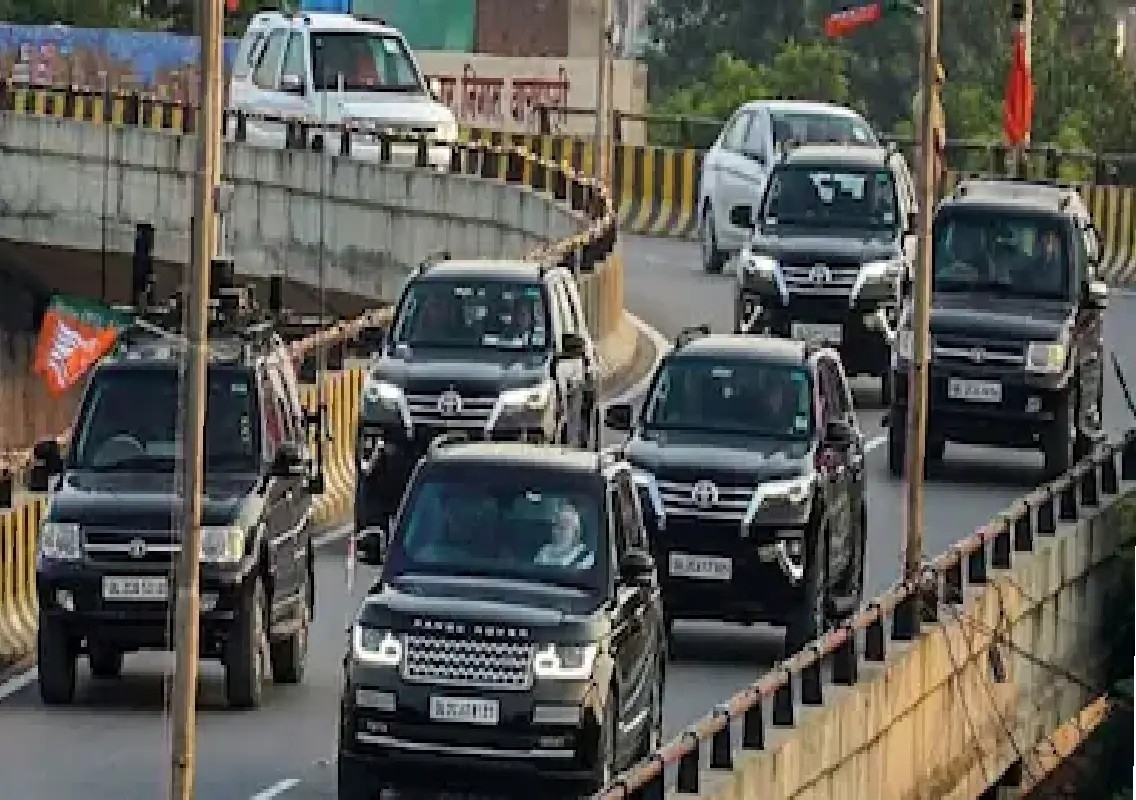


New Delhi: Narendra Modi has significantly reduced the number of vehicles in his official convoy as part of a wider effort to promote fuel conservation and restraint amid the ongoing geopolitical crisis in West Asia.
According to sources, the scaled-down convoy arrangement was implemented during the prime minister’s recent visits to Gujarat and Assam and is now being projected as a model for state governments to emulate.
The move comes shortly after Modi appealed to citizens to reduce petrol and diesel consumption, avoid unnecessary foreign travel, and adopt work-from-home practices wherever feasible due to growing concerns over global energy instability.
Convoy reduction seen during recent state visits
Officials said the reduced convoy was first noticed after the prime minister’s public appeal during an event in Hyderabad.
The smaller convoy formation was subsequently followed during Modi’s visits to Vadodara in Gujarat and Guwahati in Assam.
Sources indicated that the prime minister deliberately chose to personally adopt the conservation measures he had advised citizens to follow, thereby reinforcing the government’s broader message of restraint during a period of global uncertainty.
The ongoing tensions in West Asia have triggered fresh concerns over rising crude oil prices and their potential impact on India’s economy and foreign exchange reserves.
Government officials believe symbolic measures taken by senior political leaders could encourage wider public participation in fuel-saving efforts.
Security arrangements remain unchanged
Sources clarified that the reduction in convoy vehicles has not affected the prime minister’s security arrangements in any manner.
All mandatory protocols enforced by the Special Protection Group continue to remain fully operational.
Officials stated that only the number of accompanying support vehicles had been rationalised while maintaining all essential security layers required for the prime minister’s movement.
The decision is being viewed as part of a broader administrative effort to encourage austerity and responsible energy usage during the current international situation.
PMO circulates energy-saving action plan
During the swearing-in ceremony of Himanta Biswa Sarma in Assam on Tuesday, the Prime Minister’s Office reportedly distributed copies of Modi’s recent speech along with an action plan to chief ministers attending the event.
The advisory urged states to adopt measures aimed at reducing fuel consumption and improving energy efficiency.
According to sources, the suggested measures included:
- Increased use of electric vehicles
- Greater reliance on virtual meetings
- Reduction in unnecessary official travel
- Adoption of energy-saving practices in government functioning
The initiative forms part of the Centre’s attempt to prepare states for potential economic pressures arising from prolonged geopolitical tensions in West Asia.
States begin adopting similar measures
Sources indicated that several chief ministers began implementing similar austerity measures after attending the Assam ceremony.
Some states are reportedly considering reducing the size of official convoys, limiting ceremonial expenditure, and encouraging digital governance methods to reduce travel-related fuel usage.
The developments follow Modi’s recent public appeals encouraging citizens to prioritise domestic tourism, reduce non-essential consumption, and exercise financial caution during the ongoing global uncertainty.
The Centre’s messaging has increasingly focused on minimising pressure on India’s economy amid volatile international energy markets and disruptions caused by the Iran-related conflict.
Political observers note that the government appears keen to combine symbolic leadership measures with practical administrative reforms in order to build broader public participation in energy conservation efforts.
The reduced convoy initiative is therefore being projected not merely as a security or logistical adjustment, but as part of a larger national campaign promoting restraint, efficiency, and preparedness during a period of global economic uncertainty.