







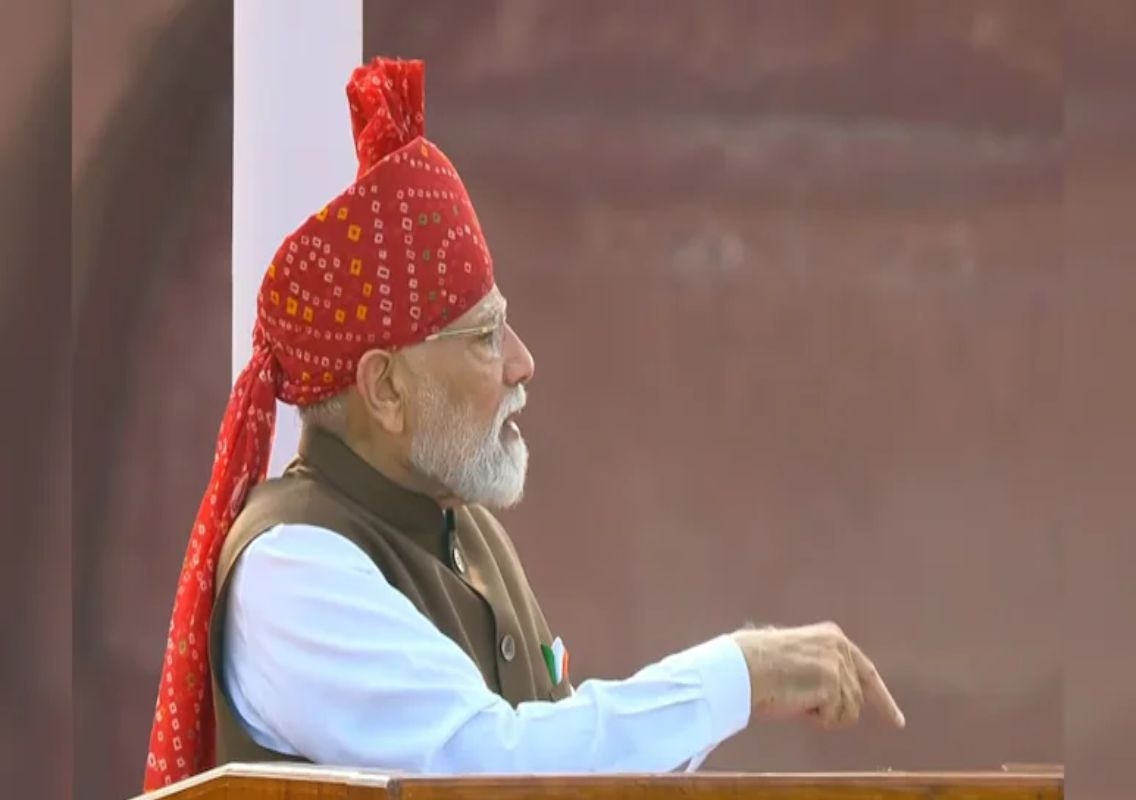


New Delhi: Prime Minister Narendra Modi on Saturday made a fresh appeal to political parties to work together to ensure 33 per cent reservation for women in the Lok Sabha and State Legislative Assemblies. Speaking from the Red Fort during India’s 80th Independence Day celebrations, Modi described women’s political representation as the “call of the hour” and urged parties to reach a consensus on implementing the quota without delay.
The Prime Minister’s appeal comes nearly three years after Parliament passed the Nari Shakti Vandan Adhiniyam, 2023, which provides for 33 per cent reservation for women in the Lok Sabha and State Assemblies. However, implementation has remained linked to the completion of delimitation and the subsequent restructuring of constituencies.
PM Modi asks parties to ‘take credit’ for women’s quota
Addressing the nation from the Red Fort, Modi appealed to political parties to come together on the issue of women’s representation.
He urged parties to recognise the contribution and capabilities of women and work towards ensuring that women receive 33 per cent representation in the Lok Sabha and State Legislative Assemblies.
The Prime Minister also asked political parties to “take credit” for the move, arguing that all parties could share the credit for what he described as a landmark step.
The appeal was framed not as a political demand directed at one particular party, but as a call for consensus across the political spectrum.
Modi said women are already playing a major leadership role at the grassroots level and argued that their representation should extend more strongly to Parliament and state legislatures.
What is the women’s reservation law?
The Nari Shakti Vandan Adhiniyam, passed by both Houses of Parliament in 2023, provides for reserving one-third of seats in the Lok Sabha and State Legislative Assemblies for women.
The legislation was presented as a major step towards increasing women’s participation in India’s political system.
The law, however, does not provide for immediate implementation based simply on the existing number and boundaries of seats.
Its implementation is connected to delimitation, the constitutional exercise through which the boundaries and allocation of constituencies are determined based on population and other prescribed considerations.
This link between delimitation and women’s reservation has subsequently become a major political point of disagreement.
Why delimitation is at the centre of the debate
The implementation of the women’s quota has become closely connected with the wider debate over delimitation.
The Centre has maintained that the 33 per cent reservation will be implemented after delimitation, which is expected to determine the future number and distribution of seats in Parliament and state legislatures.
The Opposition, however, has objected to linking women’s reservation to an increase in the number of seats. Opposition parties have argued that the quota should instead be implemented within the existing strength of legislatures.
This difference has made the issue politically sensitive.
The question is therefore not simply whether women should receive 33 per cent reservation. There is also a disagreement over when and through what mechanism the reservation should become operational.
Modi highlights women’s grassroots leadership
During his Independence Day address, Modi pointed to the large number of women already serving as elected representatives in Panchayats, municipalities and municipal corporations.
He said women representatives at the grassroots level are solving local problems and providing capable leadership.
The Prime Minister used this experience to argue that women’s participation in political decision-making should be expanded to higher levels of government.
His message was that women have already demonstrated their ability to lead in local governance and should consequently have a stronger presence in state legislatures and Parliament.
The 2023 law and the road ahead
The Nari Shakti Vandan Adhiniyam was passed by Parliament in September 2023 after being introduced by the Union government.
The legislation represented one of the most significant changes proposed to women’s political representation in independent India.
However, its implementation depends on subsequent constitutional and electoral processes.
According to the NDTV report, an earlier attempt to move forward with the Constitution (131st Amendment) Bill failed in the Lok Sabha on April 17 after it did not secure the constitutionally required two-thirds majority of members present and voting. The Bill dealt with the implementation of the women’s reservation alongside delimitation.
The setback illustrates the political complexity surrounding the issue despite broad public support for greater representation of women in politics.
Why 33% representation matters
Women account for a substantial share of India’s population, but their representation in Parliament and state legislatures has historically remained below their demographic strength.
A 33 per cent reservation would therefore significantly alter the composition of elected legislatures.
Supporters argue that greater representation can bring more women’s perspectives into policymaking and encourage political parties to develop a stronger pipeline of women leaders.
The experience of Panchayats and urban local bodies is frequently cited in the debate, as these institutions have already provided constitutional reservations for women.
The proposed quota for Parliament and State Assemblies would take the principle of political representation to a much larger scale.
A political challenge for parties
Modi’s Independence Day appeal puts political parties in a position where they may be asked to clarify their stance on the implementation of women’s reservation.
His suggestion that parties should “take credit” is significant because it attempts to shift the debate away from political ownership and towards collective action.
However, the disagreement over delimitation means that reaching consensus may require negotiations on the broader question of parliamentary and legislative representation.
For the government, moving ahead on women’s reservation could become an important political and social priority. For Opposition parties, the challenge is to support greater women’s representation while continuing to raise concerns about the process through which the quota would be implemented.
What happens next?
The immediate next step will depend on the political consensus around delimitation and the implementation framework for the reservation.
The Prime Minister has now publicly urged all parties to work together and ensure that women receive their promised share of representation.
Whether the appeal translates into legislative action will depend on discussions between the government and Opposition parties, as well as the constitutional processes required before the reservation can take effect.
The issue could therefore remain an important part of India’s political debate as the country moves towards the next phase of delimitation and electoral restructuring.
Conclusion
PM Modi’s Independence Day appeal has brought the issue of women’s political reservation back into the national spotlight.
While Parliament passed the Nari Shakti Vandan Adhiniyam in 2023 to provide 33 per cent reservation for women in the Lok Sabha and State Assemblies, its implementation remains tied to delimitation and the associated constitutional process.
By asking political parties to come together and “take credit” for the landmark move, Modi has called for consensus rather than political ownership.
The coming political discussions will determine whether that appeal can translate into concrete progress towards greater women’s representation in India’s legislatures.