







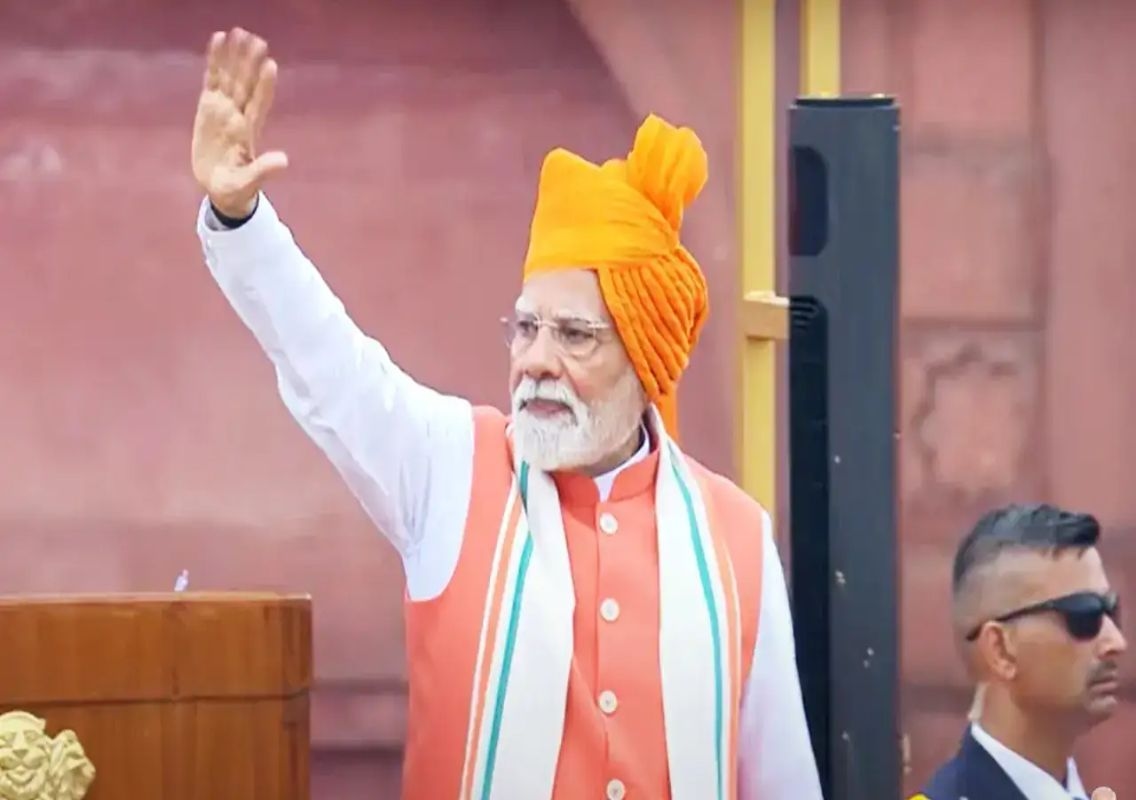


New Delhi: Prime Minister Narendra Modi greeted citizens on the occasion of India’s 80th Independence Day on Saturday, saying the country is continuing to scale new heights of progress while reaffirming the commitment to building a stronger and self-reliant India. He addressed the nation from the ramparts of the Red Fort in New Delhi, marking his 13th consecutive Independence Day address as Prime Minister.
The Independence Day celebrations come eight decades after India gained independence from British rule in 1947. The milestone has been marked by celebrations across the country, with the Prime Minister’s Red Fort address remaining the centrepiece of the national programme.
In a message shared after the address, Modi wished that India would continue to scale new heights of progress. He also remembered the country’s freedom fighters and called for a renewed commitment to building a stronger and self-reliant India.
PM Modi highlights India’s journey and future
The Prime Minister’s address placed emphasis on India’s development journey and the country’s ambitions for the years ahead. A major theme was the vision of building a developed India by 2047, when the nation will complete 100 years of independence.
Modi has repeatedly used the Red Fort platform to outline the long-term vision of a Viksit Bharat. In his 2025 Independence Day address, he described the goal as transforming India into a globally competitive, technologically advanced and economically resilient country by 2047.
The 2026 address continues that broader development narrative, with the government highlighting areas such as technology, manufacturing, innovation, defence, energy and employment as important components of India’s future growth.
The Prime Minister also stressed the importance of remembering the sacrifices made during the freedom struggle. Independence Day, he said, is not simply a celebration but also an opportunity to reaffirm the responsibilities that come with freedom.
‘India scaling new heights’ message
In his Independence Day message, Modi expressed confidence in India’s continued progress and said the country should keep moving towards new heights.
The emphasis on progress builds on a recurring theme in his Independence Day speeches. In 2024, he said India should move forward with a new zeal and aim for higher levels of development, while stressing that the country should continue aspiring for greater achievements.
The Prime Minister has also previously linked India’s development ambitions with the participation of citizens. His vision of Viksit Bharat 2047 places emphasis on collective effort, innovation and economic opportunity, with the government seeking to make citizens active participants in the country’s development journey.
80 years of independence marks a major milestone
India’s 80th Independence Day is a significant national milestone. The country became independent on August 15, 1947, following a prolonged freedom movement against British colonial rule.
The occasion provides an opportunity to look back at India’s transformation over eight decades while also considering the challenges that remain. From a newly independent nation dealing with poverty and limited industrial capacity, India has developed into one of the world’s major economies and an important player in technology, space, pharmaceuticals, digital services and manufacturing.
The government’s current focus is increasingly centred on moving India further up the global value chain. Areas such as semiconductor manufacturing, artificial intelligence, defence production, renewable energy and advanced technology have become increasingly important to the country’s economic strategy.
Focus on self-reliance and innovation
Self-reliance has remained another important theme in the Prime Minister’s Independence Day addresses.
In previous speeches, Modi has highlighted India’s progress in sectors ranging from defence and fintech to manufacturing and digital infrastructure. He has argued that strengthening domestic capabilities can help India reduce dependence on imports while creating jobs and expanding opportunities for Indian businesses.
The government has also promoted initiatives aimed at increasing domestic manufacturing and attracting investment into strategic industries. The semiconductor sector, for example, has emerged as a major area of focus as India attempts to establish itself as an important part of the global electronics supply chain.
Defence manufacturing is another area where India has sought to increase domestic production and exports. In his 2024 address, Modi said India was becoming increasingly self-reliant in defence and highlighted the country’s emergence as a manufacturer and exporter of defence equipment.
Viksit Bharat 2047 remains the larger goal
The vision of Viksit Bharat 2047 is likely to remain central to the government’s messaging as India moves towards the centenary of independence.
The objective is broader than economic growth alone. It includes improvements in infrastructure, technology, education, healthcare, employment, manufacturing and living standards.
The Prime Minister has previously described the journey towards 2047 as a collective national effort. His 2025 Independence Day speech focused on self-reliance, innovation and citizen empowerment while setting out a long-term roadmap for India’s transformation.
The challenge for the government will be to translate these ambitions into improvements that are felt across different sections of society. India’s growth has created new opportunities, but issues such as employment, income inequality, rural development, education and access to quality healthcare remain important policy priorities.
Independence Day celebrations across the country
The national celebrations were accompanied by programmes across India, including flag-hoisting ceremonies, cultural events and tributes to freedom fighters.
In New Delhi, the Prime Minister’s appearance at the Red Fort followed his customary visit to Rajghat, where he paid tribute to Mahatma Gandhi. The gesture marked the beginning of the day’s national celebrations before he proceeded to the Red Fort.
This year’s celebrations also featured a notable change in the Red Fort ceremony. For the first time, Vande Mataram was played during the official Independence Day programme, alongside the traditional elements of the ceremony.
Across the country, citizens, schools, government institutions and private organisations participated in Independence Day programmes, with the Tricolour forming the central symbol of the celebrations.
Looking ahead to 2047
As India marks 80 years of independence, the focus is increasingly shifting from celebrating the achievements of the past to preparing for the country’s centenary in 2047.
The Prime Minister’s message of scaling new heights reflects that transition. Over the next two decades, India will need to sustain economic growth while creating sufficient employment, strengthening infrastructure, improving human development and remaining competitive in emerging technologies.
The government’s emphasis on self-reliance and innovation is expected to remain part of this strategy. At the same time, ensuring that economic opportunities reach rural communities, small businesses, young people and other sections of society will be crucial to making the development vision more inclusive.
Conclusion
Prime Minister Narendra Modi’s 80th Independence Day message centred on India’s progress, national pride and the ambition to build a stronger and self-reliant country. His call for India to continue scaling new heights comes as the nation looks towards Viksit Bharat 2047 and its centenary of independence.
The next 20 years will be critical for turning that long-term vision into measurable outcomes. India’s ability to combine economic growth with employment, innovation, social development and greater self-reliance will determine how successfully the country moves towards its 2047 goal.